

9.9 Merged Fit (Albritton et al. 1977)
253
Table 9.5 Equilibrium
structure of methanime, CH 2
= NH (distances in pm,
angles in degree)
Original fit a
Merged fit b
Mixed fit b
C = N
127.09(1)
127.09(1)
127.09(1)
NH
101.95(2)
101.92(2)
101.93(2)
CH c
t
108.39(31)
108.61(5)
108.61(7)
CH c
c
109.19(32)
108.96(4)
108.96(7)
HNC
110.348(37)
110.33(1)
110.33(1)
H t CN
119.25(45)
118.74(8)
118.8(1)
H c CN
123.72(43)
124.21(8)
124.1(1)
a Fit of the moments of inertia of 6 isotopologues
b With CH c = 108.98(20) pm, CH t = 1.0856(20) pm, ∠(H t CN) =
118.5(2)°, and ∠(H c CN) = 124.7(2)°, see text
c c = cis with respect to NH, t = trans with respect to NH
standard deviations of the two r e (CH) bond lengths are assumed to be 0.1 pm with
a correlation coefficient of 0.9. This value, although arbitrary, is reasonable because
the errors affecting the two ab initio CH bond lengths are expected to be quite similar.
Furthermore, it was checked that the result is not sensitive to the value of the correlation coefficient (a value of 0.5 instead of 0.9 gives practically identical results).
With this choice of weights, only the ab initio values of the two CH bond lengths (or,
more exactly, their difference) will significantly affect the final result. The correlation
is indeed broken, the correlation coefficient dropping from −0.997 to −0.029, and
all parameters are now precisely determined with r e (CH s ) = 108.857(38) pm and
∠(SCH s ) = 107.420(7)°.
The main advantage of the merged fit over the mixed fit is that it is possible to
take into account correlations between the predicate parameters. This is particularly
useful when the predicate parameters are ab initio values because they are usually
affected by systematic errors.
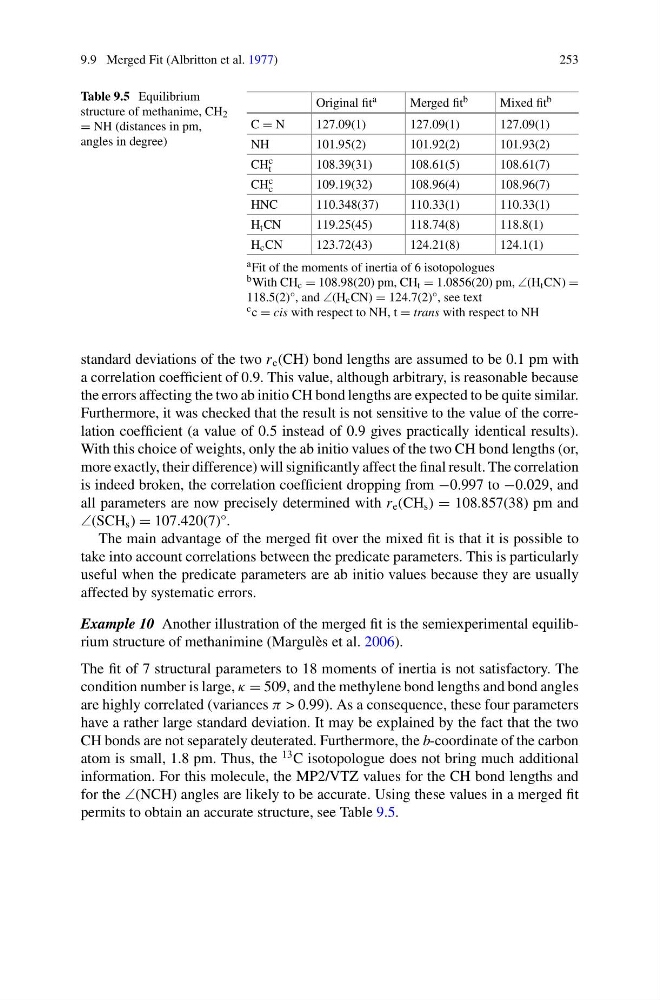
Example 10 Another illustration of the merged fit is the semiexperimental equilibrium structure of methanimine (Margulès et al. 2006).
The fit of 7 structural parameters to 18 moments of inertia is not satisfactory. The
condition number is large, κ = 509, and the methylene bond lengths and bond angles
are highly correlated (variances π > 0.99). As a consequence, these four parameters
have a rather large standard deviation. It may be explained by the fact that the two
CH bonds are not separately deuterated. Furthermore, the b-coordinate of the carbon
atom is small, 1.8 pm. Thus, the
13 C isotopologue does not bring much additional
information. For this molecule, the MP2/VTZ values for the CH bond lengths and
for the ∠(NCH) angles are likely to be accurate. Using these values in a merged fit
permits to obtain an accurate structure, see Table 9.5.
253
Table 9.5 Equilibrium
structure of methanime, CH 2
= NH (distances in pm,
angles in degree)
Original fit a
Merged fit b
Mixed fit b
C = N
127.09(1)
127.09(1)
127.09(1)
NH
101.95(2)
101.92(2)
101.93(2)
CH c
t
108.39(31)
108.61(5)
108.61(7)
CH c
c
109.19(32)
108.96(4)
108.96(7)
HNC
110.348(37)
110.33(1)
110.33(1)
H t CN
119.25(45)
118.74(8)
118.8(1)
H c CN
123.72(43)
124.21(8)
124.1(1)
a Fit of the moments of inertia of 6 isotopologues
b With CH c = 108.98(20) pm, CH t = 1.0856(20) pm, ∠(H t CN) =
118.5(2)°, and ∠(H c CN) = 124.7(2)°, see text
c c = cis with respect to NH, t = trans with respect to NH
standard deviations of the two r e (CH) bond lengths are assumed to be 0.1 pm with
a correlation coefficient of 0.9. This value, although arbitrary, is reasonable because
the errors affecting the two ab initio CH bond lengths are expected to be quite similar.
Furthermore, it was checked that the result is not sensitive to the value of the correlation coefficient (a value of 0.5 instead of 0.9 gives practically identical results).
With this choice of weights, only the ab initio values of the two CH bond lengths (or,
more exactly, their difference) will significantly affect the final result. The correlation
is indeed broken, the correlation coefficient dropping from −0.997 to −0.029, and
all parameters are now precisely determined with r e (CH s ) = 108.857(38) pm and
∠(SCH s ) = 107.420(7)°.
The main advantage of the merged fit over the mixed fit is that it is possible to
take into account correlations between the predicate parameters. This is particularly
useful when the predicate parameters are ab initio values because they are usually
affected by systematic errors.
Example 10 Another illustration of the merged fit is the semiexperimental equilibrium structure of methanimine (Margulès et al. 2006).
The fit of 7 structural parameters to 18 moments of inertia is not satisfactory. The
condition number is large, κ = 509, and the methylene bond lengths and bond angles
are highly correlated (variances π > 0.99). As a consequence, these four parameters
have a rather large standard deviation. It may be explained by the fact that the two
CH bonds are not separately deuterated. Furthermore, the b-coordinate of the carbon
atom is small, 1.8 pm. Thus, the
13 C isotopologue does not bring much additional
information. For this molecule, the MP2/VTZ values for the CH bond lengths and
for the ∠(NCH) angles are likely to be accurate. Using these values in a merged fit
permits to obtain an accurate structure, see Table 9.5.