

252
9 Least-Squares Method
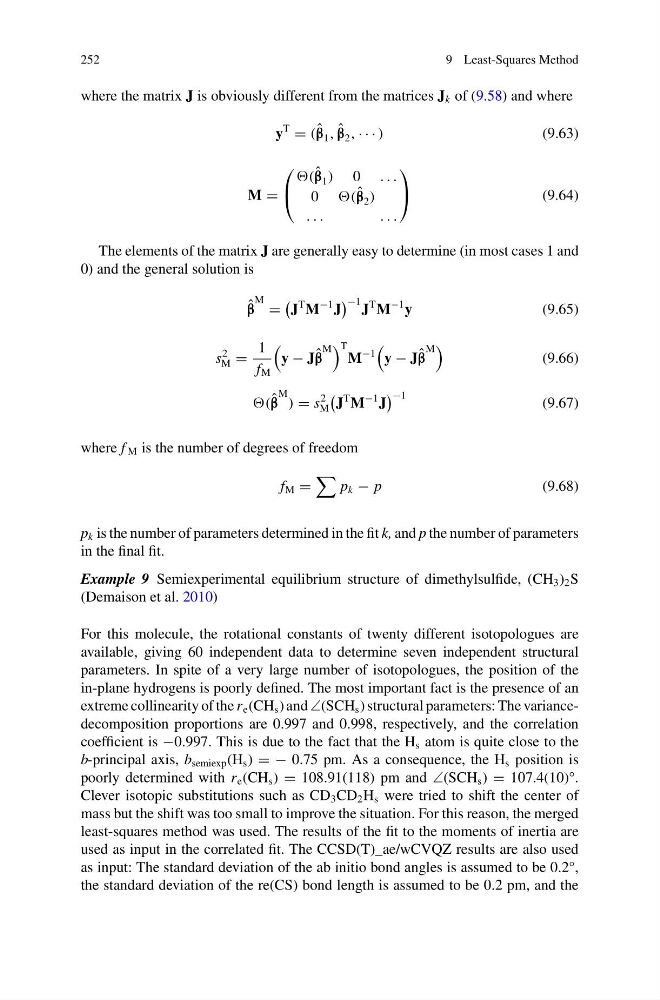
where the matrix J is obviously different from the matrices J k of (9.58) and where
y
T
= ( ˆ
β 1 , ˆ
β 2 , · · · )
(9.63)
M =
⎛
⎝
( ˆ
β 1 ) 0 . . .
0 ( ˆ
β 2 )
. . .
. . .
⎞
⎠
(9.64)
The elements of the matrix J are generally easy to determine (in most cases 1 and
0) and the general solution is
ˆ
β
M =
J
T M
−1 J
−1 J
T M
−1 y
(9.65)
s
2
M =
1
f M
y − J ˆ
β
M
T
M
−1
y − J ˆ
β
M
(9.66)
( ˆ
β
M ) = s
2
M
J
T M
−1 J
−1
(9.67)
where f M is the number of degrees of freedom
f M =
p k − p
(9.68)
p k is the number of parameters determined in the fit k, and p the number of parameters
in the final fit.
Example 9 Semiexperimental equilibrium structure of dimethylsulfide, (CH 3 ) 2 S
(Demaison et al. 2010)
For this molecule, the rotational constants of twenty different isotopologues are
available, giving 60 independent data to determine seven independent structural
parameters. In spite of a very large number of isotopologues, the position of the
in-plane hydrogens is poorly defined. The most important fact is the presence of an
extreme collinearity of the r e (CH s ) and ∠(SCH s ) structural parameters: The variancedecomposition proportions are 0.997 and 0.998, respectively, and the correlation
coefficient is −0.997. This is due to the fact that the H s atom is quite close to the
b-principal axis, b semiexp (H s ) = − 0.75 pm. As a consequence, the H s position is
poorly determined with r e (CH s ) = 108.91(118) pm and ∠(SCH s ) = 107.4(10)°.
Clever isotopic substitutions such as CD 3 CD 2 H s were tried to shift the center of
mass but the shift was too small to improve the situation. For this reason, the merged
least-squares method was used. The results of the fit to the moments of inertia are
used as input in the correlated fit. The CCSD(T)_ae/wCVQZ results are also used
as input: The standard deviation of the ab initio bond angles is assumed to be 0.2°,
the standard deviation of the re(CS) bond length is assumed to be 0.2 pm, and the
9 Least-Squares Method
where the matrix J is obviously different from the matrices J k of (9.58) and where
y
T
= ( ˆ
β 1 , ˆ
β 2 , · · · )
(9.63)
M =
⎛
⎝
( ˆ
β 1 ) 0 . . .
0 ( ˆ
β 2 )
. . .
. . .
⎞
⎠
(9.64)
The elements of the matrix J are generally easy to determine (in most cases 1 and
0) and the general solution is
ˆ
β
M =
J
T M
−1 J
−1 J
T M
−1 y
(9.65)
s
2
M =
1
f M
y − J ˆ
β
M
T
M
−1
y − J ˆ
β
M
(9.66)
( ˆ
β
M ) = s
2
M
J
T M
−1 J
−1
(9.67)
where f M is the number of degrees of freedom
f M =
p k − p
(9.68)
p k is the number of parameters determined in the fit k, and p the number of parameters
in the final fit.
Example 9 Semiexperimental equilibrium structure of dimethylsulfide, (CH 3 ) 2 S
(Demaison et al. 2010)
For this molecule, the rotational constants of twenty different isotopologues are
available, giving 60 independent data to determine seven independent structural
parameters. In spite of a very large number of isotopologues, the position of the
in-plane hydrogens is poorly defined. The most important fact is the presence of an
extreme collinearity of the r e (CH s ) and ∠(SCH s ) structural parameters: The variancedecomposition proportions are 0.997 and 0.998, respectively, and the correlation
coefficient is −0.997. This is due to the fact that the H s atom is quite close to the
b-principal axis, b semiexp (H s ) = − 0.75 pm. As a consequence, the H s position is
poorly determined with r e (CH s ) = 108.91(118) pm and ∠(SCH s ) = 107.4(10)°.
Clever isotopic substitutions such as CD 3 CD 2 H s were tried to shift the center of
mass but the shift was too small to improve the situation. For this reason, the merged
least-squares method was used. The results of the fit to the moments of inertia are
used as input in the correlated fit. The CCSD(T)_ae/wCVQZ results are also used
as input: The standard deviation of the ab initio bond angles is assumed to be 0.2°,
the standard deviation of the re(CS) bond length is assumed to be 0.2 pm, and the