

9.7 Mixed Regression (Bartell et al. 1975; Belsley 1991)
249
Table 9.3 Data used for the
mixed estimation of the
semiexperimental equilibrium
structure of FCP (Dréan et al.
1996)
Data
Exp. a
r b
h ii
I e (F 12 CP)/uÅ 2
95.8396(45)
−0.0005
0.80
I e (F 13 CP)/uÅ 2
95.9851(91)
0.0019
0.20
r e (C–F) c /pm
127.70(20)
0.09
0.56
r e (C≡P) c /pm
154.55(20)
0.10
0.43
a The uncertainty given in parentheses is used to weight the data
b Residual of the fit
c Corrected ab initio value used as predicate
rotational constants, it is not possible to obtain a reliable structure. In this case, the
best solution is to use predicate values for the two bond lengths, r(C–F) and r(C≡P).
The offsets used to correct the ab initio distances are estimated, using the same
method and the same basis set, CCSD(T)/6-311 + G(2d, p), from the structurally
similar molecules HC≡P and FC≡N whose equilibrium structures are accurately
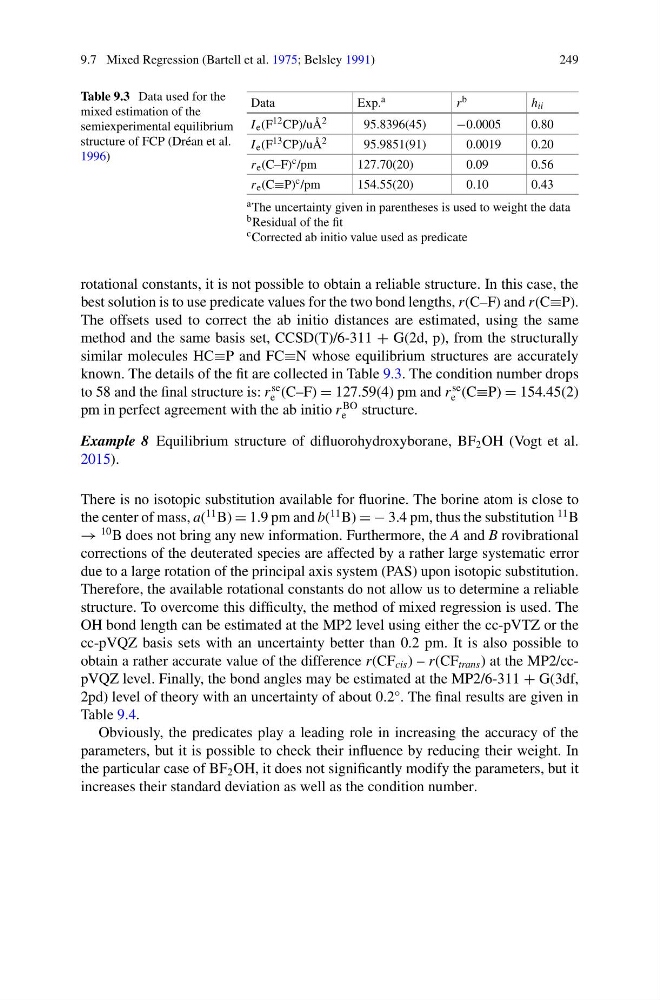
known. The details of the fit are collected in Table 9.3. The condition number drops
to 58 and the final structure is: r
se
e (C–F) = 127.59(4) pm and r
se
e (C≡P) = 154.45(2)
pm in perfect agreement with the ab initio r
BO
e structure.
Example 8 Equilibrium structure of difluorohydroxyborane, BF 2 OH (Vogt et al.
2015).
There is no isotopic substitution available for fluorine. The borine atom is close to
the center of mass, a(
11 B) = 1.9 pm and b(
11 B) = − 3.4 pm, thus the substitution
11 B
→
10 B does not bring any new information. Furthermore, the A and B rovibrational
corrections of the deuterated species are affected by a rather large systematic error
due to a large rotation of the principal axis system (PAS) upon isotopic substitution.
Therefore, the available rotational constants do not allow us to determine a reliable
structure. To overcome this difficulty, the method of mixed regression is used. The
OH bond length can be estimated at the MP2 level using either the cc-pVTZ or the
cc-pVQZ basis sets with an uncertainty better than 0.2 pm. It is also possible to
obtain a rather accurate value of the difference r(CF cis ) – r(CF trans ) at the MP2/ccpVQZ level. Finally, the bond angles may be estimated at the MP2/6-311 + G(3df,
2pd) level of theory with an uncertainty of about 0.2°. The final results are given in
Table 9.4.
Obviously, the predicates play a leading role in increasing the accuracy of the
parameters, but it is possible to check their influence by reducing their weight. In
the particular case of BF 2 OH, it does not significantly modify the parameters, but it
increases their standard deviation as well as the condition number.
249
Table 9.3 Data used for the
mixed estimation of the
semiexperimental equilibrium
structure of FCP (Dréan et al.
1996)
Data
Exp. a
r b
h ii
I e (F 12 CP)/uÅ 2
95.8396(45)
−0.0005
0.80
I e (F 13 CP)/uÅ 2
95.9851(91)
0.0019
0.20
r e (C–F) c /pm
127.70(20)
0.09
0.56
r e (C≡P) c /pm
154.55(20)
0.10
0.43
a The uncertainty given in parentheses is used to weight the data
b Residual of the fit
c Corrected ab initio value used as predicate
rotational constants, it is not possible to obtain a reliable structure. In this case, the
best solution is to use predicate values for the two bond lengths, r(C–F) and r(C≡P).
The offsets used to correct the ab initio distances are estimated, using the same
method and the same basis set, CCSD(T)/6-311 + G(2d, p), from the structurally
similar molecules HC≡P and FC≡N whose equilibrium structures are accurately
known. The details of the fit are collected in Table 9.3. The condition number drops
to 58 and the final structure is: r
se
e (C–F) = 127.59(4) pm and r
se
e (C≡P) = 154.45(2)
pm in perfect agreement with the ab initio r
BO
e structure.
Example 8 Equilibrium structure of difluorohydroxyborane, BF 2 OH (Vogt et al.
2015).
There is no isotopic substitution available for fluorine. The borine atom is close to
the center of mass, a(
11 B) = 1.9 pm and b(
11 B) = − 3.4 pm, thus the substitution
11 B
→
10 B does not bring any new information. Furthermore, the A and B rovibrational
corrections of the deuterated species are affected by a rather large systematic error
due to a large rotation of the principal axis system (PAS) upon isotopic substitution.
Therefore, the available rotational constants do not allow us to determine a reliable
structure. To overcome this difficulty, the method of mixed regression is used. The
OH bond length can be estimated at the MP2 level using either the cc-pVTZ or the
cc-pVQZ basis sets with an uncertainty better than 0.2 pm. It is also possible to
obtain a rather accurate value of the difference r(CF cis ) – r(CF trans ) at the MP2/ccpVQZ level. Finally, the bond angles may be estimated at the MP2/6-311 + G(3df,
2pd) level of theory with an uncertainty of about 0.2°. The final results are given in
Table 9.4.
Obviously, the predicates play a leading role in increasing the accuracy of the
parameters, but it is possible to check their influence by reducing their weight. In
the particular case of BF 2 OH, it does not significantly modify the parameters, but it
increases their standard deviation as well as the condition number.