

248
9 Least-Squares Method
the original data. Thus, it is better and easier to use additional data derived from
some other way as electron diffraction (Sect. 7.10), ab initio calculations (Chap. 2)
or empirical correlation (Sect. 8.5). These additional data, when used as constraints,
significantly improve the quality of the fit, but the derived parameters are affected
by a bias and their standard deviations are too small, see previous Sect. 9.6. If the
uncertainties of the additional data are known, it is easy to calculate correct standard
deviations but this is not always the case.
In this case, the simplest and most useful method is the mixed estimation (also
called method of predicate observations), which makes it possible to determine a
complete structure even without a complete set of isotopologues. Auxiliary information is added directly to the data matrix. It always is possible to find linear relations
between the parameters, which may be written in the form
c = Rβ + η
(9.48)
c is a vector of known values, R is a matrix of known constants, and η is a random
vector whose variance-covariance matrix is V(η) =
−1 . The solution proceeds by
augmenting y, J, and W by c, R, and , respectively. The solution is then
ˆ
β =
J
T WJ + R
T
R
−1
J
T Wr + R
T
c
(9.49)
with
c = R(β
pred
− β)
(9.50)
Practically, (9.20) may still be used but the vector r is augmented by the values
r n+k = c
pred
k
− c k , the diagonal elements of the matrix W by W n+k, n+k = kk , and
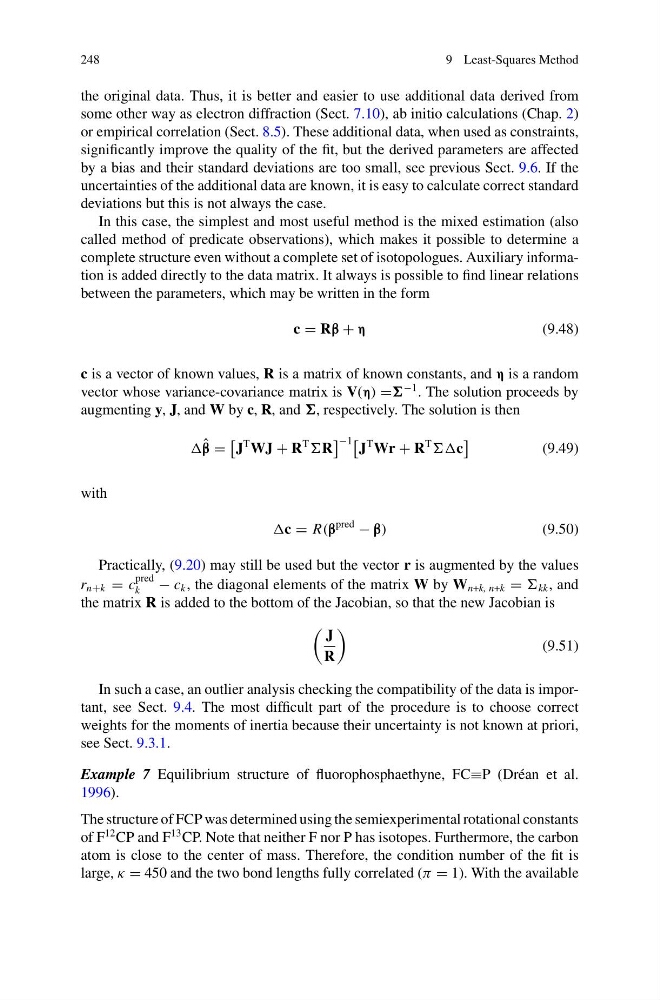
the matrix R is added to the bottom of the Jacobian, so that the new Jacobian is
J
R
(9.51)
In such a case, an outlier analysis checking the compatibility of the data is important, see Sect. 9.4. The most difficult part of the procedure is to choose correct
weights for the moments of inertia because their uncertainty is not known at priori,
see Sect. 9.3.1.
Example 7 Equilibrium structure of fluorophosphaethyne, FC≡P (Dréan et al.
1996).
The structure of FCP was determined using the semiexperimental rotational constants
of F
12 CP and F
13 CP. Note that neither F nor P has isotopes. Furthermore, the carbon
atom is close to the center of mass. Therefore, the condition number of the fit is
large, κ = 450 and the two bond lengths fully correlated (π = 1). With the available
9 Least-Squares Method
the original data. Thus, it is better and easier to use additional data derived from
some other way as electron diffraction (Sect. 7.10), ab initio calculations (Chap. 2)
or empirical correlation (Sect. 8.5). These additional data, when used as constraints,
significantly improve the quality of the fit, but the derived parameters are affected
by a bias and their standard deviations are too small, see previous Sect. 9.6. If the
uncertainties of the additional data are known, it is easy to calculate correct standard
deviations but this is not always the case.
In this case, the simplest and most useful method is the mixed estimation (also
called method of predicate observations), which makes it possible to determine a
complete structure even without a complete set of isotopologues. Auxiliary information is added directly to the data matrix. It always is possible to find linear relations
between the parameters, which may be written in the form
c = Rβ + η
(9.48)
c is a vector of known values, R is a matrix of known constants, and η is a random
vector whose variance-covariance matrix is V(η) =
−1 . The solution proceeds by
augmenting y, J, and W by c, R, and , respectively. The solution is then
ˆ
β =
J
T WJ + R
T
R
−1
J
T Wr + R
T
c
(9.49)
with
c = R(β
pred
− β)
(9.50)
Practically, (9.20) may still be used but the vector r is augmented by the values
r n+k = c
pred
k
− c k , the diagonal elements of the matrix W by W n+k, n+k = kk , and
the matrix R is added to the bottom of the Jacobian, so that the new Jacobian is
J
R
(9.51)
In such a case, an outlier analysis checking the compatibility of the data is important, see Sect. 9.4. The most difficult part of the procedure is to choose correct
weights for the moments of inertia because their uncertainty is not known at priori,
see Sect. 9.3.1.
Example 7 Equilibrium structure of fluorophosphaethyne, FC≡P (Dréan et al.
1996).
The structure of FCP was determined using the semiexperimental rotational constants
of F
12 CP and F
13 CP. Note that neither F nor P has isotopes. Furthermore, the carbon
atom is close to the center of mass. Therefore, the condition number of the fit is
large, κ = 450 and the two bond lengths fully correlated (π = 1). With the available