

9.4 Diagnostics
243
moments of inertia because we have at our disposal six isotopologues (Kawashima
et al. 1989). A fit of r z (BO), r z (BH), and δr z gives δr z = − 0.470(75) pm. The
fitted isotopic dependence does not even have the correct sign. Using (9.26), an
extrapolation of the r z structure to obtain the r e structure gives a result in perfect
agreement with high-level ab initio calculations. In conclusion, the results of the fit
are inaccurate. To understand the origin of the problem, one calculates the condition
number κ = 96, which is rather large, and the corresponding variance-decomposition
proportions which indicate that δr z is fully correlated with the two bond lengths (π
> 0.99).
9.4.2 Leverage
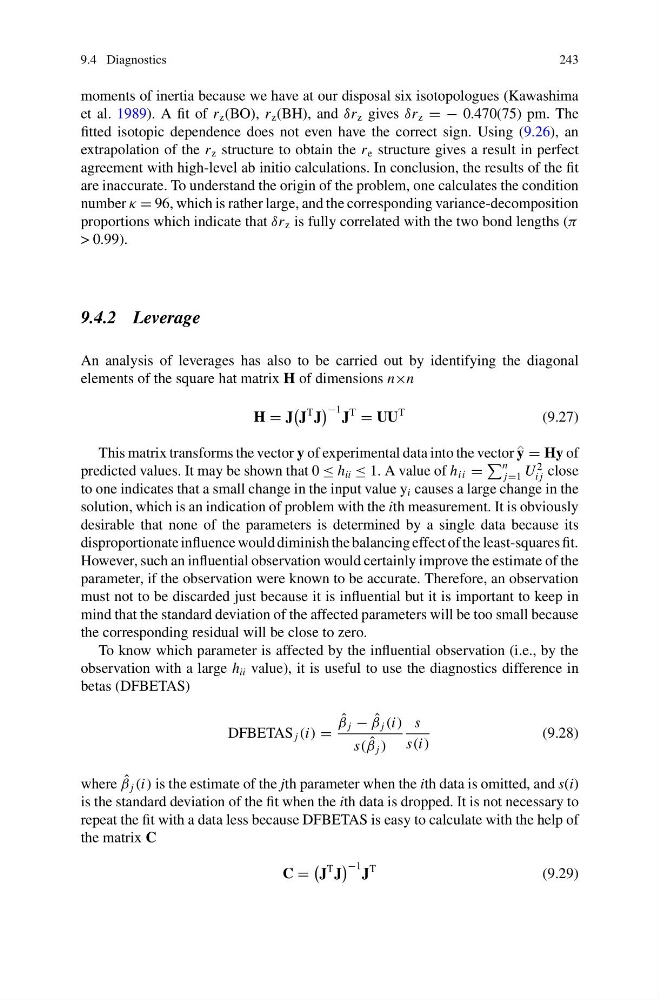
An analysis of leverages has also to be carried out by identifying the diagonal
elements of the square hat matrix H of dimensions n×n
H = J
J
T J
−1 J
T
= UU
T
(9.27)
This matrix transforms the vector y of experimental data into the vector y
= Hy of
predicted values. It may be shown that 0 ≤ h ii ≤ 1. A value of h ii =
n
j=1 U
2
i j close
to one indicates that a small change in the input value y i causes a large change in the
solution, which is an indication of problem with the ith measurement. It is obviously
desirable that none of the parameters is determined by a single data because its
disproportionate influence would diminish the balancing effect of the least-squares fit.
However, such an influential observation would certainly improve the estimate of the
parameter, if the observation were known to be accurate. Therefore, an observation
must not to be discarded just because it is influential but it is important to keep in
mind that the standard deviation of the affected parameters will be too small because
the corresponding residual will be close to zero.
To know which parameter is affected by the influential observation (i.e., by the
observation with a large h ii value), it is useful to use the diagnostics difference in
betas (DFBETAS)
DFBETAS j (i) =
ˆ
β j − ˆ
β j (i)
s( ˆ
β j )
s
s(i)
(9.28)
where ˆ
β j (i) is the estimate of the jth parameter when the ith data is omitted, and s(i)
is the standard deviation of the fit when the ith data is dropped. It is not necessary to
repeat the fit with a data less because DFBETAS is easy to calculate with the help of
the matrix C
C =
J
T J
−1 J
T
(9.29)
243
moments of inertia because we have at our disposal six isotopologues (Kawashima
et al. 1989). A fit of r z (BO), r z (BH), and δr z gives δr z = − 0.470(75) pm. The
fitted isotopic dependence does not even have the correct sign. Using (9.26), an
extrapolation of the r z structure to obtain the r e structure gives a result in perfect
agreement with high-level ab initio calculations. In conclusion, the results of the fit
are inaccurate. To understand the origin of the problem, one calculates the condition
number κ = 96, which is rather large, and the corresponding variance-decomposition
proportions which indicate that δr z is fully correlated with the two bond lengths (π
> 0.99).
9.4.2 Leverage
An analysis of leverages has also to be carried out by identifying the diagonal
elements of the square hat matrix H of dimensions n×n
H = J
J
T J
−1 J
T
= UU
T
(9.27)
This matrix transforms the vector y of experimental data into the vector y
= Hy of
predicted values. It may be shown that 0 ≤ h ii ≤ 1. A value of h ii =
n
j=1 U
2
i j close
to one indicates that a small change in the input value y i causes a large change in the
solution, which is an indication of problem with the ith measurement. It is obviously
desirable that none of the parameters is determined by a single data because its
disproportionate influence would diminish the balancing effect of the least-squares fit.
However, such an influential observation would certainly improve the estimate of the
parameter, if the observation were known to be accurate. Therefore, an observation
must not to be discarded just because it is influential but it is important to keep in
mind that the standard deviation of the affected parameters will be too small because
the corresponding residual will be close to zero.
To know which parameter is affected by the influential observation (i.e., by the
observation with a large h ii value), it is useful to use the diagnostics difference in
betas (DFBETAS)
DFBETAS j (i) =
ˆ
β j − ˆ
β j (i)
s( ˆ
β j )
s
s(i)
(9.28)
where ˆ
β j (i) is the estimate of the jth parameter when the ith data is omitted, and s(i)
is the standard deviation of the fit when the ith data is dropped. It is not necessary to
repeat the fit with a data less because DFBETAS is easy to calculate with the help of
the matrix C
C =
J
T J
−1 J
T
(9.29)