

242
9 Least-Squares Method
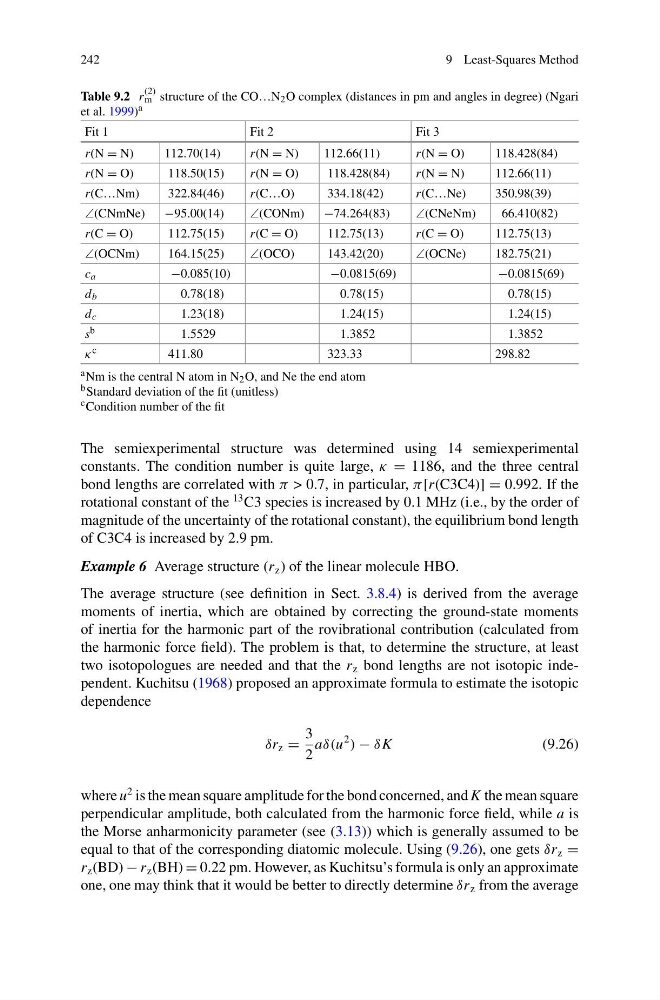
Table 9.2 r
(2)
m structure of the CO…N 2 O complex (distances in pm and angles in degree) (Ngari
et al. 1999) a
Fit 1
Fit 2
Fit 3
r(N = N)
112.70(14)
r(N = N)
112.66(11)
r(N = O)
118.428(84)
r(N = O)
118.50(15)
r(N = O)
118.428(84)
r(N = N)
112.66(11)
r(C…Nm)
322.84(46)
r(C…O)
334.18(42)
r(C…Ne)
350.98(39)
∠(CNmNe)
−95.00(14)
∠(CONm)
−74.264(83)
∠(CNeNm)
66.410(82)
r(C = O)
112.75(15)
r(C = O)
112.75(13)
r(C = O)
112.75(13)
∠(OCNm)
164.15(25)
∠(OCO)
143.42(20)
∠(OCNe)
182.75(21)
c a
−0.085(10)
−0.0815(69)
−0.0815(69)
d b
0.78(18)
0.78(15)
0.78(15)
d c
1.23(18)
1.24(15)
1.24(15)
s b
1.5529
1.3852
1.3852
κ c
411.80
323.33
298.82
a Nm is the central N atom in N 2 O, and Ne the end atom
b Standard deviation of the fit (unitless)
c Condition number of the fit
The semiexperimental structure was determined using 14 semiexperimental
constants. The condition number is quite large, κ = 1186, and the three central
bond lengths are correlated with π > 0.7, in particular, π [r(C3C4)] = 0.992. If the
rotational constant of the
13 C3 species is increased by 0.1 MHz (i.e., by the order of
magnitude of the uncertainty of the rotational constant), the equilibrium bond length
of C3C4 is increased by 2.9 pm.
Example 6 Average structure (r z ) of the linear molecule HBO.
The average structure (see definition in Sect. 3.8.4) is derived from the average
moments of inertia, which are obtained by correcting the ground-state moments
of inertia for the harmonic part of the rovibrational contribution (calculated from
the harmonic force field). The problem is that, to determine the structure, at least
two isotopologues are needed and that the r z bond lengths are not isotopic independent. Kuchitsu (1968) proposed an approximate formula to estimate the isotopic
dependence
δr z =
3
2
aδ(u
2
) − δ K
(9.26)
where u
2 is the mean square amplitude for the bond concerned, and K the mean square
perpendicular amplitude, both calculated from the harmonic force field, while a is
the Morse anharmonicity parameter (see (3.13)) which is generally assumed to be
equal to that of the corresponding diatomic molecule. Using (9.26), one gets δr z =
r z (BD) − r z (BH) = 0.22 pm. However, as Kuchitsu’s formula is only an approximate
one, one may think that it would be better to directly determine δr z from the average
9 Least-Squares Method
Table 9.2 r
(2)
m structure of the CO…N 2 O complex (distances in pm and angles in degree) (Ngari
et al. 1999) a
Fit 1
Fit 2
Fit 3
r(N = N)
112.70(14)
r(N = N)
112.66(11)
r(N = O)
118.428(84)
r(N = O)
118.50(15)
r(N = O)
118.428(84)
r(N = N)
112.66(11)
r(C…Nm)
322.84(46)
r(C…O)
334.18(42)
r(C…Ne)
350.98(39)
∠(CNmNe)
−95.00(14)
∠(CONm)
−74.264(83)
∠(CNeNm)
66.410(82)
r(C = O)
112.75(15)
r(C = O)
112.75(13)
r(C = O)
112.75(13)
∠(OCNm)
164.15(25)
∠(OCO)
143.42(20)
∠(OCNe)
182.75(21)
c a
−0.085(10)
−0.0815(69)
−0.0815(69)
d b
0.78(18)
0.78(15)
0.78(15)
d c
1.23(18)
1.24(15)
1.24(15)
s b
1.5529
1.3852
1.3852
κ c
411.80
323.33
298.82
a Nm is the central N atom in N 2 O, and Ne the end atom
b Standard deviation of the fit (unitless)
c Condition number of the fit
The semiexperimental structure was determined using 14 semiexperimental
constants. The condition number is quite large, κ = 1186, and the three central
bond lengths are correlated with π > 0.7, in particular, π [r(C3C4)] = 0.992. If the
rotational constant of the
13 C3 species is increased by 0.1 MHz (i.e., by the order of
magnitude of the uncertainty of the rotational constant), the equilibrium bond length
of C3C4 is increased by 2.9 pm.
Example 6 Average structure (r z ) of the linear molecule HBO.
The average structure (see definition in Sect. 3.8.4) is derived from the average
moments of inertia, which are obtained by correcting the ground-state moments
of inertia for the harmonic part of the rovibrational contribution (calculated from
the harmonic force field). The problem is that, to determine the structure, at least
two isotopologues are needed and that the r z bond lengths are not isotopic independent. Kuchitsu (1968) proposed an approximate formula to estimate the isotopic
dependence
δr z =
3
2
aδ(u
2
) − δ K
(9.26)
where u
2 is the mean square amplitude for the bond concerned, and K the mean square
perpendicular amplitude, both calculated from the harmonic force field, while a is
the Morse anharmonicity parameter (see (3.13)) which is generally assumed to be
equal to that of the corresponding diatomic molecule. Using (9.26), one gets δr z =
r z (BD) − r z (BH) = 0.22 pm. However, as Kuchitsu’s formula is only an approximate
one, one may think that it would be better to directly determine δr z from the average