

8.3 Valence-Shell Electron-Pair Repulsion (VSEPR) Model
215
Table 8.4 Structure of the
molecules X 2 C=O (distances
in pm, angles in degrees)
X
∠(XCX)
r(C=O)
H
116.74
120.47
CH 3
116.48(13)
121.17(21)
F
107.80(3)
116.99(4)
Cl
111.85(2)
117.59(4)
Source MOGADOC database, Vogt et al. (2015)
Example. Propene CH 3 C H=CH 3 , central carbon
The central carbon has four valence electrons, the methyl group contributes one
electron, the hydrogen atom one electron also, and the =CH 2 group one electron,
thus a total of seven electrons but one has to subtract one electron of carbon forming
the π-bond. In conclusion, there are six electrons, i.e., three bonding pairs, and the
geometry is trigonal. The angle ∠(C–C=C) at 124.46° is larger than 120° because
the double bond occupies more space.
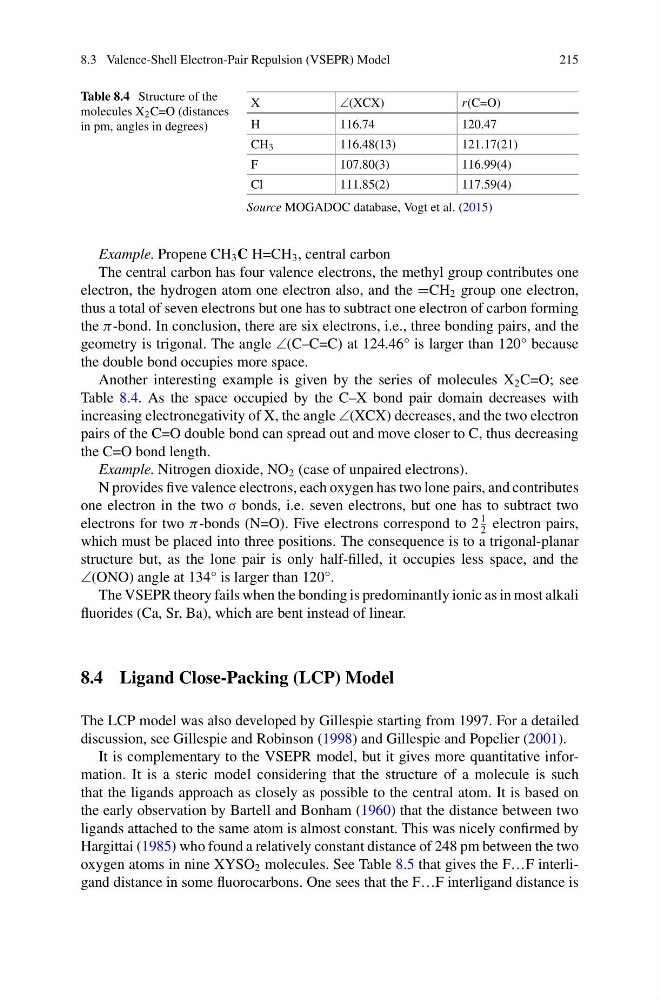
Another interesting example is given by the series of molecules X 2 C=O; see
Table 8.4. As the space occupied by the C–X bond pair domain decreases with
increasing electronegativity of X, the angle ∠(XCX) decreases, and the two electron
pairs of the C=O double bond can spread out and move closer to C, thus decreasing
the C=O bond length.
Example. Nitrogen dioxide, NO 2 (case of unpaired electrons).
N provides five valence electrons, each oxygen has two lone pairs, and contributes
one electron in the two σ bonds, i.e. seven electrons, but one has to subtract two
electrons for two π-bonds (N=O). Five electrons correspond to 2
1
2
electron pairs,
which must be placed into three positions. The consequence is to a trigonal-planar
structure but, as the lone pair is only half-filled, it occupies less space, and the
∠(ONO) angle at 134° is larger than 120°.
The VSEPR theory fails when the bonding is predominantly ionic as in most alkali
fluorides (Ca, Sr, Ba), which are bent instead of linear.
8.4 Ligand Close-Packing (LCP) Model
The LCP model was also developed by Gillespie starting from 1997. For a detailed
discussion, see Gillespie and Robinson (1998) and Gillespie and Popelier (2001).
It is complementary to the VSEPR model, but it gives more quantitative information. It is a steric model considering that the structure of a molecule is such
that the ligands approach as closely as possible to the central atom. It is based on
the early observation by Bartell and Bonham (1960) that the distance between two
ligands attached to the same atom is almost constant. This was nicely confirmed by
Hargittai (1985) who found a relatively constant distance of 248 pm between the two
oxygen atoms in nine XYSO 2 molecules. See Table 8.5 that gives the F…F interligand distance in some fluorocarbons. One sees that the F…F interligand distance is
215
Table 8.4 Structure of the
molecules X 2 C=O (distances
in pm, angles in degrees)
X
∠(XCX)
r(C=O)
H
116.74
120.47
CH 3
116.48(13)
121.17(21)
F
107.80(3)
116.99(4)
Cl
111.85(2)
117.59(4)
Source MOGADOC database, Vogt et al. (2015)
Example. Propene CH 3 C H=CH 3 , central carbon
The central carbon has four valence electrons, the methyl group contributes one
electron, the hydrogen atom one electron also, and the =CH 2 group one electron,
thus a total of seven electrons but one has to subtract one electron of carbon forming
the π-bond. In conclusion, there are six electrons, i.e., three bonding pairs, and the
geometry is trigonal. The angle ∠(C–C=C) at 124.46° is larger than 120° because
the double bond occupies more space.
Another interesting example is given by the series of molecules X 2 C=O; see
Table 8.4. As the space occupied by the C–X bond pair domain decreases with
increasing electronegativity of X, the angle ∠(XCX) decreases, and the two electron
pairs of the C=O double bond can spread out and move closer to C, thus decreasing
the C=O bond length.
Example. Nitrogen dioxide, NO 2 (case of unpaired electrons).
N provides five valence electrons, each oxygen has two lone pairs, and contributes
one electron in the two σ bonds, i.e. seven electrons, but one has to subtract two
electrons for two π-bonds (N=O). Five electrons correspond to 2
1
2
electron pairs,
which must be placed into three positions. The consequence is to a trigonal-planar
structure but, as the lone pair is only half-filled, it occupies less space, and the
∠(ONO) angle at 134° is larger than 120°.
The VSEPR theory fails when the bonding is predominantly ionic as in most alkali
fluorides (Ca, Sr, Ba), which are bent instead of linear.
8.4 Ligand Close-Packing (LCP) Model
The LCP model was also developed by Gillespie starting from 1997. For a detailed
discussion, see Gillespie and Robinson (1998) and Gillespie and Popelier (2001).
It is complementary to the VSEPR model, but it gives more quantitative information. It is a steric model considering that the structure of a molecule is such
that the ligands approach as closely as possible to the central atom. It is based on
the early observation by Bartell and Bonham (1960) that the distance between two
ligands attached to the same atom is almost constant. This was nicely confirmed by
Hargittai (1985) who found a relatively constant distance of 248 pm between the two
oxygen atoms in nine XYSO 2 molecules. See Table 8.5 that gives the F…F interligand distance in some fluorocarbons. One sees that the F…F interligand distance is