

216
8 Models of Chemical Bonding and “Empirical” Methods
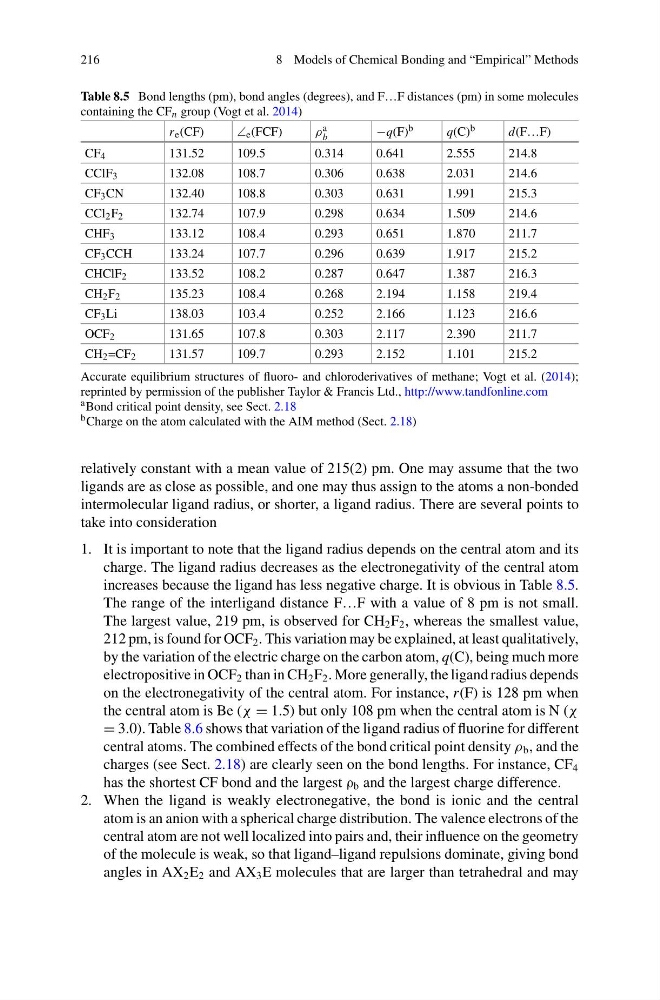
Table 8.5 Bond lengths (pm), bond angles (degrees), and F…F distances (pm) in some molecules
containing the CF n group (Vogt et al. 2014)
r e (CF)
∠ e (FCF)
ρ a
b
−q(F) b
q(C) b
d(F…F)
CF 4
131.52
109.5
0.314
0.641
2.555
214.8
CClF 3
132.08
108.7
0.306
0.638
2.031
214.6
CF 3 CN
132.40
108.8
0.303
0.631
1.991
215.3
CCl 2 F 2
132.74
107.9
0.298
0.634
1.509
214.6
CHF 3
133.12
108.4
0.293
0.651
1.870
211.7
CF 3 CCH
133.24
107.7
0.296
0.639
1.917
215.2
CHClF 2
133.52
108.2
0.287
0.647
1.387
216.3
CH 2 F 2
135.23
108.4
0.268
2.194
1.158
219.4
CF 3 Li
138.03
103.4
0.252
2.166
1.123
216.6
OCF 2
131.65
107.8
0.303
2.117
2.390
211.7
CH 2 =CF 2
131.57
109.7
0.293
2.152
1.101
215.2
Accurate equilibrium structures of fluoro- and chloroderivatives of methane; Vogt et al. (2014);
reprinted by permission of the publisher Taylor & Francis Ltd., http://www.tandfonline.com
a Bond critical point density, see Sect. 2.18
b Charge on the atom calculated with the AIM method (Sect. 2.18)
relatively constant with a mean value of 215(2) pm. One may assume that the two
ligands are as close as possible, and one may thus assign to the atoms a non-bonded
intermolecular ligand radius, or shorter, a ligand radius. There are several points to
take into consideration
1. It is important to note that the ligand radius depends on the central atom and its
charge. The ligand radius decreases as the electronegativity of the central atom
increases because the ligand has less negative charge. It is obvious in Table 8.5.
The range of the interligand distance F…F with a value of 8 pm is not small.
The largest value, 219 pm, is observed for CH 2 F 2 , whereas the smallest value,
212 pm, is found for OCF 2 . This variation may be explained, at least qualitatively,
by the variation of the electric charge on the carbon atom, q(C), being much more
electropositive in OCF 2 than in CH 2 F 2 . More generally, the ligand radius depends
on the electronegativity of the central atom. For instance, r(F) is 128 pm when
the central atom is Be (χ = 1.5) but only 108 pm when the central atom is N (χ
= 3.0). Table 8.6 shows that variation of the ligand radius of fluorine for different
central atoms. The combined effects of the bond critical point density ρ b , and the
charges (see Sect. 2.18) are clearly seen on the bond lengths. For instance, CF 4
has the shortest CF bond and the largest ρ b and the largest charge difference.
2. When the ligand is weakly electronegative, the bond is ionic and the central
atom is an anion with a spherical charge distribution. The valence electrons of the
central atom are not well localized into pairs and, their influence on the geometry
of the molecule is weak, so that ligand–ligand repulsions dominate, giving bond
angles in AX 2 E 2 and AX 3 E molecules that are larger than tetrahedral and may
8 Models of Chemical Bonding and “Empirical” Methods
Table 8.5 Bond lengths (pm), bond angles (degrees), and F…F distances (pm) in some molecules
containing the CF n group (Vogt et al. 2014)
r e (CF)
∠ e (FCF)
ρ a
b
−q(F) b
q(C) b
d(F…F)
CF 4
131.52
109.5
0.314
0.641
2.555
214.8
CClF 3
132.08
108.7
0.306
0.638
2.031
214.6
CF 3 CN
132.40
108.8
0.303
0.631
1.991
215.3
CCl 2 F 2
132.74
107.9
0.298
0.634
1.509
214.6
CHF 3
133.12
108.4
0.293
0.651
1.870
211.7
CF 3 CCH
133.24
107.7
0.296
0.639
1.917
215.2
CHClF 2
133.52
108.2
0.287
0.647
1.387
216.3
CH 2 F 2
135.23
108.4
0.268
2.194
1.158
219.4
CF 3 Li
138.03
103.4
0.252
2.166
1.123
216.6
OCF 2
131.65
107.8
0.303
2.117
2.390
211.7
CH 2 =CF 2
131.57
109.7
0.293
2.152
1.101
215.2
Accurate equilibrium structures of fluoro- and chloroderivatives of methane; Vogt et al. (2014);
reprinted by permission of the publisher Taylor & Francis Ltd., http://www.tandfonline.com
a Bond critical point density, see Sect. 2.18
b Charge on the atom calculated with the AIM method (Sect. 2.18)
relatively constant with a mean value of 215(2) pm. One may assume that the two
ligands are as close as possible, and one may thus assign to the atoms a non-bonded
intermolecular ligand radius, or shorter, a ligand radius. There are several points to
take into consideration
1. It is important to note that the ligand radius depends on the central atom and its
charge. The ligand radius decreases as the electronegativity of the central atom
increases because the ligand has less negative charge. It is obvious in Table 8.5.
The range of the interligand distance F…F with a value of 8 pm is not small.
The largest value, 219 pm, is observed for CH 2 F 2 , whereas the smallest value,
212 pm, is found for OCF 2 . This variation may be explained, at least qualitatively,
by the variation of the electric charge on the carbon atom, q(C), being much more
electropositive in OCF 2 than in CH 2 F 2 . More generally, the ligand radius depends
on the electronegativity of the central atom. For instance, r(F) is 128 pm when
the central atom is Be (χ = 1.5) but only 108 pm when the central atom is N (χ
= 3.0). Table 8.6 shows that variation of the ligand radius of fluorine for different
central atoms. The combined effects of the bond critical point density ρ b , and the
charges (see Sect. 2.18) are clearly seen on the bond lengths. For instance, CF 4
has the shortest CF bond and the largest ρ b and the largest charge difference.
2. When the ligand is weakly electronegative, the bond is ionic and the central
atom is an anion with a spherical charge distribution. The valence electrons of the
central atom are not well localized into pairs and, their influence on the geometry
of the molecule is weak, so that ligand–ligand repulsions dominate, giving bond
angles in AX 2 E 2 and AX 3 E molecules that are larger than tetrahedral and may