

214
8 Models of Chemical Bonding and “Empirical” Methods
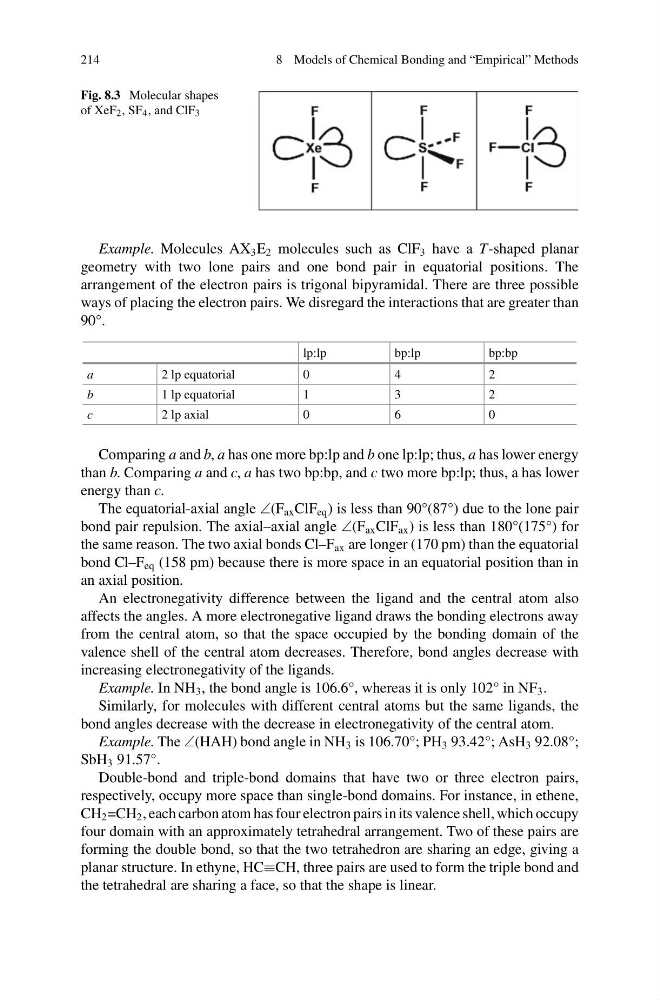
Fig. 8.3 Molecular shapes
of XeF 2 , SF 4 , and ClF 3
Example. Molecules AX 3 E 2 molecules such as ClF 3 have a T-shaped planar
geometry with two lone pairs and one bond pair in equatorial positions. The
arrangement of the electron pairs is trigonal bipyramidal. There are three possible
ways of placing the electron pairs. We disregard the interactions that are greater than
90°.
lp:lp
bp:lp
bp:bp
a
2 lp equatorial
0
4
2
b
1 lp equatorial
1
3
2
c
2 lp axial
0
6
0
Comparing a and b, a has one more bp:lp and b one lp:lp; thus, a has lower energy
than b. Comparing a and c, a has two bp:bp, and c two more bp:lp; thus, a has lower
energy than c.
The equatorial-axial angle ∠(F ax ClF eq ) is less than 90°(87°) due to the lone pair
bond pair repulsion. The axial–axial angle ∠(F ax ClF ax ) is less than 180°(175°) for
the same reason. The two axial bonds Cl–F ax are longer (170 pm) than the equatorial
bond Cl–F eq (158 pm) because there is more space in an equatorial position than in
an axial position.
An electronegativity difference between the ligand and the central atom also
affects the angles. A more electronegative ligand draws the bonding electrons away
from the central atom, so that the space occupied by the bonding domain of the
valence shell of the central atom decreases. Therefore, bond angles decrease with
increasing electronegativity of the ligands.
Example. In NH 3 , the bond angle is 106.6°, whereas it is only 102° in NF 3 .
Similarly, for molecules with different central atoms but the same ligands, the
bond angles decrease with the decrease in electronegativity of the central atom.
Example. The ∠(HAH) bond angle in NH 3 is 106.70°; PH 3 93.42°; AsH 3 92.08°;
SbH 3 91.57°.
Double-bond and triple-bond domains that have two or three electron pairs,
respectively, occupy more space than single-bond domains. For instance, in ethene,
CH 2 =CH 2 , each carbon atom has four electron pairs in its valence shell, which occupy
four domain with an approximately tetrahedral arrangement. Two of these pairs are
forming the double bond, so that the two tetrahedron are sharing an edge, giving a
planar structure. In ethyne, HC≡CH, three pairs are used to form the triple bond and
the tetrahedral are sharing a face, so that the shape is linear.
8 Models of Chemical Bonding and “Empirical” Methods
Fig. 8.3 Molecular shapes
of XeF 2 , SF 4 , and ClF 3
Example. Molecules AX 3 E 2 molecules such as ClF 3 have a T-shaped planar
geometry with two lone pairs and one bond pair in equatorial positions. The
arrangement of the electron pairs is trigonal bipyramidal. There are three possible
ways of placing the electron pairs. We disregard the interactions that are greater than
90°.
lp:lp
bp:lp
bp:bp
a
2 lp equatorial
0
4
2
b
1 lp equatorial
1
3
2
c
2 lp axial
0
6
0
Comparing a and b, a has one more bp:lp and b one lp:lp; thus, a has lower energy
than b. Comparing a and c, a has two bp:bp, and c two more bp:lp; thus, a has lower
energy than c.
The equatorial-axial angle ∠(F ax ClF eq ) is less than 90°(87°) due to the lone pair
bond pair repulsion. The axial–axial angle ∠(F ax ClF ax ) is less than 180°(175°) for
the same reason. The two axial bonds Cl–F ax are longer (170 pm) than the equatorial
bond Cl–F eq (158 pm) because there is more space in an equatorial position than in
an axial position.
An electronegativity difference between the ligand and the central atom also
affects the angles. A more electronegative ligand draws the bonding electrons away
from the central atom, so that the space occupied by the bonding domain of the
valence shell of the central atom decreases. Therefore, bond angles decrease with
increasing electronegativity of the ligands.
Example. In NH 3 , the bond angle is 106.6°, whereas it is only 102° in NF 3 .
Similarly, for molecules with different central atoms but the same ligands, the
bond angles decrease with the decrease in electronegativity of the central atom.
Example. The ∠(HAH) bond angle in NH 3 is 106.70°; PH 3 93.42°; AsH 3 92.08°;
SbH 3 91.57°.
Double-bond and triple-bond domains that have two or three electron pairs,
respectively, occupy more space than single-bond domains. For instance, in ethene,
CH 2 =CH 2 , each carbon atom has four electron pairs in its valence shell, which occupy
four domain with an approximately tetrahedral arrangement. Two of these pairs are
forming the double bond, so that the two tetrahedron are sharing an edge, giving a
planar structure. In ethyne, HC≡CH, three pairs are used to form the triple bond and
the tetrahedral are sharing a face, so that the shape is linear.