

8.3 Valence-Shell Electron-Pair Repulsion (VSEPR) Model
213
lp:lp > lp:bp > bp:bp
In molecules with lone pairs, bond angles are smaller than the ideal values and
decrease with increasing number of lone pairs.
Example. In CH 4 , NH 3 , and H 2 O there are four electron pairs, and their arrangement should be tetrahedral. The ideal bond angle should be 109° 28
. It is verified for
CH 4 because methane does not have a lone pair. But for NH 3 with one lone pair, the
bond angle is 106.6° and for H 2 O with two lone pairs, the bond angle is only 104.5°.
Another consequence is that the lone pairs prefer an equatorial position because
they need more space.
Example. AX 4 E 2 molecules such as XeF 4 . There are four bond pairs and two lone
pairs (on Xe), thus an octahedral geometry for the electron pairs. The structure is
planar with two trans-lone pairs (E) and angles of 90° between the electron pairs.
There are eight bp:lp interactions. With the other two possible configurations, some
bp:lp interactions would be replaced by lp:lp interactions, which are less favorable.
The lone pairs on opposite sides of the molecular plane minimize the lp:lp interaction.
Example. AX 2 E 3 molecules such as XeF 2 have three lone pairs and two bonding
pairs (on Xe), hence a trigonal bipyramidal geometry for electron pairs. There are
three possible stereoisomers: (a) the F atoms occupy axial sites, which gives a linear
molecule (b) one F atom occupies an equatorial position (c) the two lone pairs are
in axial position. To a first approximation, one can neglect the interactions that are
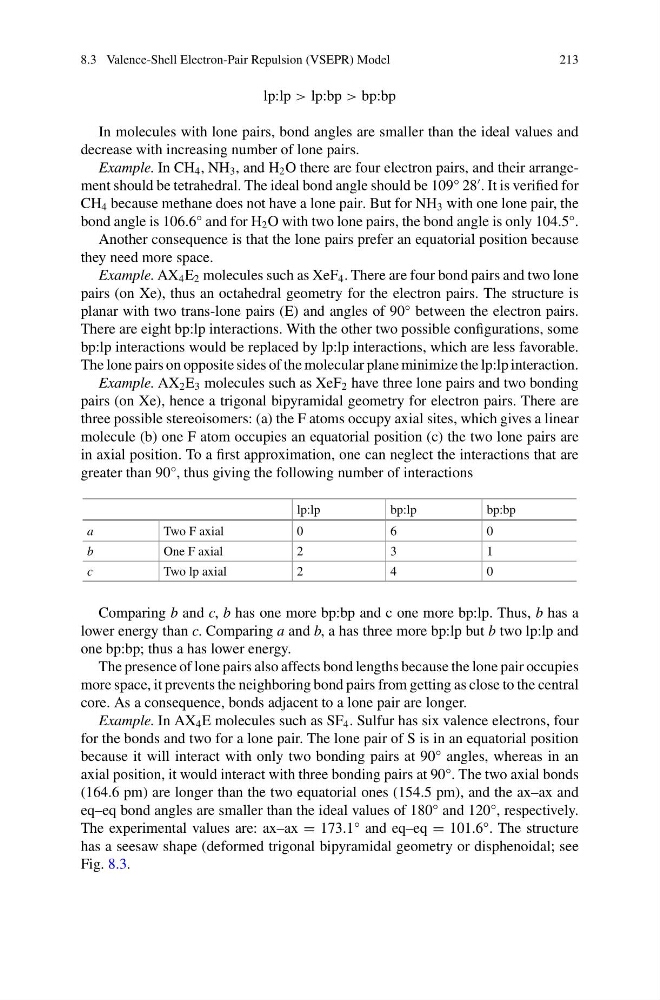
greater than 90°, thus giving the following number of interactions
lp:lp
bp:lp
bp:bp
a
Two F axial
0
6
0
b
One F axial
2
3
1
c
Two lp axial
2
4
0
Comparing b and c, b has one more bp:bp and c one more bp:lp. Thus, b has a
lower energy than c. Comparing a and b, a has three more bp:lp but b two lp:lp and
one bp:bp; thus a has lower energy.
The presence of lone pairs also affects bond lengths because the lone pair occupies
more space, it prevents the neighboring bond pairs from getting as close to the central
core. As a consequence, bonds adjacent to a lone pair are longer.
Example. In AX 4 E molecules such as SF 4 . Sulfur has six valence electrons, four
for the bonds and two for a lone pair. The lone pair of S is in an equatorial position
because it will interact with only two bonding pairs at 90° angles, whereas in an
axial position, it would interact with three bonding pairs at 90°. The two axial bonds
(164.6 pm) are longer than the two equatorial ones (154.5 pm), and the ax–ax and
eq–eq bond angles are smaller than the ideal values of 180° and 120°, respectively.
The experimental values are: ax–ax = 173.1° and eq–eq = 101.6°. The structure
has a seesaw shape (deformed trigonal bipyramidal geometry or disphenoidal; see
Fig. 8.3.
213
lp:lp > lp:bp > bp:bp
In molecules with lone pairs, bond angles are smaller than the ideal values and
decrease with increasing number of lone pairs.
Example. In CH 4 , NH 3 , and H 2 O there are four electron pairs, and their arrangement should be tetrahedral. The ideal bond angle should be 109° 28
. It is verified for
CH 4 because methane does not have a lone pair. But for NH 3 with one lone pair, the
bond angle is 106.6° and for H 2 O with two lone pairs, the bond angle is only 104.5°.
Another consequence is that the lone pairs prefer an equatorial position because
they need more space.
Example. AX 4 E 2 molecules such as XeF 4 . There are four bond pairs and two lone
pairs (on Xe), thus an octahedral geometry for the electron pairs. The structure is
planar with two trans-lone pairs (E) and angles of 90° between the electron pairs.
There are eight bp:lp interactions. With the other two possible configurations, some
bp:lp interactions would be replaced by lp:lp interactions, which are less favorable.
The lone pairs on opposite sides of the molecular plane minimize the lp:lp interaction.
Example. AX 2 E 3 molecules such as XeF 2 have three lone pairs and two bonding
pairs (on Xe), hence a trigonal bipyramidal geometry for electron pairs. There are
three possible stereoisomers: (a) the F atoms occupy axial sites, which gives a linear
molecule (b) one F atom occupies an equatorial position (c) the two lone pairs are
in axial position. To a first approximation, one can neglect the interactions that are
greater than 90°, thus giving the following number of interactions
lp:lp
bp:lp
bp:bp
a
Two F axial
0
6
0
b
One F axial
2
3
1
c
Two lp axial
2
4
0
Comparing b and c, b has one more bp:bp and c one more bp:lp. Thus, b has a
lower energy than c. Comparing a and b, a has three more bp:lp but b two lp:lp and
one bp:bp; thus a has lower energy.
The presence of lone pairs also affects bond lengths because the lone pair occupies
more space, it prevents the neighboring bond pairs from getting as close to the central
core. As a consequence, bonds adjacent to a lone pair are longer.
Example. In AX 4 E molecules such as SF 4 . Sulfur has six valence electrons, four
for the bonds and two for a lone pair. The lone pair of S is in an equatorial position
because it will interact with only two bonding pairs at 90° angles, whereas in an
axial position, it would interact with three bonding pairs at 90°. The two axial bonds
(164.6 pm) are longer than the two equatorial ones (154.5 pm), and the ax–ax and
eq–eq bond angles are smaller than the ideal values of 180° and 120°, respectively.
The experimental values are: ax–ax = 173.1° and eq–eq = 101.6°. The structure
has a seesaw shape (deformed trigonal bipyramidal geometry or disphenoidal; see
Fig. 8.3.