

8.2 Bond Lengths
209
8.2.4 Van der Waals Radii
See also Appendix 2.19.5.
The van der Waals radius, r w , is half the minimum distance between two nonbonded atoms of the same kind in adjacent molecules. This definition assumes that
atoms have a spherical shape except in the bonding direction and that they are incompressible. The van der Waals radius of an atom in a molecule does not have a constant
value because it depends on the strength of the forces holding the atoms together. In
particular, the larger the negative charge of an atom, the greater is its size. Moreover,
atoms in molecules are not spherical: In the direction of the bond, the covalent radius
is smaller than the van der Waals radius in any other direction. For these reasons, the
values depend on the method of determination.
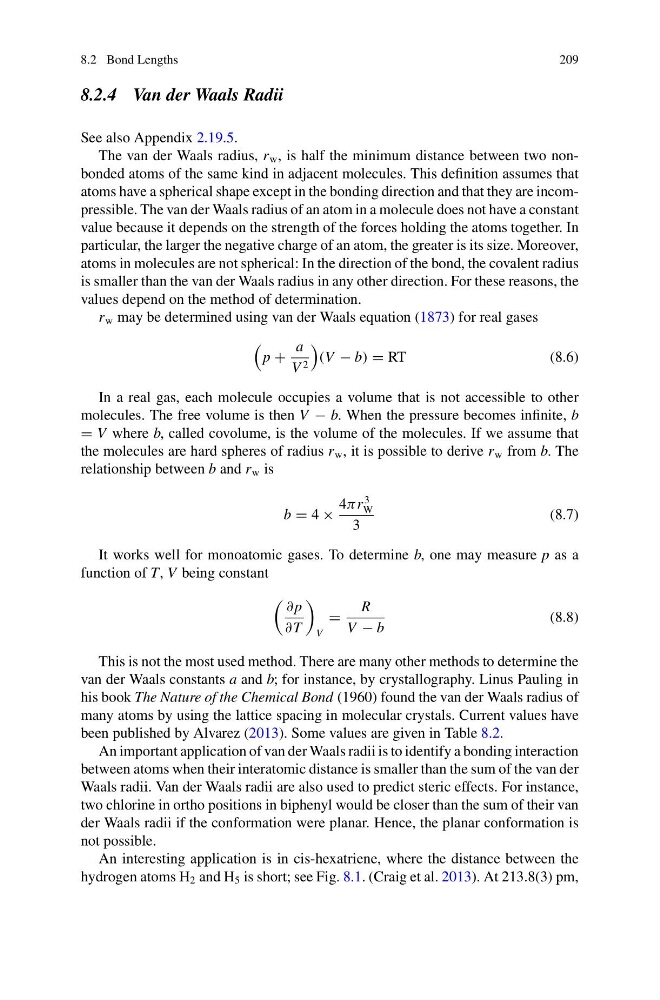
r w may be determined using van der Waals equation (1873) for real gases
p +
a
V 2
(V − b) = RT
(8.6)
In a real gas, each molecule occupies a volume that is not accessible to other
molecules. The free volume is then V − b. When the pressure becomes infinite, b
= V where b, called covolume, is the volume of the molecules. If we assume that
the molecules are hard spheres of radius r w , it is possible to derive r w from b. The
relationship between b and r w is
b = 4 ×
4πr
3
W
3
(8.7)
It works well for monoatomic gases. To determine b, one may measure p as a
function of T, V being constant
∂ p
∂ T
V
=
R
V − b
(8.8)
This is not the most used method. There are many other methods to determine the
van der Waals constants a and b; for instance, by crystallography. Linus Pauling in
his book The Nature of the Chemical Bond (1960) found the van der Waals radius of
many atoms by using the lattice spacing in molecular crystals. Current values have
been published by Alvarez (2013). Some values are given in Table 8.2.
An important application of van der Waals radii is to identify a bonding interaction
between atoms when their interatomic distance is smaller than the sum of the van der
Waals radii. Van der Waals radii are also used to predict steric effects. For instance,
two chlorine in ortho positions in biphenyl would be closer than the sum of their van
der Waals radii if the conformation were planar. Hence, the planar conformation is
not possible.
An interesting application is in cis-hexatriene, where the distance between the
hydrogen atoms H 2 and H 5 is short; see Fig. 8.1. (Craig et al. 2013). At 213.8(3) pm,
209
8.2.4 Van der Waals Radii
See also Appendix 2.19.5.
The van der Waals radius, r w , is half the minimum distance between two nonbonded atoms of the same kind in adjacent molecules. This definition assumes that
atoms have a spherical shape except in the bonding direction and that they are incompressible. The van der Waals radius of an atom in a molecule does not have a constant
value because it depends on the strength of the forces holding the atoms together. In
particular, the larger the negative charge of an atom, the greater is its size. Moreover,
atoms in molecules are not spherical: In the direction of the bond, the covalent radius
is smaller than the van der Waals radius in any other direction. For these reasons, the
values depend on the method of determination.
r w may be determined using van der Waals equation (1873) for real gases
p +
a
V 2
(V − b) = RT
(8.6)
In a real gas, each molecule occupies a volume that is not accessible to other
molecules. The free volume is then V − b. When the pressure becomes infinite, b
= V where b, called covolume, is the volume of the molecules. If we assume that
the molecules are hard spheres of radius r w , it is possible to derive r w from b. The
relationship between b and r w is
b = 4 ×
4πr
3
W
3
(8.7)
It works well for monoatomic gases. To determine b, one may measure p as a
function of T, V being constant
∂ p
∂ T
V
=
R
V − b
(8.8)
This is not the most used method. There are many other methods to determine the
van der Waals constants a and b; for instance, by crystallography. Linus Pauling in
his book The Nature of the Chemical Bond (1960) found the van der Waals radius of
many atoms by using the lattice spacing in molecular crystals. Current values have
been published by Alvarez (2013). Some values are given in Table 8.2.
An important application of van der Waals radii is to identify a bonding interaction
between atoms when their interatomic distance is smaller than the sum of the van der
Waals radii. Van der Waals radii are also used to predict steric effects. For instance,
two chlorine in ortho positions in biphenyl would be closer than the sum of their van
der Waals radii if the conformation were planar. Hence, the planar conformation is
not possible.
An interesting application is in cis-hexatriene, where the distance between the
hydrogen atoms H 2 and H 5 is short; see Fig. 8.1. (Craig et al. 2013). At 213.8(3) pm,