

208
8 Models of Chemical Bonding and “Empirical” Methods
χ A and χ B are the electronegativities of atoms A and B in eV from the Allred-Rochow
scale (1958).
In conclusion, (8.1) gives in most cases an upper limit for the bond length, and
the accuracy decreases as the electronegativity difference of the atoms increases.
Another defect of these (8.1, 8.3, 8.4) is that they are unable to predict the effect of the
environment on the bond length. A typical example of the effect of the environment
is given by the C–C single bond; see Sect. 8.5.3.4.
8.2.3 Bond Order
In the previous Sect. 8.2.1, it was shown that the values of the covalent radii depend
on the multiplicity of the bond. For instance, the covalent radius of the carbon atom
is 75 pm in case of a single bond (sp
3 ) and 60 pm for a triple bond (sp). However,
a difficulty arises when the bond order is fractional as, for instance, in aromatic
compounds.
The concept of bond order is crucial to understand the bonding in molecules. In
particular, it is useful to determine which ab initio method will give reliable bond
lengths (see for instance Demaison et al. 2012). The bond order is simply the number
of shared electron pairs. Thus, the bond orders of single, double, and triple bonds
are 1, 2, and 3, respectively. It was observed early that some bonds are intermediate
between a single and a double bond or between a double and triple bond. For instance,
in the simple case of benzene, C 6 H 6 , each bond consists of one shared pair and onehalf shared pair and its bond order is 1.5 (note that different methods may give slightly
different results). Another typical example is the structure of the peptide bond studied
by Pauling et al. (1951). Examining the resonances structures, they concluded that
both carbon–oxygen and carbon–nitrogen bonds have a considerable double-bond
character implying the planarity of the peptide group.
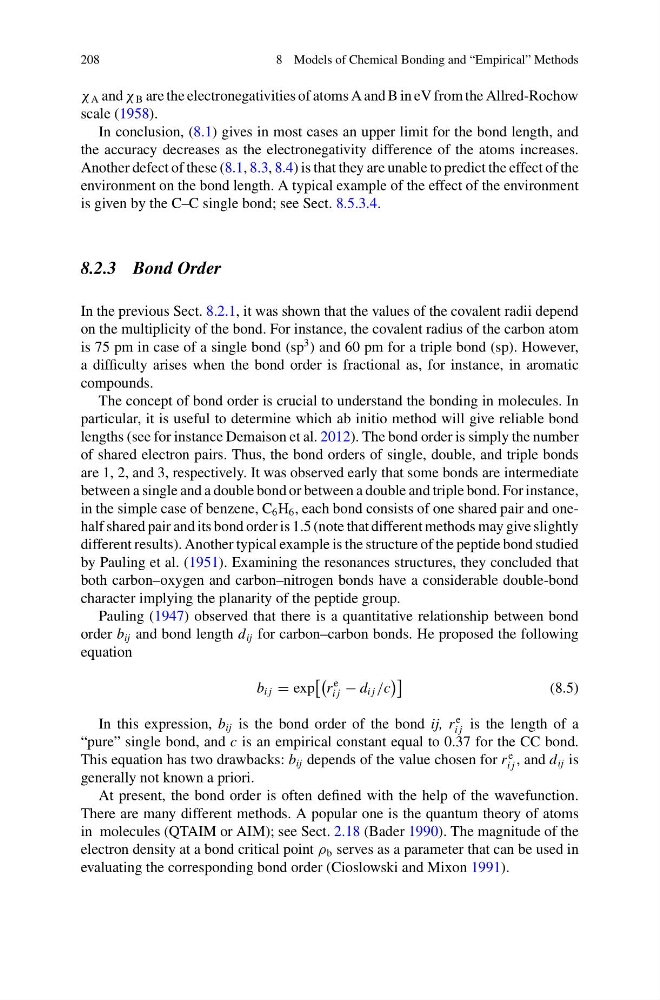
Pauling (1947) observed that there is a quantitative relationship between bond
order b ij and bond length d ij for carbon–carbon bonds. He proposed the following
equation
b i j = exp
r
e
i j − d i j /c
(8.5)
In this expression, b ij is the bond order of the bond ij, r
e
i j is the length of a
“pure” single bond, and c is an empirical constant equal to 0.37 for the CC bond.
This equation has two drawbacks: b ij depends of the value chosen for r
e
i j , and d ij is
generally not known a priori.
At present, the bond order is often defined with the help of the wavefunction.
There are many different methods. A popular one is the quantum theory of atoms
in molecules (QTAIM or AIM); see Sect. 2.18 (Bader 1990). The magnitude of the
electron density at a bond critical point ρ b serves as a parameter that can be used in
evaluating the corresponding bond order (Cioslowski and Mixon 1991).
8 Models of Chemical Bonding and “Empirical” Methods
χ A and χ B are the electronegativities of atoms A and B in eV from the Allred-Rochow
scale (1958).
In conclusion, (8.1) gives in most cases an upper limit for the bond length, and
the accuracy decreases as the electronegativity difference of the atoms increases.
Another defect of these (8.1, 8.3, 8.4) is that they are unable to predict the effect of the
environment on the bond length. A typical example of the effect of the environment
is given by the C–C single bond; see Sect. 8.5.3.4.
8.2.3 Bond Order
In the previous Sect. 8.2.1, it was shown that the values of the covalent radii depend
on the multiplicity of the bond. For instance, the covalent radius of the carbon atom
is 75 pm in case of a single bond (sp
3 ) and 60 pm for a triple bond (sp). However,
a difficulty arises when the bond order is fractional as, for instance, in aromatic
compounds.
The concept of bond order is crucial to understand the bonding in molecules. In
particular, it is useful to determine which ab initio method will give reliable bond
lengths (see for instance Demaison et al. 2012). The bond order is simply the number
of shared electron pairs. Thus, the bond orders of single, double, and triple bonds
are 1, 2, and 3, respectively. It was observed early that some bonds are intermediate
between a single and a double bond or between a double and triple bond. For instance,
in the simple case of benzene, C 6 H 6 , each bond consists of one shared pair and onehalf shared pair and its bond order is 1.5 (note that different methods may give slightly
different results). Another typical example is the structure of the peptide bond studied
by Pauling et al. (1951). Examining the resonances structures, they concluded that
both carbon–oxygen and carbon–nitrogen bonds have a considerable double-bond
character implying the planarity of the peptide group.
Pauling (1947) observed that there is a quantitative relationship between bond
order b ij and bond length d ij for carbon–carbon bonds. He proposed the following
equation
b i j = exp
r
e
i j − d i j /c
(8.5)
In this expression, b ij is the bond order of the bond ij, r
e
i j is the length of a
“pure” single bond, and c is an empirical constant equal to 0.37 for the CC bond.
This equation has two drawbacks: b ij depends of the value chosen for r
e
i j , and d ij is
generally not known a priori.
At present, the bond order is often defined with the help of the wavefunction.
There are many different methods. A popular one is the quantum theory of atoms
in molecules (QTAIM or AIM); see Sect. 2.18 (Bader 1990). The magnitude of the
electron density at a bond critical point ρ b serves as a parameter that can be used in
evaluating the corresponding bond order (Cioslowski and Mixon 1991).