

8.2 Bond Lengths
207
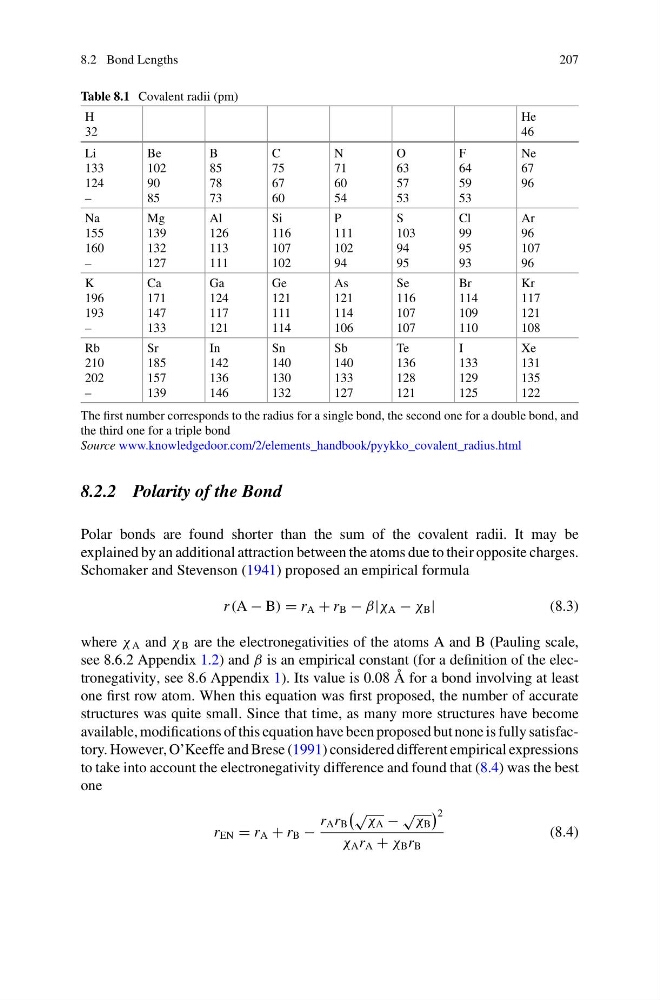
Table 8.1 Covalent radii (pm)
H
32
He
46
Li
133
124
–
Be
102
90
85
B
85
78
73
C
75
67
60
N
71
60
54
O
63
57
53
F
64
59
53
Ne
67
96
Na
155
160
–
Mg
139
132
127
Al
126
113
111
Si
116
107
102
P
111
102
94
S
103
94
95
Cl
99
95
93
Ar
96
107
96
K
196
193
–
Ca
171
147
133
Ga
124
117
121
Ge
121
111
114
As
121
114
106
Se
116
107
107
Br
114
109
110
Kr
117
121
108
Rb
210
202
–
Sr
185
157
139
In
142
136
146
Sn
140
130
132
Sb
140
133
127
Te
136
128
121
I
133
129
125
Xe
131
135
122
The first number corresponds to the radius for a single bond, the second one for a double bond, and
the third one for a triple bond
Source www.knowledgedoor.com/2/elements_handbook/pyykko_covalent_radius.html
8.2.2 Polarity of the Bond
Polar bonds are found shorter than the sum of the covalent radii. It may be
explained by an additional attraction between the atoms due to their opposite charges.
Schomaker and Stevenson (1941) proposed an empirical formula
r (A − B) = r A + r B − β|χ A − χ B |
(8.3)
where χ A and χ B are the electronegativities of the atoms A and B (Pauling scale,
see 8.6.2 Appendix 1.2) and β is an empirical constant (for a definition of the electronegativity, see 8.6 Appendix 1). Its value is 0.08 Å for a bond involving at least
one first row atom. When this equation was first proposed, the number of accurate
structures was quite small. Since that time, as many more structures have become
available, modifications of this equation have been proposed but none is fully satisfactory. However, O’Keeffe and Brese (1991) considered different empirical expressions
to take into account the electronegativity difference and found that (8.4) was the best
one
r EN = r A + r B −
r A r B
√ χ A −
√
χ B
2
χ A r A + χ B r B
(8.4)
207
Table 8.1 Covalent radii (pm)
H
32
He
46
Li
133
124
–
Be
102
90
85
B
85
78
73
C
75
67
60
N
71
60
54
O
63
57
53
F
64
59
53
Ne
67
96
Na
155
160
–
Mg
139
132
127
Al
126
113
111
Si
116
107
102
P
111
102
94
S
103
94
95
Cl
99
95
93
Ar
96
107
96
K
196
193
–
Ca
171
147
133
Ga
124
117
121
Ge
121
111
114
As
121
114
106
Se
116
107
107
Br
114
109
110
Kr
117
121
108
Rb
210
202
–
Sr
185
157
139
In
142
136
146
Sn
140
130
132
Sb
140
133
127
Te
136
128
121
I
133
129
125
Xe
131
135
122
The first number corresponds to the radius for a single bond, the second one for a double bond, and
the third one for a triple bond
Source www.knowledgedoor.com/2/elements_handbook/pyykko_covalent_radius.html
8.2.2 Polarity of the Bond
Polar bonds are found shorter than the sum of the covalent radii. It may be
explained by an additional attraction between the atoms due to their opposite charges.
Schomaker and Stevenson (1941) proposed an empirical formula
r (A − B) = r A + r B − β|χ A − χ B |
(8.3)
where χ A and χ B are the electronegativities of the atoms A and B (Pauling scale,
see 8.6.2 Appendix 1.2) and β is an empirical constant (for a definition of the electronegativity, see 8.6 Appendix 1). Its value is 0.08 Å for a bond involving at least
one first row atom. When this equation was first proposed, the number of accurate
structures was quite small. Since that time, as many more structures have become
available, modifications of this equation have been proposed but none is fully satisfactory. However, O’Keeffe and Brese (1991) considered different empirical expressions
to take into account the electronegativity difference and found that (8.4) was the best
one
r EN = r A + r B −
r A r B
√ χ A −
√
χ B
2
χ A r A + χ B r B
(8.4)