

210
8 Models of Chemical Bonding and “Empirical” Methods
Table 8.2 Some van der Waals radii (pm)
Element
Radius
Element
Radius
Element
Radius
Element
Radius
H
120
He
143
Li
212
Na
250
K
273
Rb
321
Be
198
Mg
251
Ca
262
Sr
284
B
191
Al
225
Ga
232
In
243
C
177
Si
219
Ge
229
Sn
242
N
166
P
190
As
188
Sb
247
O
150
S
189
Se
182
Te
199
F
146
Cl
182
Br
186
I
204
Ne
158
Ar
183
Kr
225
Xe
206
Source Alvarez (2013)
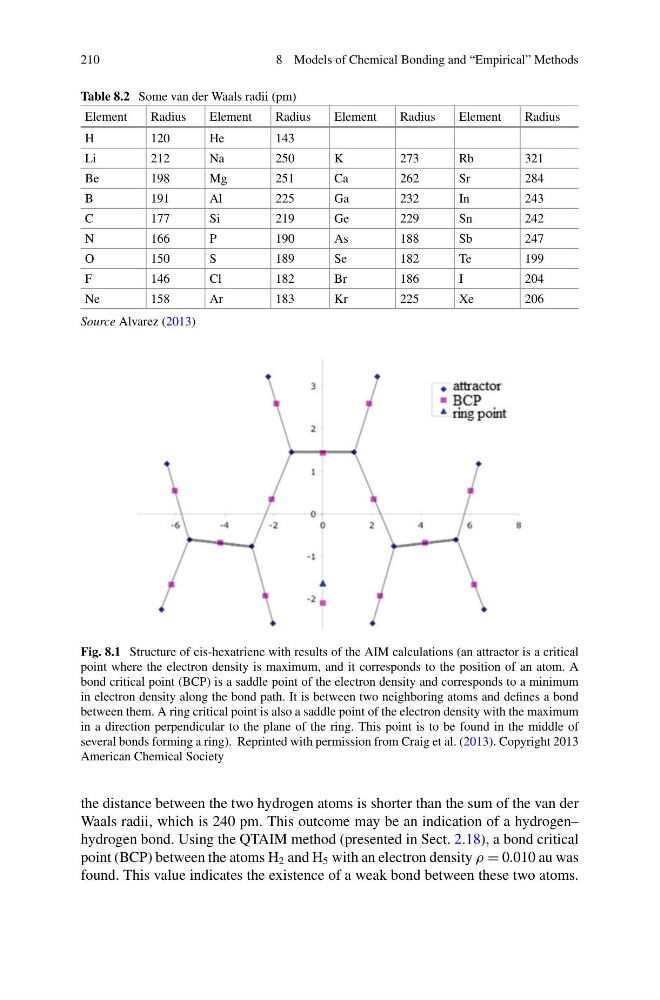
Fig. 8.1 Structure of cis-hexatriene with results of the AIM calculations (an attractor is a critical
point where the electron density is maximum, and it corresponds to the position of an atom. A
bond critical point (BCP) is a saddle point of the electron density and corresponds to a minimum
in electron density along the bond path. It is between two neighboring atoms and defines a bond
between them. A ring critical point is also a saddle point of the electron density with the maximum
in a direction perpendicular to the plane of the ring. This point is to be found in the middle of
several bonds forming a ring). Reprinted with permission from Craig et al. (2013). Copyright 2013
American Chemical Society
the distance between the two hydrogen atoms is shorter than the sum of the van der
Waals radii, which is 240 pm. This outcome may be an indication of a hydrogen–
hydrogen bond. Using the QTAIM method (presented in Sect. 2.18), a bond critical
point (BCP) between the atoms H 2 and H 5 with an electron density ρ = 0.010 au was
found. This value indicates the existence of a weak bond between these two atoms.
8 Models of Chemical Bonding and “Empirical” Methods
Table 8.2 Some van der Waals radii (pm)
Element
Radius
Element
Radius
Element
Radius
Element
Radius
H
120
He
143
Li
212
Na
250
K
273
Rb
321
Be
198
Mg
251
Ca
262
Sr
284
B
191
Al
225
Ga
232
In
243
C
177
Si
219
Ge
229
Sn
242
N
166
P
190
As
188
Sb
247
O
150
S
189
Se
182
Te
199
F
146
Cl
182
Br
186
I
204
Ne
158
Ar
183
Kr
225
Xe
206
Source Alvarez (2013)
Fig. 8.1 Structure of cis-hexatriene with results of the AIM calculations (an attractor is a critical
point where the electron density is maximum, and it corresponds to the position of an atom. A
bond critical point (BCP) is a saddle point of the electron density and corresponds to a minimum
in electron density along the bond path. It is between two neighboring atoms and defines a bond
between them. A ring critical point is also a saddle point of the electron density with the maximum
in a direction perpendicular to the plane of the ring. This point is to be found in the middle of
several bonds forming a ring). Reprinted with permission from Craig et al. (2013). Copyright 2013
American Chemical Society
the distance between the two hydrogen atoms is shorter than the sum of the van der
Waals radii, which is 240 pm. This outcome may be an indication of a hydrogen–
hydrogen bond. Using the QTAIM method (presented in Sect. 2.18), a bond critical
point (BCP) between the atoms H 2 and H 5 with an electron density ρ = 0.010 au was
found. This value indicates the existence of a weak bond between these two atoms.