

190
7 Molecular Structures from Gas-Phase Electron Diffraction
s M(s) =
s M(s, ρ)P nr (ρ)dρ,
(7.45)
where
s M(s, ρ) =
N
i> j
g i j (s)
P r (R, ρ)r
−1
i j × sin(sr i j )dR.
(7.46)
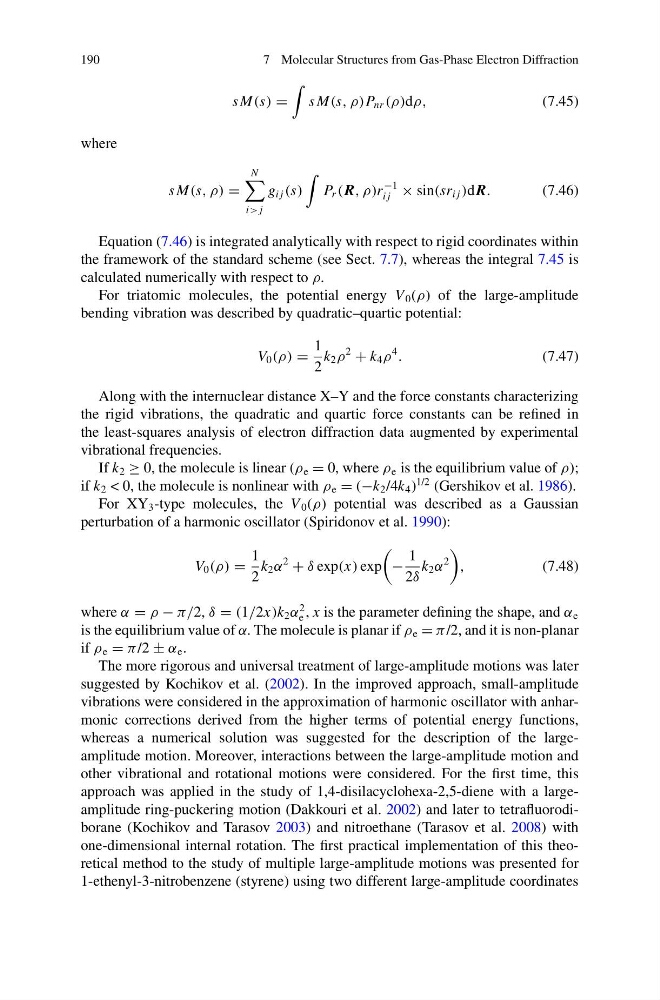
Equation (7.46) is integrated analytically with respect to rigid coordinates within
the framework of the standard scheme (see Sect. 7.7), whereas the integral 7.45 is
calculated numerically with respect to ρ.
For triatomic molecules, the potential energy V 0 (ρ) of the large-amplitude
bending vibration was described by quadratic–quartic potential:
V 0 (ρ) =
1
2
k 2 ρ
2
+ k 4 ρ
4
.
(7.47)
Along with the internuclear distance X–Y and the force constants characterizing
the rigid vibrations, the quadratic and quartic force constants can be refined in
the least-squares analysis of electron diffraction data augmented by experimental
vibrational frequencies.
If k 2 ≥ 0, the molecule is linear (ρ e = 0, where ρ e is the equilibrium value of ρ);
if k 2 < 0, the molecule is nonlinear with ρ e = (−k 2 /4k 4 )
1/2 (Gershikov et al. 1986).
For XY 3 -type molecules, the V 0 (ρ) potential was described as a Gaussian
perturbation of a harmonic oscillator (Spiridonov et al. 1990):
V 0 (ρ) =
1
2
k 2 α
2
+ δ exp(x) exp
−
1
2δ
k 2 α
2
,
(7.48)
where α = ρ − π/2, δ = (1/2x)k 2 α
2
e , x is the parameter defining the shape, and α e
is the equilibrium value of α. The molecule is planar if ρ e = π /2, and it is non-planar
if ρ e = π /2 ± α e .
The more rigorous and universal treatment of large-amplitude motions was later
suggested by Kochikov et al. (2002). In the improved approach, small-amplitude
vibrations were considered in the approximation of harmonic oscillator with anharmonic corrections derived from the higher terms of potential energy functions,
whereas a numerical solution was suggested for the description of the largeamplitude motion. Moreover, interactions between the large-amplitude motion and
other vibrational and rotational motions were considered. For the first time, this
approach was applied in the study of 1,4-disilacyclohexa-2,5-diene with a largeamplitude ring-puckering motion (Dakkouri et al. 2002) and later to tetrafluorodiborane (Kochikov and Tarasov 2003) and nitroethane (Tarasov et al. 2008) with
one-dimensional internal rotation. The first practical implementation of this theoretical method to the study of multiple large-amplitude motions was presented for
1-ethenyl-3-nitrobenzene (styrene) using two different large-amplitude coordinates
7 Molecular Structures from Gas-Phase Electron Diffraction
s M(s) =
s M(s, ρ)P nr (ρ)dρ,
(7.45)
where
s M(s, ρ) =
N
i> j
g i j (s)
P r (R, ρ)r
−1
i j × sin(sr i j )dR.
(7.46)
Equation (7.46) is integrated analytically with respect to rigid coordinates within
the framework of the standard scheme (see Sect. 7.7), whereas the integral 7.45 is
calculated numerically with respect to ρ.
For triatomic molecules, the potential energy V 0 (ρ) of the large-amplitude
bending vibration was described by quadratic–quartic potential:
V 0 (ρ) =
1
2
k 2 ρ
2
+ k 4 ρ
4
.
(7.47)
Along with the internuclear distance X–Y and the force constants characterizing
the rigid vibrations, the quadratic and quartic force constants can be refined in
the least-squares analysis of electron diffraction data augmented by experimental
vibrational frequencies.
If k 2 ≥ 0, the molecule is linear (ρ e = 0, where ρ e is the equilibrium value of ρ);
if k 2 < 0, the molecule is nonlinear with ρ e = (−k 2 /4k 4 )
1/2 (Gershikov et al. 1986).
For XY 3 -type molecules, the V 0 (ρ) potential was described as a Gaussian
perturbation of a harmonic oscillator (Spiridonov et al. 1990):
V 0 (ρ) =
1
2
k 2 α
2
+ δ exp(x) exp
−
1
2δ
k 2 α
2
,
(7.48)
where α = ρ − π/2, δ = (1/2x)k 2 α
2
e , x is the parameter defining the shape, and α e
is the equilibrium value of α. The molecule is planar if ρ e = π /2, and it is non-planar
if ρ e = π /2 ± α e .
The more rigorous and universal treatment of large-amplitude motions was later
suggested by Kochikov et al. (2002). In the improved approach, small-amplitude
vibrations were considered in the approximation of harmonic oscillator with anharmonic corrections derived from the higher terms of potential energy functions,
whereas a numerical solution was suggested for the description of the largeamplitude motion. Moreover, interactions between the large-amplitude motion and
other vibrational and rotational motions were considered. For the first time, this
approach was applied in the study of 1,4-disilacyclohexa-2,5-diene with a largeamplitude ring-puckering motion (Dakkouri et al. 2002) and later to tetrafluorodiborane (Kochikov and Tarasov 2003) and nitroethane (Tarasov et al. 2008) with
one-dimensional internal rotation. The first practical implementation of this theoretical method to the study of multiple large-amplitude motions was presented for
1-ethenyl-3-nitrobenzene (styrene) using two different large-amplitude coordinates