

7.9 Large-Amplitude Motions
191
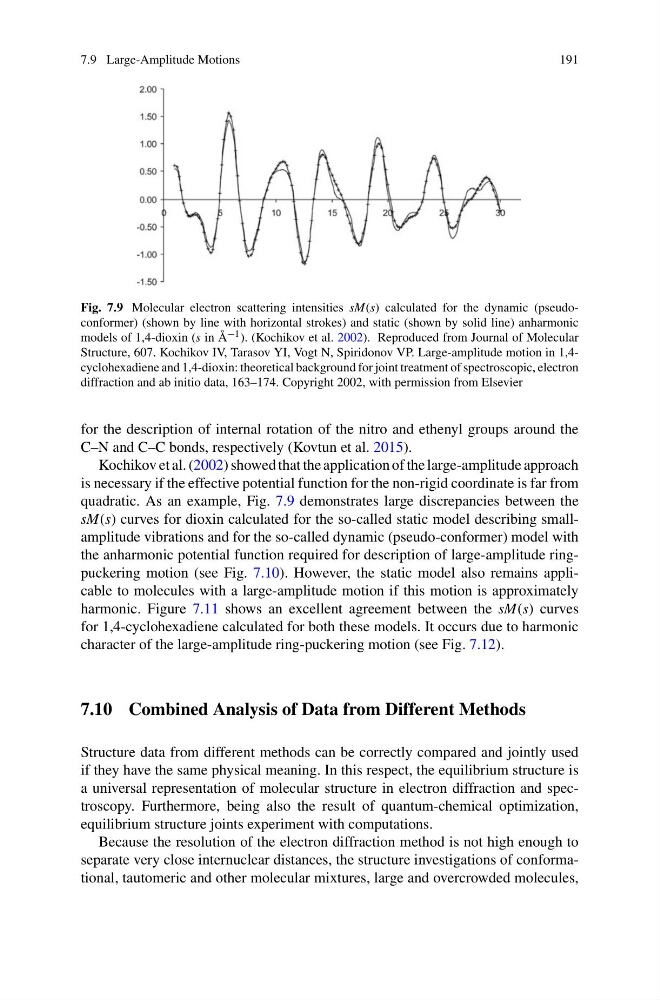
Fig. 7.9 Molecular electron scattering intensities sM(s) calculated for the dynamic (pseudoconformer) (shown by line with horizontal strokes) and static (shown by solid line) anharmonic
models of 1,4-dioxin (s in Å −1 ). (Kochikov et al. 2002). Reproduced from Journal of Molecular
Structure, 607. Kochikov IV, Tarasov YI, Vogt N, Spiridonov VP. Large-amplitude motion in 1,4cyclohexadiene and 1,4-dioxin: theoretical background for joint treatment of spectroscopic, electron
diffraction and ab initio data, 163–174. Copyright 2002, with permission from Elsevier
for the description of internal rotation of the nitro and ethenyl groups around the
C–N and C–C bonds, respectively (Kovtun et al. 2015).
Kochikov et al. (2002) showed that the application of the large-amplitude approach
is necessary if the effective potential function for the non-rigid coordinate is far from
quadratic. As an example, Fig. 7.9 demonstrates large discrepancies between the
sM(s) curves for dioxin calculated for the so-called static model describing smallamplitude vibrations and for the so-called dynamic (pseudo-conformer) model with
the anharmonic potential function required for description of large-amplitude ringpuckering motion (see Fig. 7.10). However, the static model also remains applicable to molecules with a large-amplitude motion if this motion is approximately
harmonic. Figure 7.11 shows an excellent agreement between the sM(s) curves
for 1,4-cyclohexadiene calculated for both these models. It occurs due to harmonic
character of the large-amplitude ring-puckering motion (see Fig. 7.12).
7.10 Combined Analysis of Data from Different Methods
Structure data from different methods can be correctly compared and jointly used
if they have the same physical meaning. In this respect, the equilibrium structure is
a universal representation of molecular structure in electron diffraction and spectroscopy. Furthermore, being also the result of quantum-chemical optimization,
equilibrium structure joints experiment with computations.
Because the resolution of the electron diffraction method is not high enough to
separate very close internuclear distances, the structure investigations of conformational, tautomeric and other molecular mixtures, large and overcrowded molecules,
191
Fig. 7.9 Molecular electron scattering intensities sM(s) calculated for the dynamic (pseudoconformer) (shown by line with horizontal strokes) and static (shown by solid line) anharmonic
models of 1,4-dioxin (s in Å −1 ). (Kochikov et al. 2002). Reproduced from Journal of Molecular
Structure, 607. Kochikov IV, Tarasov YI, Vogt N, Spiridonov VP. Large-amplitude motion in 1,4cyclohexadiene and 1,4-dioxin: theoretical background for joint treatment of spectroscopic, electron
diffraction and ab initio data, 163–174. Copyright 2002, with permission from Elsevier
for the description of internal rotation of the nitro and ethenyl groups around the
C–N and C–C bonds, respectively (Kovtun et al. 2015).
Kochikov et al. (2002) showed that the application of the large-amplitude approach
is necessary if the effective potential function for the non-rigid coordinate is far from
quadratic. As an example, Fig. 7.9 demonstrates large discrepancies between the
sM(s) curves for dioxin calculated for the so-called static model describing smallamplitude vibrations and for the so-called dynamic (pseudo-conformer) model with
the anharmonic potential function required for description of large-amplitude ringpuckering motion (see Fig. 7.10). However, the static model also remains applicable to molecules with a large-amplitude motion if this motion is approximately
harmonic. Figure 7.11 shows an excellent agreement between the sM(s) curves
for 1,4-cyclohexadiene calculated for both these models. It occurs due to harmonic
character of the large-amplitude ring-puckering motion (see Fig. 7.12).
7.10 Combined Analysis of Data from Different Methods
Structure data from different methods can be correctly compared and jointly used
if they have the same physical meaning. In this respect, the equilibrium structure is
a universal representation of molecular structure in electron diffraction and spectroscopy. Furthermore, being also the result of quantum-chemical optimization,
equilibrium structure joints experiment with computations.
Because the resolution of the electron diffraction method is not high enough to
separate very close internuclear distances, the structure investigations of conformational, tautomeric and other molecular mixtures, large and overcrowded molecules,