

7.9 Large-Amplitude Motions
189
where P r (r, φ) is the probability function related to the rigid frame vibrations at
the given value of large-amplitude coordinate φ. The probability function P(φ) was
usually replaced by the classical Boltzmann distribution:
P(φ) = N A exp(−V (φ)/kT ),
(7.42)
where N A is a normalization constant.
In the traditional approach of thermal-average parameters, the method of pseudoconformers was first improved by accounting for relaxation effects (Samdal 1994).
The structural parameters of molecule (internuclear distances, bond angles, and
torsional angles) were suggested to be considered as functions of a large-amplitude
coordinate according to quantum-chemical calculations.
In the modern electron diffraction analysis, the description of pseudo-conformers
is based on the equilibrium geometry related to thermal-average internuclear
distances via vibrational corrections (see Sect. 7.8). Some examples of such analysis can be found in Vogt et al. (2009, 2015). It is worth noting that the method of
pseudo-conformers, based on adiabatic separation of small- and large-amplitude
motions and initially developed for molecules with single non-rigid coordinate,
can be used for study of molecules with multiple large-amplitude motions without
additional theoretical problems. However, the study of molecules with many largeamplitude motions requires a lot of technical efforts due to noticeably larger number
of pseudo-conformers.
An alternative approach in terms of the potential energy function parameters
was initially suggested by Gershikov and Spiridonov (1986) for simplest polyatomic molecules (of XY 2 - type) with single large-amplitude bending motion. From
the standpoint of the theory developed by Hougen et al. (1970) for spectroscopy,
the rotation–bending–stretching motion Hamiltonian was separated into rotation–
bending and stretching parts instead of a rotation and bending–stretching ones, as
is customary; the single large-amplitude bending motion was described using curvilinear coordinate ρ. In this case, the coordinate distribution function is defined by
rigid and non-rigid components, P r (R, ρ) and P nr (ρ), respectively, i.e.,
P(R, ρ) = P r (R, ρ) · P nr (ρ),
(7.43)
where R = (R 1 , …, R n ) is a set of small-amplitude vibrational coordinates; ρ is the
large-amplitude coordinate, ρ = π − γ , where γ is the instantaneous value of the
Y–X–Y angle.
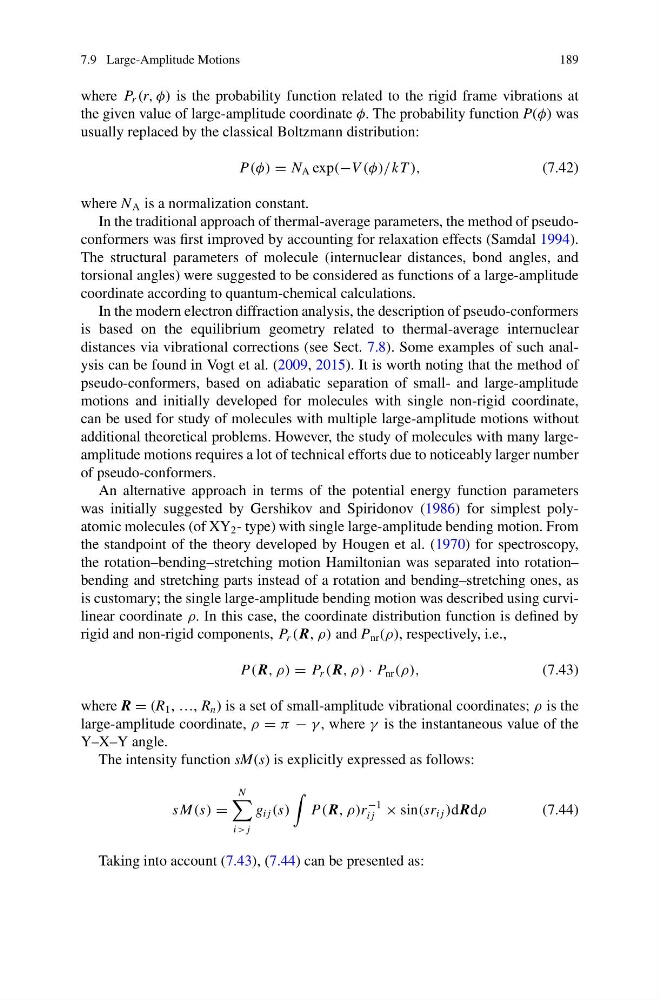
The intensity function sM(s) is explicitly expressed as follows:
s M(s) =
N
i> j
g i j (s)
P(R, ρ)r
−1
i j × sin(sr i j )dRdρ
(7.44)
Taking into account (7.43), (7.44) can be presented as:
189
where P r (r, φ) is the probability function related to the rigid frame vibrations at
the given value of large-amplitude coordinate φ. The probability function P(φ) was
usually replaced by the classical Boltzmann distribution:
P(φ) = N A exp(−V (φ)/kT ),
(7.42)
where N A is a normalization constant.
In the traditional approach of thermal-average parameters, the method of pseudoconformers was first improved by accounting for relaxation effects (Samdal 1994).
The structural parameters of molecule (internuclear distances, bond angles, and
torsional angles) were suggested to be considered as functions of a large-amplitude
coordinate according to quantum-chemical calculations.
In the modern electron diffraction analysis, the description of pseudo-conformers
is based on the equilibrium geometry related to thermal-average internuclear
distances via vibrational corrections (see Sect. 7.8). Some examples of such analysis can be found in Vogt et al. (2009, 2015). It is worth noting that the method of
pseudo-conformers, based on adiabatic separation of small- and large-amplitude
motions and initially developed for molecules with single non-rigid coordinate,
can be used for study of molecules with multiple large-amplitude motions without
additional theoretical problems. However, the study of molecules with many largeamplitude motions requires a lot of technical efforts due to noticeably larger number
of pseudo-conformers.
An alternative approach in terms of the potential energy function parameters
was initially suggested by Gershikov and Spiridonov (1986) for simplest polyatomic molecules (of XY 2 - type) with single large-amplitude bending motion. From
the standpoint of the theory developed by Hougen et al. (1970) for spectroscopy,
the rotation–bending–stretching motion Hamiltonian was separated into rotation–
bending and stretching parts instead of a rotation and bending–stretching ones, as
is customary; the single large-amplitude bending motion was described using curvilinear coordinate ρ. In this case, the coordinate distribution function is defined by
rigid and non-rigid components, P r (R, ρ) and P nr (ρ), respectively, i.e.,
P(R, ρ) = P r (R, ρ) · P nr (ρ),
(7.43)
where R = (R 1 , …, R n ) is a set of small-amplitude vibrational coordinates; ρ is the
large-amplitude coordinate, ρ = π − γ , where γ is the instantaneous value of the
Y–X–Y angle.
The intensity function sM(s) is explicitly expressed as follows:
s M(s) =
N
i> j
g i j (s)
P(R, ρ)r
−1
i j × sin(sr i j )dRdρ
(7.44)
Taking into account (7.43), (7.44) can be presented as: