

182
7 Molecular Structures from Gas-Phase Electron Diffraction
z =
1
2
n
i,k=1
a k T i
S
iik
(1 + 2δ ik ) + S
k
ii
,
χ =
1
4
n
i≤ j≤k
S
i jk a i a j a k −
1
4
p
i≤ j,k
S
k
i j a i a j a k T i T j ,
T k = coth(hcω k /2kT ),
(7.31)
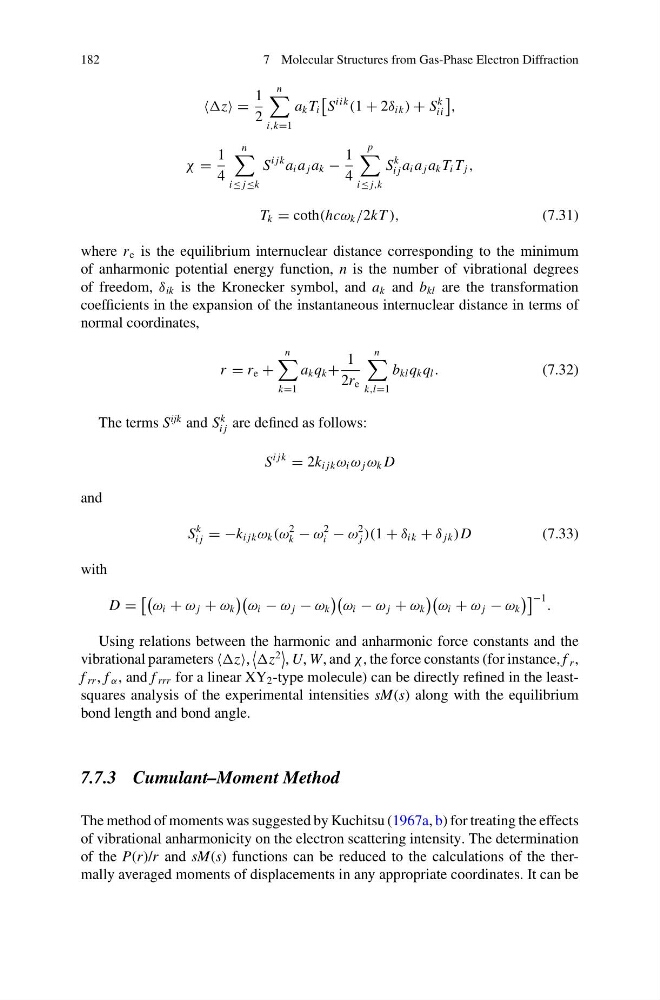
where r e is the equilibrium internuclear distance corresponding to the minimum
of anharmonic potential energy function, n is the number of vibrational degrees
of freedom, δ ik is the Kronecker symbol, and a k and b kl are the transformation
coefficients in the expansion of the instantaneous internuclear distance in terms of
normal coordinates,
r = r e +
n
k=1
a k q k +
1
2r e
n
k,l=1
b kl q k q l .
(7.32)
The terms S
ijk and S
k
i j are defined as follows:
S
i jk
= 2k i jk ω i ω j ω k D
and
S
k
i j = −k i jk ω k (ω
2
k − ω
2
i − ω
2
j )(1 + δ ik + δ jk )D
(7.33)
with
D =
ω i + ω j + ω k
ω i − ω j − ω k
ω i − ω j + ω k
ω i + ω j − ω k
−1 .
Using relations between the harmonic and anharmonic force constants and the
vibrational parameters z,
z
2
, U, W, and χ, the force constants (for instance, f r ,
f rr , f α , and f rrr for a linear XY 2 -type molecule) can be directly refined in the leastsquares analysis of the experimental intensities sM(s) along with the equilibrium
bond length and bond angle.
7.7.3 Cumulant–Moment Method
The method of moments was suggested by Kuchitsu (1967a, b) for treating the effects
of vibrational anharmonicity on the electron scattering intensity. The determination
of the P(r)/r and sM(s) functions can be reduced to the calculations of the thermally averaged moments of displacements in any appropriate coordinates. It can be
7 Molecular Structures from Gas-Phase Electron Diffraction
z =
1
2
n
i,k=1
a k T i
S
iik
(1 + 2δ ik ) + S
k
ii
,
χ =
1
4
n
i≤ j≤k
S
i jk a i a j a k −
1
4
p
i≤ j,k
S
k
i j a i a j a k T i T j ,
T k = coth(hcω k /2kT ),
(7.31)
where r e is the equilibrium internuclear distance corresponding to the minimum
of anharmonic potential energy function, n is the number of vibrational degrees
of freedom, δ ik is the Kronecker symbol, and a k and b kl are the transformation
coefficients in the expansion of the instantaneous internuclear distance in terms of
normal coordinates,
r = r e +
n
k=1
a k q k +
1
2r e
n
k,l=1
b kl q k q l .
(7.32)
The terms S
ijk and S
k
i j are defined as follows:
S
i jk
= 2k i jk ω i ω j ω k D
and
S
k
i j = −k i jk ω k (ω
2
k − ω
2
i − ω
2
j )(1 + δ ik + δ jk )D
(7.33)
with
D =
ω i + ω j + ω k
ω i − ω j − ω k
ω i − ω j + ω k
ω i + ω j − ω k
−1 .
Using relations between the harmonic and anharmonic force constants and the
vibrational parameters z,
z
2
, U, W, and χ, the force constants (for instance, f r ,
f rr , f α , and f rrr for a linear XY 2 -type molecule) can be directly refined in the leastsquares analysis of the experimental intensities sM(s) along with the equilibrium
bond length and bond angle.
7.7.3 Cumulant–Moment Method
The method of moments was suggested by Kuchitsu (1967a, b) for treating the effects
of vibrational anharmonicity on the electron scattering intensity. The determination
of the P(r)/r and sM(s) functions can be reduced to the calculations of the thermally averaged moments of displacements in any appropriate coordinates. It can be