

7.7 Determination of Molecular Structure in Terms of Potential Energy Functions
181
V =
1
2
f r [(ˆ r 1 − r e )
2
+ (ˆ r 2 − r e )
2
] + f rr (ˆ r 1 − r e )(ˆ r 2 − r e )
+
1
2
f α (r e )
2
( ˆ
α − α e )
2
+ f rrr r
−1
e [(ˆ r 1 − r e )
3
+ (ˆ r 2 − r e )
3
],
(7.28)
where ˆ
r 1 , ˆ
r 2 , and ˆ
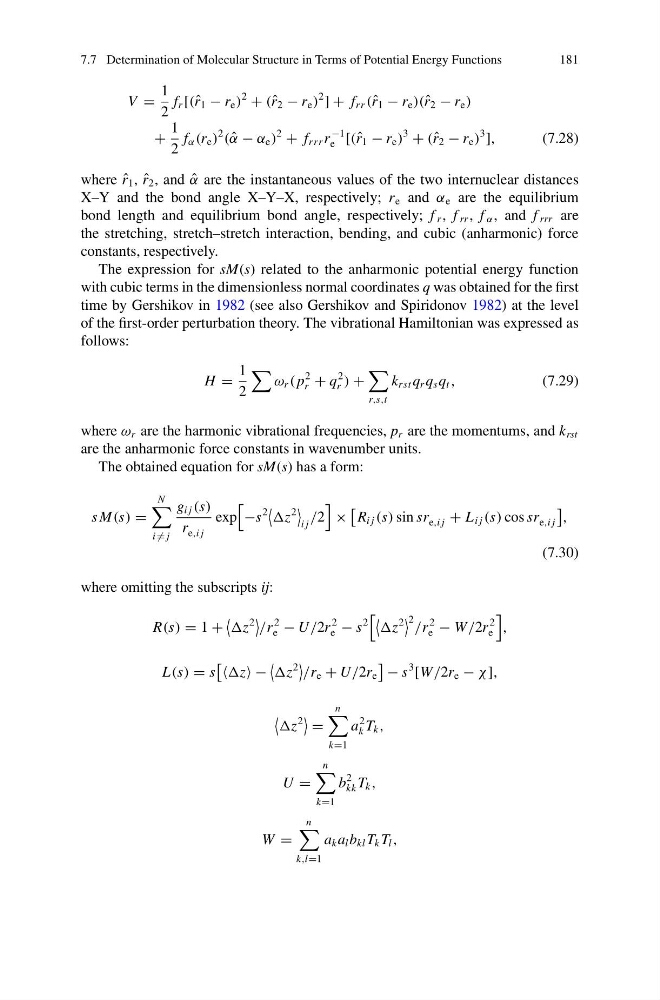
α are the instantaneous values of the two internuclear distances
X–Y and the bond angle X–Y–X, respectively; r e and α e are the equilibrium
bond length and equilibrium bond angle, respectively; f r , f rr , f α , and f rrr are
the stretching, stretch–stretch interaction, bending, and cubic (anharmonic) force
constants, respectively.
The expression for sM(s) related to the anharmonic potential energy function
with cubic terms in the dimensionless normal coordinates q was obtained for the first
time by Gershikov in 1982 (see also Gershikov and Spiridonov 1982) at the level
of the first-order perturbation theory. The vibrational Hamiltonian was expressed as
follows:
H =
1
2
ω r ( p
2
r + q
2
r ) +
r,s,t
k rst q r q s q t ,
(7.29)
where ω r are the harmonic vibrational frequencies, p r are the momentums, and k rst
are the anharmonic force constants in wavenumber units.
The obtained equation for sM(s) has a form:
s M(s) =
N
i = j
g i j (s)
r e,i j
exp
−s
2
z
2
i j
/2
×
R i j (s) sin sr e,i j + L i j (s) cos sr e,i j
,
(7.30)
where omitting the subscripts ij:
R(s) = 1 +
z
2
/r
2
e − U/2r
2
e − s
2
z
2
2 /r
2
e − W/2r
2
e
,
L(s) = s
z −
z
2
/r e + U/2r e
− s
3 [W/2r e − χ ],
z
2
=
n
k=1
a
2
k T k ,
U =
n
k=1
b
2
kk T k ,
W =
n
k,l=1
a k a l b kl T k T l ,
181
V =
1
2
f r [(ˆ r 1 − r e )
2
+ (ˆ r 2 − r e )
2
] + f rr (ˆ r 1 − r e )(ˆ r 2 − r e )
+
1
2
f α (r e )
2
( ˆ
α − α e )
2
+ f rrr r
−1
e [(ˆ r 1 − r e )
3
+ (ˆ r 2 − r e )
3
],
(7.28)
where ˆ
r 1 , ˆ
r 2 , and ˆ
α are the instantaneous values of the two internuclear distances
X–Y and the bond angle X–Y–X, respectively; r e and α e are the equilibrium
bond length and equilibrium bond angle, respectively; f r , f rr , f α , and f rrr are
the stretching, stretch–stretch interaction, bending, and cubic (anharmonic) force
constants, respectively.
The expression for sM(s) related to the anharmonic potential energy function
with cubic terms in the dimensionless normal coordinates q was obtained for the first
time by Gershikov in 1982 (see also Gershikov and Spiridonov 1982) at the level
of the first-order perturbation theory. The vibrational Hamiltonian was expressed as
follows:
H =
1
2
ω r ( p
2
r + q
2
r ) +
r,s,t
k rst q r q s q t ,
(7.29)
where ω r are the harmonic vibrational frequencies, p r are the momentums, and k rst
are the anharmonic force constants in wavenumber units.
The obtained equation for sM(s) has a form:
s M(s) =
N
i = j
g i j (s)
r e,i j
exp
−s
2
z
2
i j
/2
×
R i j (s) sin sr e,i j + L i j (s) cos sr e,i j
,
(7.30)
where omitting the subscripts ij:
R(s) = 1 +
z
2
/r
2
e − U/2r
2
e − s
2
z
2
2 /r
2
e − W/2r
2
e
,
L(s) = s
z −
z
2
/r e + U/2r e
− s
3 [W/2r e − χ ],
z
2
=
n
k=1
a
2
k T k ,
U =
n
k=1
b
2
kk T k ,
W =
n
k,l=1
a k a l b kl T k T l ,