

7.7 Determination of Molecular Structure in Terms of Potential Energy Functions
183
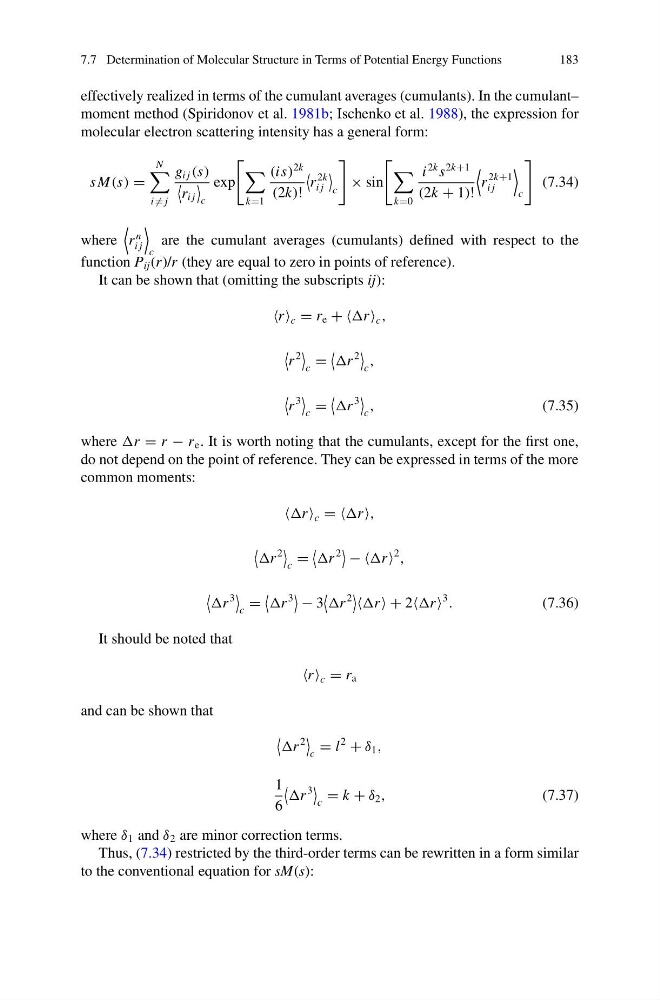
effectively realized in terms of the cumulant averages (cumulants). In the cumulant–
moment method (Spiridonov et al. 1981b; Ischenko et al. 1988), the expression for
molecular electron scattering intensity has a general form:
s M(s) =
N
i = j
g i j (s)
r i j
c
exp
k=1
(is)
2k
(2k)!
r
2k
i j
c
× sin
k=0
i
2k s
2k+1
(2k + 1)!
r
2k+1
i j
c
(7.34)
where
r
n
i j
c
are the cumulant averages (cumulants) defined with respect to the
function P ij (r)/r (they are equal to zero in points of reference).
It can be shown that (omitting the subscripts ij):
r c = r e + r c ,
r
2
c
=
r
2
c
,
r
3
c
=
r
3
c
,
(7.35)
where r = r − r e . It is worth noting that the cumulants, except for the first one,
do not depend on the point of reference. They can be expressed in terms of the more
common moments:
r c = r ,
r
2
c
=
r
2
− r
2
,
r
3
c
=
r
3
− 3
r
2
r + 2r
3
.
(7.36)
It should be noted that
r c = r a
and can be shown that
r
2
c
= l
2
+ δ 1 ,
1
6
r
3
c
= k + δ 2 ,
(7.37)
where δ 1 and δ 2 are minor correction terms.
Thus, (7.34) restricted by the third-order terms can be rewritten in a form similar
to the conventional equation for sM(s):
183
effectively realized in terms of the cumulant averages (cumulants). In the cumulant–
moment method (Spiridonov et al. 1981b; Ischenko et al. 1988), the expression for
molecular electron scattering intensity has a general form:
s M(s) =
N
i = j
g i j (s)
r i j
c
exp
k=1
(is)
2k
(2k)!
r
2k
i j
c
× sin
k=0
i
2k s
2k+1
(2k + 1)!
r
2k+1
i j
c
(7.34)
where
r
n
i j
c
are the cumulant averages (cumulants) defined with respect to the
function P ij (r)/r (they are equal to zero in points of reference).
It can be shown that (omitting the subscripts ij):
r c = r e + r c ,
r
2
c
=
r
2
c
,
r
3
c
=
r
3
c
,
(7.35)
where r = r − r e . It is worth noting that the cumulants, except for the first one,
do not depend on the point of reference. They can be expressed in terms of the more
common moments:
r c = r ,
r
2
c
=
r
2
− r
2
,
r
3
c
=
r
3
− 3
r
2
r + 2r
3
.
(7.36)
It should be noted that
r c = r a
and can be shown that
r
2
c
= l
2
+ δ 1 ,
1
6
r
3
c
= k + δ 2 ,
(7.37)
where δ 1 and δ 2 are minor correction terms.
Thus, (7.34) restricted by the third-order terms can be rewritten in a form similar
to the conventional equation for sM(s):