

7.4 Main Theoretical Expressions
177
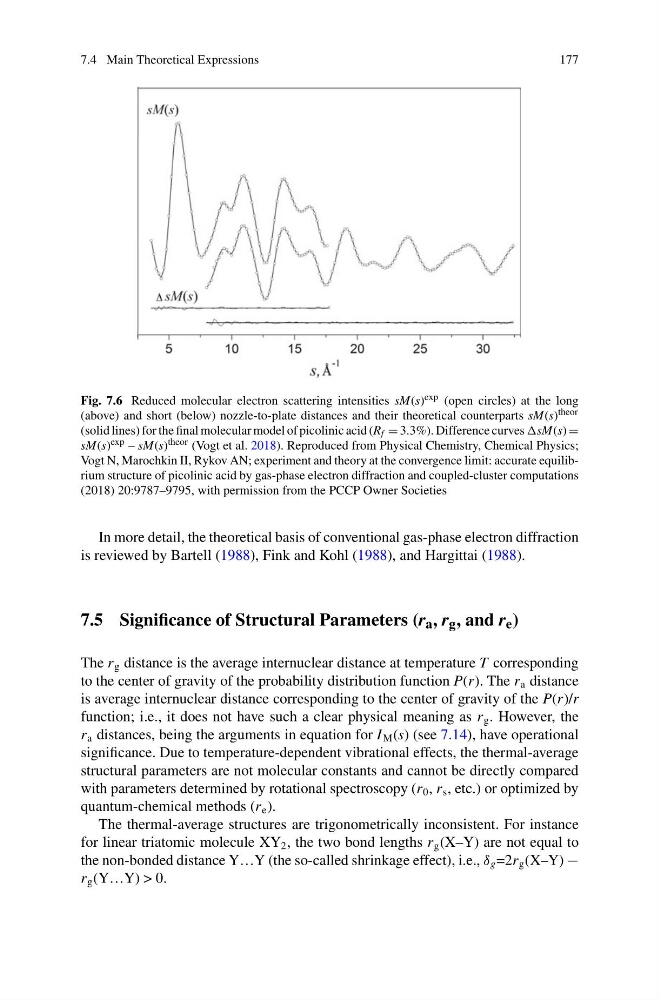
Fig. 7.6 Reduced molecular electron scattering intensities sM(s) exp (open circles) at the long
(above) and short (below) nozzle-to-plate distances and their theoretical counterparts sM(s) theor
(solid lines) for the final molecular model of picolinic acid (R f = 3.3%). Difference curves sM(s) =
sM(s) exp – sM(s) theor (Vogt et al. 2018). Reproduced from Physical Chemistry, Chemical Physics;
Vogt N, Marochkin II, Rykov AN; experiment and theory at the convergence limit: accurate equilibrium structure of picolinic acid by gas-phase electron diffraction and coupled-cluster computations
(2018) 20:9787–9795, with permission from the PCCP Owner Societies
In more detail, the theoretical basis of conventional gas-phase electron diffraction
is reviewed by Bartell (1988), Fink and Kohl (1988), and Hargittai (1988).
7.5 Significance of Structural Parameters (r a , r g , and r e )
The r g distance is the average internuclear distance at temperature T corresponding
to the center of gravity of the probability distribution function P(r). The r a distance
is average internuclear distance corresponding to the center of gravity of the P(r)/r
function; i.e., it does not have such a clear physical meaning as r g . However, the
r a distances, being the arguments in equation for I M (s) (see 7.14), have operational
significance. Due to temperature-dependent vibrational effects, the thermal-average
structural parameters are not molecular constants and cannot be directly compared
with parameters determined by rotational spectroscopy (r 0 , r s , etc.) or optimized by
quantum-chemical methods (r e ).
The thermal-average structures are trigonometrically inconsistent. For instance
for linear triatomic molecule XY 2 , the two bond lengths r g (X–Y) are not equal to
the non-bonded distance Y…Y (the so-called shrinkage effect), i.e., δ g =2r g (X–Y) −
r g (Y…Y) > 0.
177
Fig. 7.6 Reduced molecular electron scattering intensities sM(s) exp (open circles) at the long
(above) and short (below) nozzle-to-plate distances and their theoretical counterparts sM(s) theor
(solid lines) for the final molecular model of picolinic acid (R f = 3.3%). Difference curves sM(s) =
sM(s) exp – sM(s) theor (Vogt et al. 2018). Reproduced from Physical Chemistry, Chemical Physics;
Vogt N, Marochkin II, Rykov AN; experiment and theory at the convergence limit: accurate equilibrium structure of picolinic acid by gas-phase electron diffraction and coupled-cluster computations
(2018) 20:9787–9795, with permission from the PCCP Owner Societies
In more detail, the theoretical basis of conventional gas-phase electron diffraction
is reviewed by Bartell (1988), Fink and Kohl (1988), and Hargittai (1988).
7.5 Significance of Structural Parameters (r a , r g , and r e )
The r g distance is the average internuclear distance at temperature T corresponding
to the center of gravity of the probability distribution function P(r). The r a distance
is average internuclear distance corresponding to the center of gravity of the P(r)/r
function; i.e., it does not have such a clear physical meaning as r g . However, the
r a distances, being the arguments in equation for I M (s) (see 7.14), have operational
significance. Due to temperature-dependent vibrational effects, the thermal-average
structural parameters are not molecular constants and cannot be directly compared
with parameters determined by rotational spectroscopy (r 0 , r s , etc.) or optimized by
quantum-chemical methods (r e ).
The thermal-average structures are trigonometrically inconsistent. For instance
for linear triatomic molecule XY 2 , the two bond lengths r g (X–Y) are not equal to
the non-bonded distance Y…Y (the so-called shrinkage effect), i.e., δ g =2r g (X–Y) −
r g (Y…Y) > 0.