

176
7 Molecular Structures from Gas-Phase Electron Diffraction
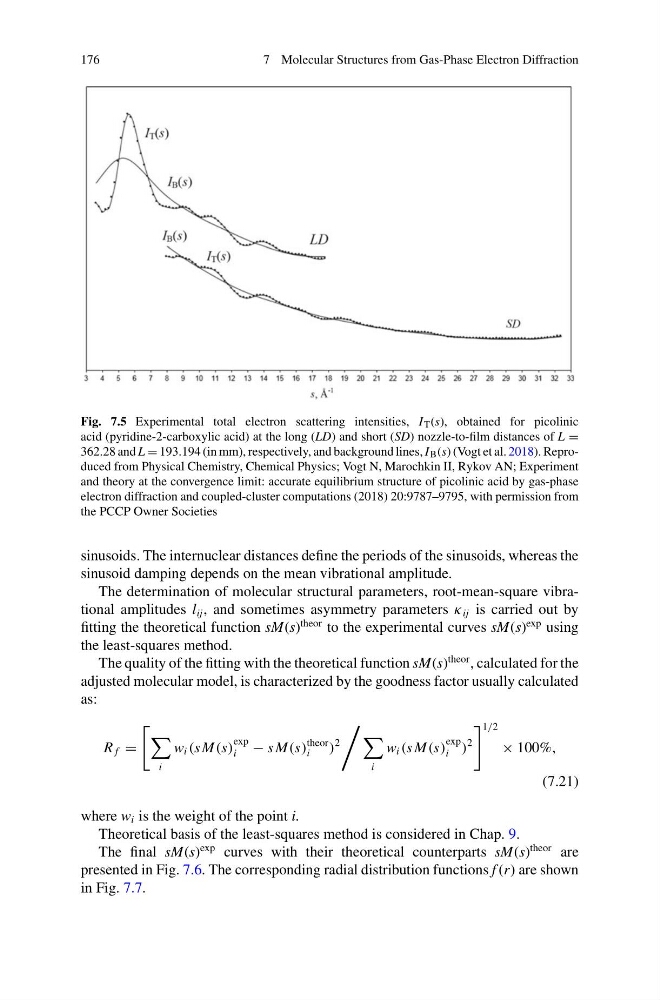
Fig. 7.5 Experimental total electron scattering intensities, I T (s), obtained for picolinic
acid (pyridine-2-carboxylic acid) at the long (LD) and short (SD) nozzle-to-film distances of L =
362.28 and L = 193.194 (in mm), respectively, and background lines, I B (s) (Vogt et al. 2018). Reproduced from Physical Chemistry, Chemical Physics; Vogt N, Marochkin II, Rykov AN; Experiment
and theory at the convergence limit: accurate equilibrium structure of picolinic acid by gas-phase
electron diffraction and coupled-cluster computations (2018) 20:9787–9795, with permission from
the PCCP Owner Societies
sinusoids. The internuclear distances define the periods of the sinusoids, whereas the
sinusoid damping depends on the mean vibrational amplitude.
The determination of molecular structural parameters, root-mean-square vibrational amplitudes l ij , and sometimes asymmetry parameters κ ij is carried out by
fitting the theoretical function sM(s)
theor to the experimental curves sM(s)
exp using
the least-squares method.
The quality of the fitting with the theoretical function sM(s)
theor , calculated for the
adjusted molecular model, is characterized by the goodness factor usually calculated
as:
R f =
i
w i (s M(s)
exp
i
− s M(s)
theor
i
)
2
i
w i (s M(s)
exp
i )
2
1/2
× 100%,
(7.21)
where w i is the weight of the point i.
Theoretical basis of the least-squares method is considered in Chap. 9.
The final sM(s)
exp curves with their theoretical counterparts sM(s)
theor are
presented in Fig. 7.6. The corresponding radial distribution functions f (r) are shown
in Fig. 7.7.
7 Molecular Structures from Gas-Phase Electron Diffraction
Fig. 7.5 Experimental total electron scattering intensities, I T (s), obtained for picolinic
acid (pyridine-2-carboxylic acid) at the long (LD) and short (SD) nozzle-to-film distances of L =
362.28 and L = 193.194 (in mm), respectively, and background lines, I B (s) (Vogt et al. 2018). Reproduced from Physical Chemistry, Chemical Physics; Vogt N, Marochkin II, Rykov AN; Experiment
and theory at the convergence limit: accurate equilibrium structure of picolinic acid by gas-phase
electron diffraction and coupled-cluster computations (2018) 20:9787–9795, with permission from
the PCCP Owner Societies
sinusoids. The internuclear distances define the periods of the sinusoids, whereas the
sinusoid damping depends on the mean vibrational amplitude.
The determination of molecular structural parameters, root-mean-square vibrational amplitudes l ij , and sometimes asymmetry parameters κ ij is carried out by
fitting the theoretical function sM(s)
theor to the experimental curves sM(s)
exp using
the least-squares method.
The quality of the fitting with the theoretical function sM(s)
theor , calculated for the
adjusted molecular model, is characterized by the goodness factor usually calculated
as:
R f =
i
w i (s M(s)
exp
i
− s M(s)
theor
i
)
2
i
w i (s M(s)
exp
i )
2
1/2
× 100%,
(7.21)
where w i is the weight of the point i.
Theoretical basis of the least-squares method is considered in Chap. 9.
The final sM(s)
exp curves with their theoretical counterparts sM(s)
theor are
presented in Fig. 7.6. The corresponding radial distribution functions f (r) are shown
in Fig. 7.7.