

5.6 Anharmonicity
119
V (Q) =
1
2
k
λ k Q
2
k +
1
6
kst
kst Q k Q s Q t +
1
24
kstu
kstu Q k Q s Q t Q u + · · ·
(5.39)
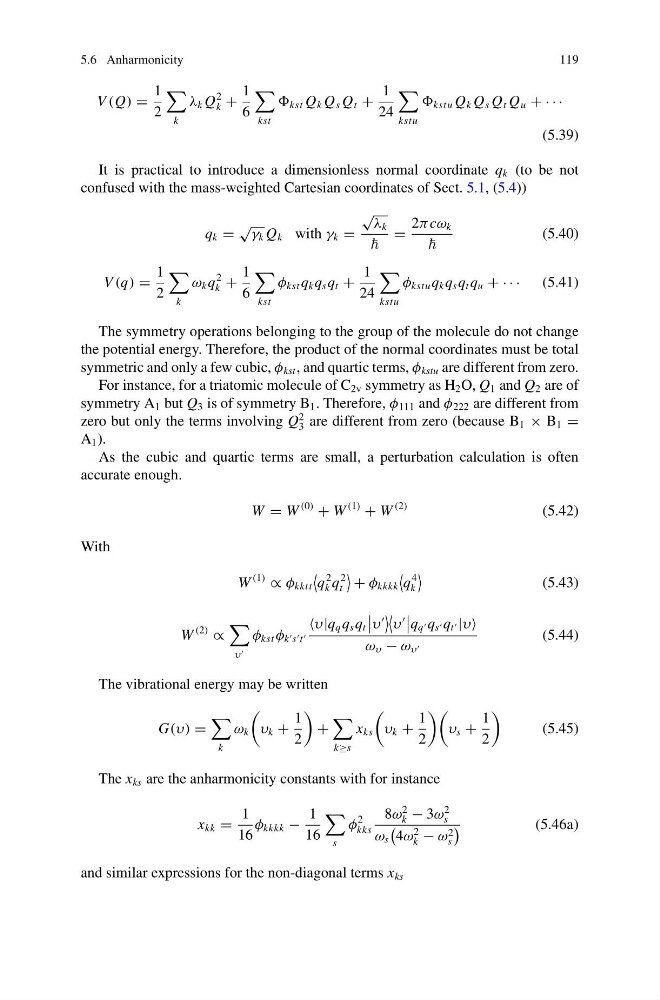
It is practical to introduce a dimensionless normal coordinate q k (to be not
confused with the mass-weighted Cartesian coordinates of Sect. 5.1, (5.4))
q k =
√
γ k Q k with γ k =
√
λ k
=
2π cω k
(5.40)
V (q) =
1
2
k
ω k q
2
k +
1
6
kst
φ kst q k q s q t +
1
24
kstu
φ kstu q k q s q t q u + · · ·
(5.41)
The symmetry operations belonging to the group of the molecule do not change
the potential energy. Therefore, the product of the normal coordinates must be total
symmetric and only a few cubic, φ kst , and quartic terms, φ kstu are different from zero.
For instance, for a triatomic molecule of C 2v symmetry as H 2 O, Q 1 and Q 2 are of
symmetry A 1 but Q 3 is of symmetry B 1 . Therefore, φ 111 and φ 222 are different from
zero but only the terms involving Q
2
3 are different from zero (because B 1 × B 1 =
A 1 ).
As the cubic and quartic terms are small, a perturbation calculation is often
accurate enough.
W = W
(0)
+ W
(1)
+ W
(2)
(5.42)
With
W
(1)
∝ φ kktt
q
2
k q
2
t
+ φ kkkk
q
4
k
(5.43)
W
(2)
∝
υ
φ kst φ k s t
υ|q q q s q t
υ
υ
q q q s q t |υ
ω υ − ω υ
(5.44)
The vibrational energy may be written
G(υ) =
k
ω k
υ k +
1
2
+
k≥s
x ks
υ k +
1
2
υ s +
1
2
(5.45)
The x ks are the anharmonicity constants with for instance
x kk =
1
16
φ kkkk −
1
16
s
φ
2
kks
8ω
2
k − 3ω
2
s
ω s
4ω
2
k − ω 2
s
(5.46a)
and similar expressions for the non-diagonal terms x ks
119
V (Q) =
1
2
k
λ k Q
2
k +
1
6
kst
kst Q k Q s Q t +
1
24
kstu
kstu Q k Q s Q t Q u + · · ·
(5.39)
It is practical to introduce a dimensionless normal coordinate q k (to be not
confused with the mass-weighted Cartesian coordinates of Sect. 5.1, (5.4))
q k =
√
γ k Q k with γ k =
√
λ k
=
2π cω k
(5.40)
V (q) =
1
2
k
ω k q
2
k +
1
6
kst
φ kst q k q s q t +
1
24
kstu
φ kstu q k q s q t q u + · · ·
(5.41)
The symmetry operations belonging to the group of the molecule do not change
the potential energy. Therefore, the product of the normal coordinates must be total
symmetric and only a few cubic, φ kst , and quartic terms, φ kstu are different from zero.
For instance, for a triatomic molecule of C 2v symmetry as H 2 O, Q 1 and Q 2 are of
symmetry A 1 but Q 3 is of symmetry B 1 . Therefore, φ 111 and φ 222 are different from
zero but only the terms involving Q
2
3 are different from zero (because B 1 × B 1 =
A 1 ).
As the cubic and quartic terms are small, a perturbation calculation is often
accurate enough.
W = W
(0)
+ W
(1)
+ W
(2)
(5.42)
With
W
(1)
∝ φ kktt
q
2
k q
2
t
+ φ kkkk
q
4
k
(5.43)
W
(2)
∝
υ
φ kst φ k s t
υ|q q q s q t
υ
υ
q q q s q t |υ
ω υ − ω υ
(5.44)
The vibrational energy may be written
G(υ) =
k
ω k
υ k +
1
2
+
k≥s
x ks
υ k +
1
2
υ s +
1
2
(5.45)
The x ks are the anharmonicity constants with for instance
x kk =
1
16
φ kkkk −
1
16
s
φ
2
kks
8ω
2
k − 3ω
2
s
ω s
4ω
2
k − ω 2
s
(5.46a)
and similar expressions for the non-diagonal terms x ks