

120
5 The Vibrations of Polyatomic Molecules
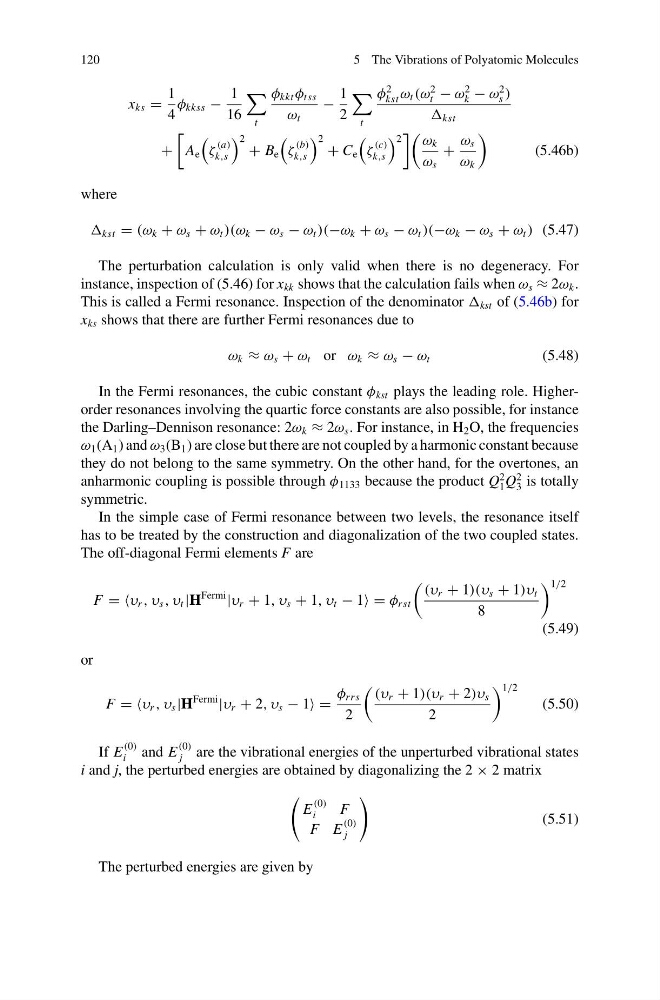
x ks =
1
4
φ kkss −
1
16
t
φ kkt φ tss
ω t
−
1
2
t
φ
2
kst ω t (ω
2
t − ω
2
k − ω
2
s )
kst
+
A e
ζ
(a)
k,s
2 + B e
ζ
(b)
k,s
2 + C e
ζ
(c)
k,s
2
ω k
ω s
+
ω s
ω k
(5.46b)
where
kst = (ω k + ω s + ω t )(ω k − ω s − ω t )(−ω k + ω s − ω t )(−ω k − ω s + ω t ) (5.47)
The perturbation calculation is only valid when there is no degeneracy. For
instance, inspection of (5.46) for x kk shows that the calculation fails when ω s ≈ 2ω k .
This is called a Fermi resonance. Inspection of the denominator kst of (5.46b) for
x ks shows that there are further Fermi resonances due to
ω k ≈ ω s + ω t or ω k ≈ ω s − ω t
(5.48)
In the Fermi resonances, the cubic constant φ kst plays the leading role. Higherorder resonances involving the quartic force constants are also possible, for instance
the Darling–Dennison resonance: 2ω k ≈ 2ω s . For instance, in H 2 O, the frequencies
ω 1 (A 1 ) and ω 3 (B 1 ) are close but there are not coupled by a harmonic constant because
they do not belong to the same symmetry. On the other hand, for the overtones, an
anharmonic coupling is possible through φ 1133 because the product Q
2
1 Q
2
3 is totally
symmetric.
In the simple case of Fermi resonance between two levels, the resonance itself
has to be treated by the construction and diagonalization of the two coupled states.
The off-diagonal Fermi elements F are
F = υ r , υ s , υ t |H
Fermi
|υ r + 1, υ s + 1, υ t − 1 = φ rst
(υ r + 1)(υ s + 1)υ t
8
1/2
(5.49)
or
F = υ r , υ s |H
Fermi
|υ r + 2, υ s − 1 =
φ rrs
2
(υ r + 1)(υ r + 2)υ s
2
1/2
(5.50)
If E
(0)
i and E
(0)
j are the vibrational energies of the unperturbed vibrational states
i and j, the perturbed energies are obtained by diagonalizing the 2 × 2 matrix
E
(0)
i
F
F E
(0)
j
(5.51)
The perturbed energies are given by
5 The Vibrations of Polyatomic Molecules
x ks =
1
4
φ kkss −
1
16
t
φ kkt φ tss
ω t
−
1
2
t
φ
2
kst ω t (ω
2
t − ω
2
k − ω
2
s )
kst
+
A e
ζ
(a)
k,s
2 + B e
ζ
(b)
k,s
2 + C e
ζ
(c)
k,s
2
ω k
ω s
+
ω s
ω k
(5.46b)
where
kst = (ω k + ω s + ω t )(ω k − ω s − ω t )(−ω k + ω s − ω t )(−ω k − ω s + ω t ) (5.47)
The perturbation calculation is only valid when there is no degeneracy. For
instance, inspection of (5.46) for x kk shows that the calculation fails when ω s ≈ 2ω k .
This is called a Fermi resonance. Inspection of the denominator kst of (5.46b) for
x ks shows that there are further Fermi resonances due to
ω k ≈ ω s + ω t or ω k ≈ ω s − ω t
(5.48)
In the Fermi resonances, the cubic constant φ kst plays the leading role. Higherorder resonances involving the quartic force constants are also possible, for instance
the Darling–Dennison resonance: 2ω k ≈ 2ω s . For instance, in H 2 O, the frequencies
ω 1 (A 1 ) and ω 3 (B 1 ) are close but there are not coupled by a harmonic constant because
they do not belong to the same symmetry. On the other hand, for the overtones, an
anharmonic coupling is possible through φ 1133 because the product Q
2
1 Q
2
3 is totally
symmetric.
In the simple case of Fermi resonance between two levels, the resonance itself
has to be treated by the construction and diagonalization of the two coupled states.
The off-diagonal Fermi elements F are
F = υ r , υ s , υ t |H
Fermi
|υ r + 1, υ s + 1, υ t − 1 = φ rst
(υ r + 1)(υ s + 1)υ t
8
1/2
(5.49)
or
F = υ r , υ s |H
Fermi
|υ r + 2, υ s − 1 =
φ rrs
2
(υ r + 1)(υ r + 2)υ s
2
1/2
(5.50)
If E
(0)
i and E
(0)
j are the vibrational energies of the unperturbed vibrational states
i and j, the perturbed energies are obtained by diagonalizing the 2 × 2 matrix
E
(0)
i
F
F E
(0)
j
(5.51)
The perturbed energies are given by