

118
5 The Vibrations of Polyatomic Molecules
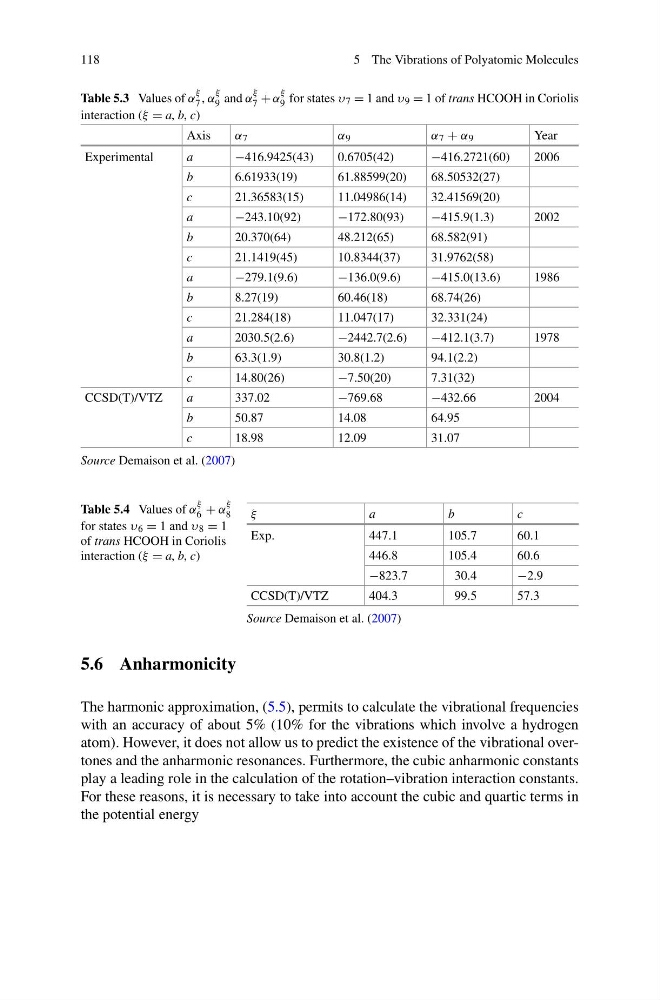
Table 5.3 Values of α
ξ
7 , α
ξ
9 and α
ξ
7 + α
ξ
9 for states υ 7 = 1 and υ 9 = 1 of trans HCOOH in Coriolis
interaction (ξ = a, b, c)
Axis
α 7
α 9
α 7 + α 9
Year
Experimental
a
−416.9425(43)
0.6705(42)
−416.2721(60)
2006
b
6.61933(19)
61.88599(20)
68.50532(27)
c
21.36583(15)
11.04986(14)
32.41569(20)
a
−243.10(92)
−172.80(93)
−415.9(1.3)
2002
b
20.370(64)
48.212(65)
68.582(91)
c
21.1419(45)
10.8344(37)
31.9762(58)
a
−279.1(9.6)
−136.0(9.6)
−415.0(13.6)
1986
b
8.27(19)
60.46(18)
68.74(26)
c
21.284(18)
11.047(17)
32.331(24)
a
2030.5(2.6)
−2442.7(2.6)
−412.1(3.7)
1978
b
63.3(1.9)
30.8(1.2)
94.1(2.2)
c
14.80(26)
−7.50(20)
7.31(32)
CCSD(T)/VTZ
a
337.02
−769.68
−432.66
2004
b
50.87
14.08
64.95
c
18.98
12.09
31.07
Source Demaison et al. (2007)
Table 5.4 Values of α
ξ
6 + α
ξ
8
for states υ 6 = 1 and υ 8 = 1
of trans HCOOH in Coriolis
interaction (ξ = a, b, c)
ξ
a
b
c
Exp.
447.1
105.7
60.1
446.8
105.4
60.6
−823.7
30.4
−2.9
CCSD(T)/VTZ
404.3
99.5
57.3
Source Demaison et al. (2007)
5.6 Anharmonicity
The harmonic approximation, (5.5), permits to calculate the vibrational frequencies
with an accuracy of about 5% (10% for the vibrations which involve a hydrogen
atom). However, it does not allow us to predict the existence of the vibrational overtones and the anharmonic resonances. Furthermore, the cubic anharmonic constants
play a leading role in the calculation of the rotation–vibration interaction constants.
For these reasons, it is necessary to take into account the cubic and quartic terms in
the potential energy
5 The Vibrations of Polyatomic Molecules
Table 5.3 Values of α
ξ
7 , α
ξ
9 and α
ξ
7 + α
ξ
9 for states υ 7 = 1 and υ 9 = 1 of trans HCOOH in Coriolis
interaction (ξ = a, b, c)
Axis
α 7
α 9
α 7 + α 9
Year
Experimental
a
−416.9425(43)
0.6705(42)
−416.2721(60)
2006
b
6.61933(19)
61.88599(20)
68.50532(27)
c
21.36583(15)
11.04986(14)
32.41569(20)
a
−243.10(92)
−172.80(93)
−415.9(1.3)
2002
b
20.370(64)
48.212(65)
68.582(91)
c
21.1419(45)
10.8344(37)
31.9762(58)
a
−279.1(9.6)
−136.0(9.6)
−415.0(13.6)
1986
b
8.27(19)
60.46(18)
68.74(26)
c
21.284(18)
11.047(17)
32.331(24)
a
2030.5(2.6)
−2442.7(2.6)
−412.1(3.7)
1978
b
63.3(1.9)
30.8(1.2)
94.1(2.2)
c
14.80(26)
−7.50(20)
7.31(32)
CCSD(T)/VTZ
a
337.02
−769.68
−432.66
2004
b
50.87
14.08
64.95
c
18.98
12.09
31.07
Source Demaison et al. (2007)
Table 5.4 Values of α
ξ
6 + α
ξ
8
for states υ 6 = 1 and υ 8 = 1
of trans HCOOH in Coriolis
interaction (ξ = a, b, c)
ξ
a
b
c
Exp.
447.1
105.7
60.1
446.8
105.4
60.6
−823.7
30.4
−2.9
CCSD(T)/VTZ
404.3
99.5
57.3
Source Demaison et al. (2007)
5.6 Anharmonicity
The harmonic approximation, (5.5), permits to calculate the vibrational frequencies
with an accuracy of about 5% (10% for the vibrations which involve a hydrogen
atom). However, it does not allow us to predict the existence of the vibrational overtones and the anharmonic resonances. Furthermore, the cubic anharmonic constants
play a leading role in the calculation of the rotation–vibration interaction constants.
For these reasons, it is necessary to take into account the cubic and quartic terms in
the potential energy