

114
5 The Vibrations of Polyatomic Molecules
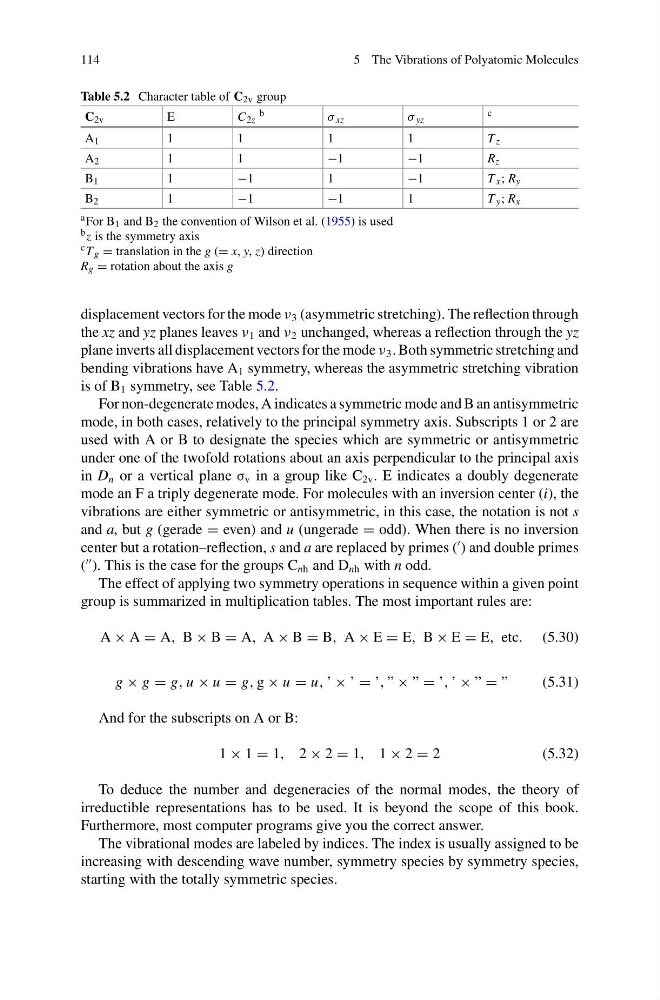
Table 5.2 Character table of C 2v group
C 2v
E
C 2z
b
σ xz
σ yz
c
A 1
1
1
1
1
T z
A 2
1
1
−1
−1
R z
B 1
1
−1
1
−1
T x ; R y
B 2
1
−1
−1
1
T y ; R x
a For B 1 and B 2 the convention of Wilson et al. (1955) is used
b z is the symmetry axis
c T g = translation in the g (= x, y, z) direction
R g = rotation about the axis g
displacement vectors for the mode ν 3 (asymmetric stretching). The reflection through
the xz and yz planes leaves ν 1 and ν 2 unchanged, whereas a reflection through the yz
plane inverts all displacement vectors for the mode ν 3 . Both symmetric stretching and
bending vibrations have A 1 symmetry, whereas the asymmetric stretching vibration
is of B 1 symmetry, see Table 5.2.
For non-degenerate modes, A indicates a symmetric mode and B an antisymmetric
mode, in both cases, relatively to the principal symmetry axis. Subscripts 1 or 2 are
used with A or B to designate the species which are symmetric or antisymmetric
under one of the twofold rotations about an axis perpendicular to the principal axis
in D n or a vertical plane σ v in a group like C 2v . E indicates a doubly degenerate
mode an F a triply degenerate mode. For molecules with an inversion center (i), the
vibrations are either symmetric or antisymmetric, in this case, the notation is not s
and a, but g (gerade = even) and u (ungerade = odd). When there is no inversion
center but a rotation–reflection, s and a are replaced by primes (
) and double primes
(
). This is the case for the groups C nh and D nh with n odd.
The effect of applying two symmetry operations in sequence within a given point
group is summarized in multiplication tables. The most important rules are:
A × A = A, B × B = A, A × B = B, A × E = E, B × E = E, etc. (5.30)
g × g = g, u × u = g, g × u = u, ’ × ’ = ’, ” × ” = ’, ’ × ” = ”
(5.31)
And for the subscripts on A or B:
1 × 1 = 1, 2 × 2 = 1, 1 × 2 = 2
(5.32)
To deduce the number and degeneracies of the normal modes, the theory of
irreductible representations has to be used. It is beyond the scope of this book.
Furthermore, most computer programs give you the correct answer.
The vibrational modes are labeled by indices. The index is usually assigned to be
increasing with descending wave number, symmetry species by symmetry species,
starting with the totally symmetric species.
5 The Vibrations of Polyatomic Molecules
Table 5.2 Character table of C 2v group
C 2v
E
C 2z
b
σ xz
σ yz
c
A 1
1
1
1
1
T z
A 2
1
1
−1
−1
R z
B 1
1
−1
1
−1
T x ; R y
B 2
1
−1
−1
1
T y ; R x
a For B 1 and B 2 the convention of Wilson et al. (1955) is used
b z is the symmetry axis
c T g = translation in the g (= x, y, z) direction
R g = rotation about the axis g
displacement vectors for the mode ν 3 (asymmetric stretching). The reflection through
the xz and yz planes leaves ν 1 and ν 2 unchanged, whereas a reflection through the yz
plane inverts all displacement vectors for the mode ν 3 . Both symmetric stretching and
bending vibrations have A 1 symmetry, whereas the asymmetric stretching vibration
is of B 1 symmetry, see Table 5.2.
For non-degenerate modes, A indicates a symmetric mode and B an antisymmetric
mode, in both cases, relatively to the principal symmetry axis. Subscripts 1 or 2 are
used with A or B to designate the species which are symmetric or antisymmetric
under one of the twofold rotations about an axis perpendicular to the principal axis
in D n or a vertical plane σ v in a group like C 2v . E indicates a doubly degenerate
mode an F a triply degenerate mode. For molecules with an inversion center (i), the
vibrations are either symmetric or antisymmetric, in this case, the notation is not s
and a, but g (gerade = even) and u (ungerade = odd). When there is no inversion
center but a rotation–reflection, s and a are replaced by primes (
) and double primes
(
). This is the case for the groups C nh and D nh with n odd.
The effect of applying two symmetry operations in sequence within a given point
group is summarized in multiplication tables. The most important rules are:
A × A = A, B × B = A, A × B = B, A × E = E, B × E = E, etc. (5.30)
g × g = g, u × u = g, g × u = u, ’ × ’ = ’, ” × ” = ’, ’ × ” = ”
(5.31)
And for the subscripts on A or B:
1 × 1 = 1, 2 × 2 = 1, 1 × 2 = 2
(5.32)
To deduce the number and degeneracies of the normal modes, the theory of
irreductible representations has to be used. It is beyond the scope of this book.
Furthermore, most computer programs give you the correct answer.
The vibrational modes are labeled by indices. The index is usually assigned to be
increasing with descending wave number, symmetry species by symmetry species,
starting with the totally symmetric species.