

5.4 Molecular Symmetry
113
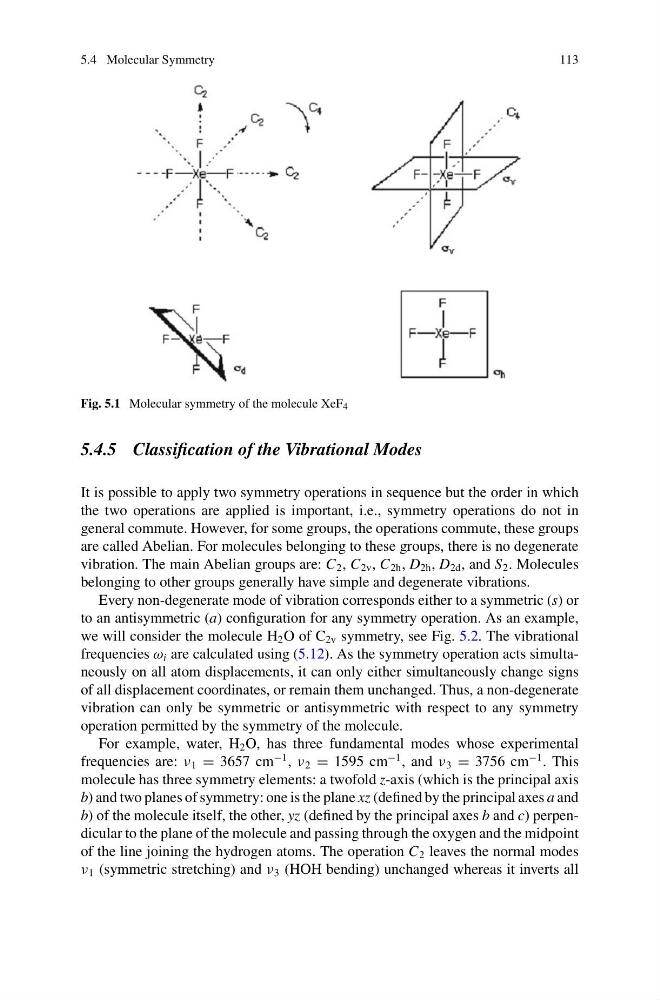
Fig. 5.1 Molecular symmetry of the molecule XeF 4
5.4.5 Classification of the Vibrational Modes
It is possible to apply two symmetry operations in sequence but the order in which
the two operations are applied is important, i.e., symmetry operations do not in
general commute. However, for some groups, the operations commute, these groups
are called Abelian. For molecules belonging to these groups, there is no degenerate
vibration. The main Abelian groups are: C 2 , C 2v , C 2h , D 2h , D 2d , and S 2 . Molecules
belonging to other groups generally have simple and degenerate vibrations.
Every non-degenerate mode of vibration corresponds either to a symmetric (s) or
to an antisymmetric (a) configuration for any symmetry operation. As an example,
we will consider the molecule H 2 O of C 2v symmetry, see Fig. 5.2. The vibrational
frequencies ω i are calculated using (5.12). As the symmetry operation acts simultaneously on all atom displacements, it can only either simultaneously change signs
of all displacement coordinates, or remain them unchanged. Thus, a non-degenerate
vibration can only be symmetric or antisymmetric with respect to any symmetry
operation permitted by the symmetry of the molecule.
For example, water, H 2 O, has three fundamental modes whose experimental
frequencies are: ν 1 = 3657 cm
−1 , ν 2 = 1595 cm
−1 , and ν 3 = 3756 cm
−1 . This
molecule has three symmetry elements: a twofold z-axis (which is the principal axis
b) and two planes of symmetry: one is the plane xz (defined by the principal axes a and
b) of the molecule itself, the other, yz (defined by the principal axes b and c) perpendicular to the plane of the molecule and passing through the oxygen and the midpoint
of the line joining the hydrogen atoms. The operation C 2 leaves the normal modes
ν 1 (symmetric stretching) and ν 3 (HOH bending) unchanged whereas it inverts all
113
Fig. 5.1 Molecular symmetry of the molecule XeF 4
5.4.5 Classification of the Vibrational Modes
It is possible to apply two symmetry operations in sequence but the order in which
the two operations are applied is important, i.e., symmetry operations do not in
general commute. However, for some groups, the operations commute, these groups
are called Abelian. For molecules belonging to these groups, there is no degenerate
vibration. The main Abelian groups are: C 2 , C 2v , C 2h , D 2h , D 2d , and S 2 . Molecules
belonging to other groups generally have simple and degenerate vibrations.
Every non-degenerate mode of vibration corresponds either to a symmetric (s) or
to an antisymmetric (a) configuration for any symmetry operation. As an example,
we will consider the molecule H 2 O of C 2v symmetry, see Fig. 5.2. The vibrational
frequencies ω i are calculated using (5.12). As the symmetry operation acts simultaneously on all atom displacements, it can only either simultaneously change signs
of all displacement coordinates, or remain them unchanged. Thus, a non-degenerate
vibration can only be symmetric or antisymmetric with respect to any symmetry
operation permitted by the symmetry of the molecule.
For example, water, H 2 O, has three fundamental modes whose experimental
frequencies are: ν 1 = 3657 cm
−1 , ν 2 = 1595 cm
−1 , and ν 3 = 3756 cm
−1 . This
molecule has three symmetry elements: a twofold z-axis (which is the principal axis
b) and two planes of symmetry: one is the plane xz (defined by the principal axes a and
b) of the molecule itself, the other, yz (defined by the principal axes b and c) perpendicular to the plane of the molecule and passing through the oxygen and the midpoint
of the line joining the hydrogen atoms. The operation C 2 leaves the normal modes
ν 1 (symmetric stretching) and ν 3 (HOH bending) unchanged whereas it inverts all