

5.5 Coriolis Interaction
115
5.5 Coriolis Interaction
Up to now, the cross-term T rv of (5.1) has been neglected. It is possible to show that
it is due to a force F Cor acting on each atom i of mass m i and of velocity υ i in the
molecule fixed axis system
F Cor = 2m i (υ i × )
(5.33a)
is the angular velocity of the molecule fixed axis system giving the acceleration
γ Cor
γ Cor = 2υ i ×
(5.33b)
At this point, it is useful to study a simple example, a XY 2 molecule of symmetry
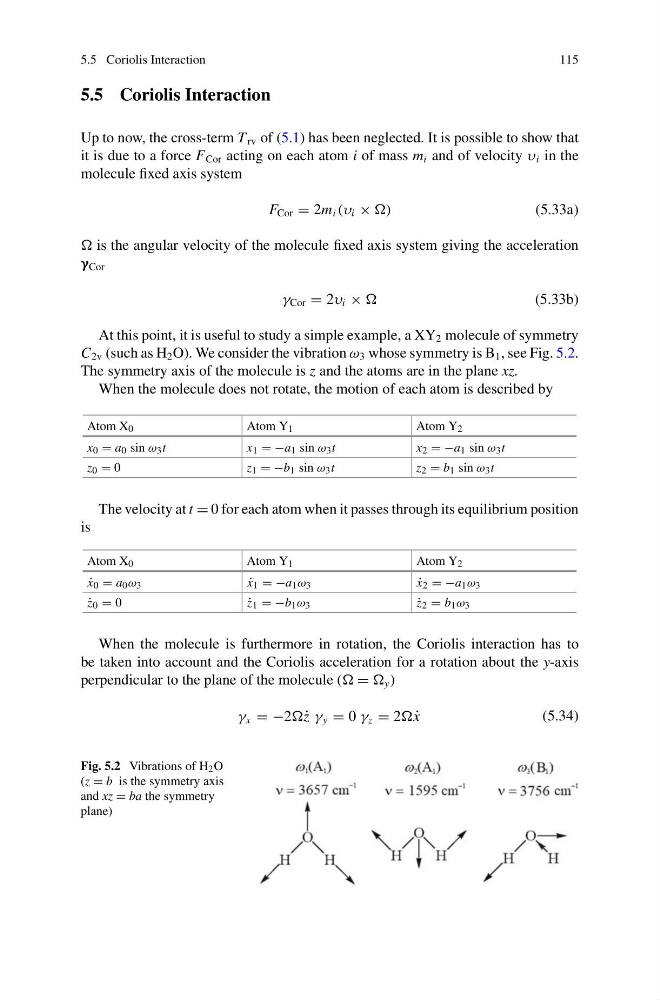
C 2v (such as H 2 O). We consider the vibration ω 3 whose symmetry is B 1 , see Fig. 5.2.
The symmetry axis of the molecule is z and the atoms are in the plane xz.
When the molecule does not rotate, the motion of each atom is described by
Atom X 0
Atom Y 1
Atom Y 2
x 0 = a 0 sin ω 3 t
x 1 = −a 1 sin ω 3 t
x 2 = −a 1 sin ω 3 t
z 0 = 0
z 1 = −b 1 sin ω 3 t
z 2 = b 1 sin ω 3 t
The velocity at t = 0 for each atom when it passes through its equilibrium position
is
Atom X 0
Atom Y 1
Atom Y 2
˙
x 0 = a 0 ω 3
˙
x 1 = −a 1 ω 3
˙
x 2 = −a 1 ω 3
˙
z 0 = 0
˙
z 1 = −b 1 ω 3
˙
z 2 = b 1 ω 3
When the molecule is furthermore in rotation, the Coriolis interaction has to
be taken into account and the Coriolis acceleration for a rotation about the y-axis
perpendicular to the plane of the molecule ( = y )
γ x = −2˙ z γ y = 0 γ z = 2 ˙
x
(5.34)
Fig. 5.2 Vibrations of H 2 O
(z = b is the symmetry axis
and xz = ba the symmetry
plane)
115
5.5 Coriolis Interaction
Up to now, the cross-term T rv of (5.1) has been neglected. It is possible to show that
it is due to a force F Cor acting on each atom i of mass m i and of velocity υ i in the
molecule fixed axis system
F Cor = 2m i (υ i × )
(5.33a)
is the angular velocity of the molecule fixed axis system giving the acceleration
γ Cor
γ Cor = 2υ i ×
(5.33b)
At this point, it is useful to study a simple example, a XY 2 molecule of symmetry
C 2v (such as H 2 O). We consider the vibration ω 3 whose symmetry is B 1 , see Fig. 5.2.
The symmetry axis of the molecule is z and the atoms are in the plane xz.
When the molecule does not rotate, the motion of each atom is described by
Atom X 0
Atom Y 1
Atom Y 2
x 0 = a 0 sin ω 3 t
x 1 = −a 1 sin ω 3 t
x 2 = −a 1 sin ω 3 t
z 0 = 0
z 1 = −b 1 sin ω 3 t
z 2 = b 1 sin ω 3 t
The velocity at t = 0 for each atom when it passes through its equilibrium position
is
Atom X 0
Atom Y 1
Atom Y 2
˙
x 0 = a 0 ω 3
˙
x 1 = −a 1 ω 3
˙
x 2 = −a 1 ω 3
˙
z 0 = 0
˙
z 1 = −b 1 ω 3
˙
z 2 = b 1 ω 3
When the molecule is furthermore in rotation, the Coriolis interaction has to
be taken into account and the Coriolis acceleration for a rotation about the y-axis
perpendicular to the plane of the molecule ( = y )
γ x = −2˙ z γ y = 0 γ z = 2 ˙
x
(5.34)
Fig. 5.2 Vibrations of H 2 O
(z = b is the symmetry axis
and xz = ba the symmetry
plane)