

5.3 Normal Modes
109
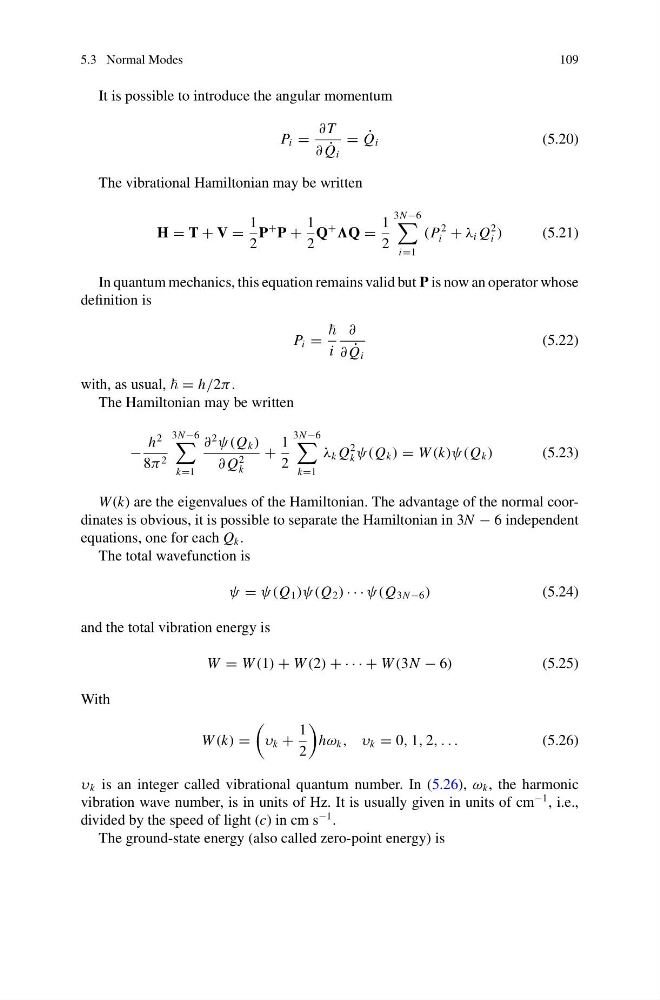
It is possible to introduce the angular momentum
P i =
∂ T
∂ ˙
Q i
= ˙
Q i
(5.20)
The vibrational Hamiltonian may be written
H = T + V =
1
2
P
+ P +
1
2
Q
+
Q =
1
2
3N −6
i=1
(P
2
i + λ i Q
2
i )
(5.21)
In quantum mechanics, this equation remains valid but P is now an operator whose
definition is
P i =
i
∂
∂ ˙
Q i
(5.22)
with, as usual, = h/2π .
The Hamiltonian may be written
−
h
2
8π 2
3N −6
k=1
∂
2
ψ(Q k )
∂ Q
2
k
+
1
2
3N −6
k=1
λ k Q
2
k ψ(Q k ) = W (k)ψ(Q k )
(5.23)
W (k) are the eigenvalues of the Hamiltonian. The advantage of the normal coordinates is obvious, it is possible to separate the Hamiltonian in 3N − 6 independent
equations, one for each Q k .
The total wavefunction is
ψ = ψ(Q 1 )ψ(Q 2 ) · · · ψ(Q 3N −6 )
(5.24)
and the total vibration energy is
W = W (1) + W (2) + · · · + W (3N − 6)
(5.25)
With
W (k) =
υ k +
1
2
hω k , υ k = 0, 1, 2, . . .
(5.26)
υ k is an integer called vibrational quantum number. In (5.26), ω k , the harmonic
vibration wave number, is in units of Hz. It is usually given in units of cm
−1 , i.e.,
divided by the speed of light (c) in cm s
−1 .
The ground-state energy (also called zero-point energy) is
109
It is possible to introduce the angular momentum
P i =
∂ T
∂ ˙
Q i
= ˙
Q i
(5.20)
The vibrational Hamiltonian may be written
H = T + V =
1
2
P
+ P +
1
2
Q
+
Q =
1
2
3N −6
i=1
(P
2
i + λ i Q
2
i )
(5.21)
In quantum mechanics, this equation remains valid but P is now an operator whose
definition is
P i =
i
∂
∂ ˙
Q i
(5.22)
with, as usual, = h/2π .
The Hamiltonian may be written
−
h
2
8π 2
3N −6
k=1
∂
2
ψ(Q k )
∂ Q
2
k
+
1
2
3N −6
k=1
λ k Q
2
k ψ(Q k ) = W (k)ψ(Q k )
(5.23)
W (k) are the eigenvalues of the Hamiltonian. The advantage of the normal coordinates is obvious, it is possible to separate the Hamiltonian in 3N − 6 independent
equations, one for each Q k .
The total wavefunction is
ψ = ψ(Q 1 )ψ(Q 2 ) · · · ψ(Q 3N −6 )
(5.24)
and the total vibration energy is
W = W (1) + W (2) + · · · + W (3N − 6)
(5.25)
With
W (k) =
υ k +
1
2
hω k , υ k = 0, 1, 2, . . .
(5.26)
υ k is an integer called vibrational quantum number. In (5.26), ω k , the harmonic
vibration wave number, is in units of Hz. It is usually given in units of cm
−1 , i.e.,
divided by the speed of light (c) in cm s
−1 .
The ground-state energy (also called zero-point energy) is