

108
5 The Vibrations of Polyatomic Molecules
l
+ f l = dim.(3N − 6) × (3N − 6)
(5.14a)
f l tr = 0 dim.(3N − 6)
(5.14b)
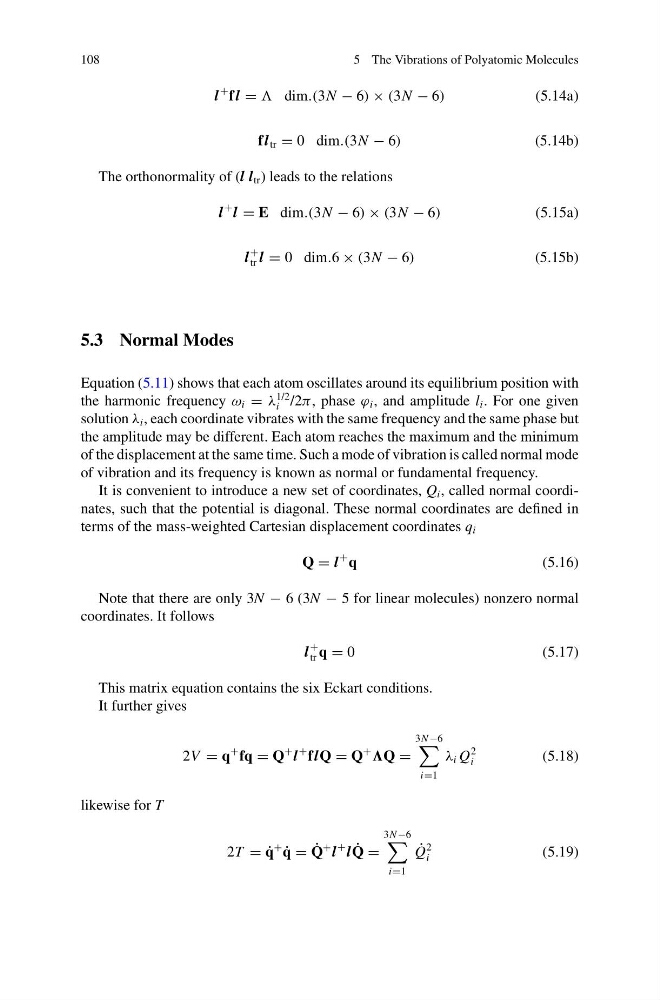
The orthonormality of (l l tr ) leads to the relations
l
+ l = E dim.(3N − 6) × (3N − 6)
(5.15a)
l
+
tr l = 0 dim.6 × (3N − 6)
(5.15b)
5.3 Normal Modes
Equation (5.11) shows that each atom oscillates around its equilibrium position with
the harmonic frequency ω i = λ
1/2
i /2π, phase ϕ i , and amplitude l i . For one given
solution λ i , each coordinate vibrates with the same frequency and the same phase but
the amplitude may be different. Each atom reaches the maximum and the minimum
of the displacement at the same time. Such a mode of vibration is called normal mode
of vibration and its frequency is known as normal or fundamental frequency.
It is convenient to introduce a new set of coordinates, Q i , called normal coordinates, such that the potential is diagonal. These normal coordinates are defined in
terms of the mass-weighted Cartesian displacement coordinates q i
Q = l
+ q
(5.16)
Note that there are only 3N − 6 (3N − 5 for linear molecules) nonzero normal
coordinates. It follows
l
+
tr q = 0
(5.17)
This matrix equation contains the six Eckart conditions.
It further gives
2V = q
+ fq = Q
+ l
+ f lQ = Q
+
Q =
3N −6
i=1
λ i Q
2
i
(5.18)
likewise for T
2T = ˙
q
+
˙
q = ˙
Q
+ l
+ l ˙
Q =
3N −6
i=1
˙
Q
2
i
(5.19)
5 The Vibrations of Polyatomic Molecules
l
+ f l = dim.(3N − 6) × (3N − 6)
(5.14a)
f l tr = 0 dim.(3N − 6)
(5.14b)
The orthonormality of (l l tr ) leads to the relations
l
+ l = E dim.(3N − 6) × (3N − 6)
(5.15a)
l
+
tr l = 0 dim.6 × (3N − 6)
(5.15b)
5.3 Normal Modes
Equation (5.11) shows that each atom oscillates around its equilibrium position with
the harmonic frequency ω i = λ
1/2
i /2π, phase ϕ i , and amplitude l i . For one given
solution λ i , each coordinate vibrates with the same frequency and the same phase but
the amplitude may be different. Each atom reaches the maximum and the minimum
of the displacement at the same time. Such a mode of vibration is called normal mode
of vibration and its frequency is known as normal or fundamental frequency.
It is convenient to introduce a new set of coordinates, Q i , called normal coordinates, such that the potential is diagonal. These normal coordinates are defined in
terms of the mass-weighted Cartesian displacement coordinates q i
Q = l
+ q
(5.16)
Note that there are only 3N − 6 (3N − 5 for linear molecules) nonzero normal
coordinates. It follows
l
+
tr q = 0
(5.17)
This matrix equation contains the six Eckart conditions.
It further gives
2V = q
+ fq = Q
+ l
+ f lQ = Q
+
Q =
3N −6
i=1
λ i Q
2
i
(5.18)
likewise for T
2T = ˙
q
+
˙
q = ˙
Q
+ l
+ l ˙
Q =
3N −6
i=1
˙
Q
2
i
(5.19)