

5.2 Classical Kinetic Energy of the Rigid Rotor
107
2V =
3N
i, j=1
f i j q i q j = q
+ fq
(5.7)
with
f i j = f ji =
∂
2 V
∂q i ∂q j
0
(5.8)
The Newton’s equations of motion may be written
d
dt
∂ T
∂ ˙
q i
+
∂ V
∂q i
= 0
(5.9)
Using the expressions of T and V, (5.2) and (5.7) give
¨
q i +
3N
j=1
f i j q j = 0, j = 1, 2, . . . , 3N
(5.10)
A possible solution for this set of simultaneous differential equations is
q i = l i cos(
λ i t + ϕ i )
(5.11)
Substituting this solution in the differential equations gives a set of equations
3N
i=1
f i j − δ i j λ i
l i = 0, j = 1, 2, . . . , 3N
(5.12a)
with
ω i =
λ i /2π
(5.12b)
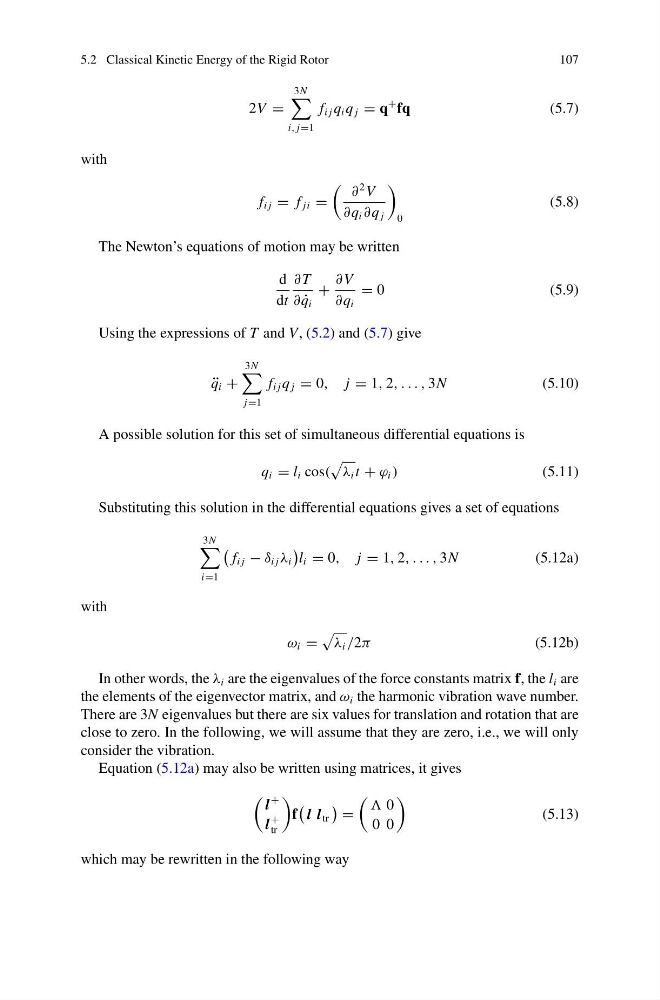
In other words, the λ i are the eigenvalues of the force constants matrix f, the l i are
the elements of the eigenvector matrix, and ω i the harmonic vibration wave number.
There are 3N eigenvalues but there are six values for translation and rotation that are
close to zero. In the following, we will assume that they are zero, i.e., we will only
consider the vibration.
Equation (5.12a) may also be written using matrices, it gives
l
+
l
+
tr
f
l l tr
=
0
0 0
(5.13)
which may be rewritten in the following way
107
2V =
3N
i, j=1
f i j q i q j = q
+ fq
(5.7)
with
f i j = f ji =
∂
2 V
∂q i ∂q j
0
(5.8)
The Newton’s equations of motion may be written
d
dt
∂ T
∂ ˙
q i
+
∂ V
∂q i
= 0
(5.9)
Using the expressions of T and V, (5.2) and (5.7) give
¨
q i +
3N
j=1
f i j q j = 0, j = 1, 2, . . . , 3N
(5.10)
A possible solution for this set of simultaneous differential equations is
q i = l i cos(
λ i t + ϕ i )
(5.11)
Substituting this solution in the differential equations gives a set of equations
3N
i=1
f i j − δ i j λ i
l i = 0, j = 1, 2, . . . , 3N
(5.12a)
with
ω i =
λ i /2π
(5.12b)
In other words, the λ i are the eigenvalues of the force constants matrix f, the l i are
the elements of the eigenvector matrix, and ω i the harmonic vibration wave number.
There are 3N eigenvalues but there are six values for translation and rotation that are
close to zero. In the following, we will assume that they are zero, i.e., we will only
consider the vibration.
Equation (5.12a) may also be written using matrices, it gives
l
+
l
+
tr
f
l l tr
=
0
0 0
(5.13)
which may be rewritten in the following way