

110
5 The Vibrations of Polyatomic Molecules
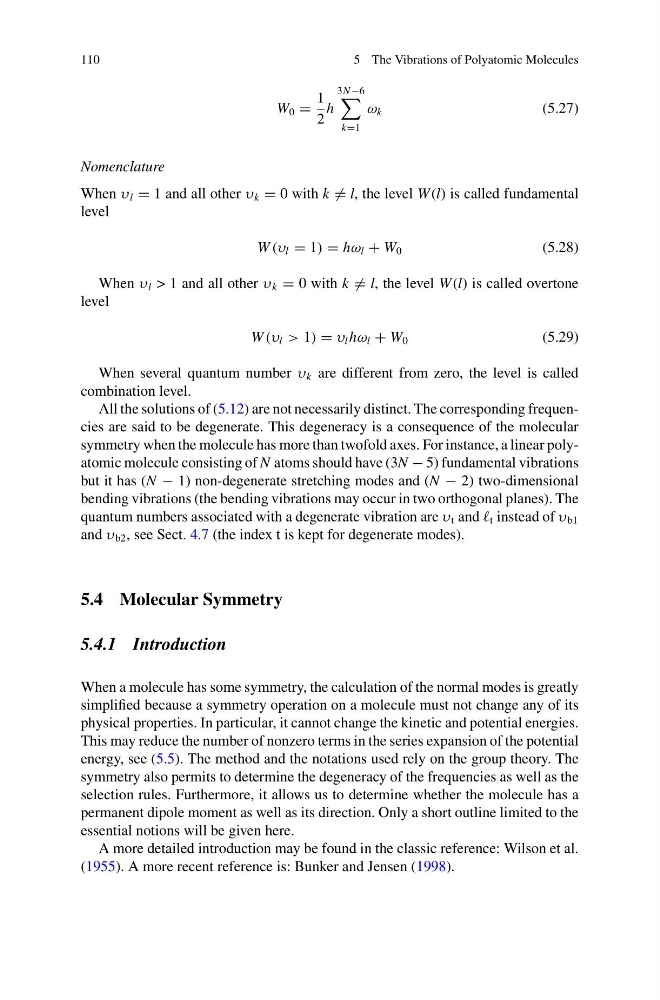
W 0 =
1
2
h
3N −6
k=1
ω k
(5.27)
Nomenclature
When υ l = 1 and all other υ k = 0 with k = l, the level W (l) is called fundamental
level
W (υ l = 1) = hω l + W 0
(5.28)
When υ l > 1 and all other υ k = 0 with k = l, the level W (l) is called overtone
level
W (υ l > 1) = υ l hω l + W 0
(5.29)
When several quantum number υ k are different from zero, the level is called
combination level.
All the solutions of (5.12) are not necessarily distinct. The corresponding frequencies are said to be degenerate. This degeneracy is a consequence of the molecular
symmetry when the molecule has more than twofold axes. For instance, a linear polyatomic molecule consisting of N atoms should have (3N − 5) fundamental vibrations
but it has (N − 1) non-degenerate stretching modes and (N − 2) two-dimensional
bending vibrations (the bending vibrations may occur in two orthogonal planes). The
quantum numbers associated with a degenerate vibration are υ t and t instead of υ b1
and υ b2 , see Sect. 4.7 (the index t is kept for degenerate modes).
5.4 Molecular Symmetry
5.4.1 Introduction
When a molecule has some symmetry, the calculation of the normal modes is greatly
simplified because a symmetry operation on a molecule must not change any of its
physical properties. In particular, it cannot change the kinetic and potential energies.
This may reduce the number of nonzero terms in the series expansion of the potential
energy, see (5.5). The method and the notations used rely on the group theory. The
symmetry also permits to determine the degeneracy of the frequencies as well as the
selection rules. Furthermore, it allows us to determine whether the molecule has a
permanent dipole moment as well as its direction. Only a short outline limited to the
essential notions will be given here.
A more detailed introduction may be found in the classic reference: Wilson et al.
(1955). A more recent reference is: Bunker and Jensen (1998).
5 The Vibrations of Polyatomic Molecules
W 0 =
1
2
h
3N −6
k=1
ω k
(5.27)
Nomenclature
When υ l = 1 and all other υ k = 0 with k = l, the level W (l) is called fundamental
level
W (υ l = 1) = hω l + W 0
(5.28)
When υ l > 1 and all other υ k = 0 with k = l, the level W (l) is called overtone
level
W (υ l > 1) = υ l hω l + W 0
(5.29)
When several quantum number υ k are different from zero, the level is called
combination level.
All the solutions of (5.12) are not necessarily distinct. The corresponding frequencies are said to be degenerate. This degeneracy is a consequence of the molecular
symmetry when the molecule has more than twofold axes. For instance, a linear polyatomic molecule consisting of N atoms should have (3N − 5) fundamental vibrations
but it has (N − 1) non-degenerate stretching modes and (N − 2) two-dimensional
bending vibrations (the bending vibrations may occur in two orthogonal planes). The
quantum numbers associated with a degenerate vibration are υ t and t instead of υ b1
and υ b2 , see Sect. 4.7 (the index t is kept for degenerate modes).
5.4 Molecular Symmetry
5.4.1 Introduction
When a molecule has some symmetry, the calculation of the normal modes is greatly
simplified because a symmetry operation on a molecule must not change any of its
physical properties. In particular, it cannot change the kinetic and potential energies.
This may reduce the number of nonzero terms in the series expansion of the potential
energy, see (5.5). The method and the notations used rely on the group theory. The
symmetry also permits to determine the degeneracy of the frequencies as well as the
selection rules. Furthermore, it allows us to determine whether the molecule has a
permanent dipole moment as well as its direction. Only a short outline limited to the
essential notions will be given here.
A more detailed introduction may be found in the classic reference: Wilson et al.
(1955). A more recent reference is: Bunker and Jensen (1998).