

92
4 Rotation of the Polyatomic Molecule
H eff =
1
2
ξ
J
2
ξ
⎛
⎝ 1
I ξ
−
2
I
2
ξ
n =0
n|L ξ |0
2
E n − E 0
⎞
⎠
(4.43)
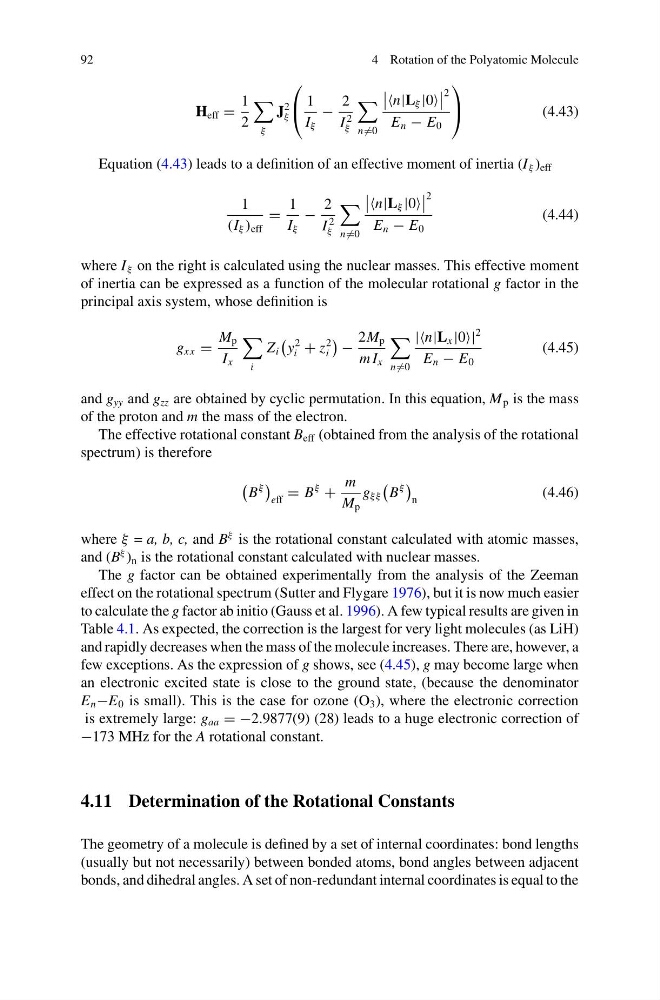
Equation (4.43) leads to a definition of an effective moment of inertia (I ξ ) eff
1
(I ξ ) eff
=
1
I ξ
−
2
I
2
ξ
n =0
n|L ξ |0
2
E n − E 0
(4.44)
where I ξ on the right is calculated using the nuclear masses. This effective moment
of inertia can be expressed as a function of the molecular rotational g factor in the
principal axis system, whose definition is
g xx =
M p
I x
i
Z i
y
2
i + z
2
i
−
2M p
m I x
n =0
||n|L x |0|
2
E n − E 0
(4.45)
and g yy and g zz are obtained by cyclic permutation. In this equation, M p is the mass
of the proton and m the mass of the electron.
The effective rotational constant B eff (obtained from the analysis of the rotational
spectrum) is therefore
B
ξ
eff
= B
ξ
+
m
M p
g ξξ
B
ξ
n
(4.46)
where ξ = a, b, c, and B
ξ is the rotational constant calculated with atomic masses,
and (B
ξ ) n is the rotational constant calculated with nuclear masses.
The g factor can be obtained experimentally from the analysis of the Zeeman
effect on the rotational spectrum (Sutter and Flygare 1976), but it is now much easier
to calculate the g factor ab initio (Gauss et al. 1996). A few typical results are given in
Table 4.1. As expected, the correction is the largest for very light molecules (as LiH)
and rapidly decreases when the mass of the molecule increases. There are, however, a
few exceptions. As the expression of g shows, see (4.45), g may become large when
an electronic excited state is close to the ground state, (because the denominator
E n −E 0 is small). This is the case for ozone (O 3 ), where the electronic correction
is extremely large: g aa = −2.9877(9) (28) leads to a huge electronic correction of
−173 MHz for the A rotational constant.
4.11 Determination of the Rotational Constants
The geometry of a molecule is defined by a set of internal coordinates: bond lengths
(usually but not necessarily) between bonded atoms, bond angles between adjacent
bonds, and dihedral angles. A set of non-redundant internal coordinates is equal to the
4 Rotation of the Polyatomic Molecule
H eff =
1
2
ξ
J
2
ξ
⎛
⎝ 1
I ξ
−
2
I
2
ξ
n =0
n|L ξ |0
2
E n − E 0
⎞
⎠
(4.43)
Equation (4.43) leads to a definition of an effective moment of inertia (I ξ ) eff
1
(I ξ ) eff
=
1
I ξ
−
2
I
2
ξ
n =0
n|L ξ |0
2
E n − E 0
(4.44)
where I ξ on the right is calculated using the nuclear masses. This effective moment
of inertia can be expressed as a function of the molecular rotational g factor in the
principal axis system, whose definition is
g xx =
M p
I x
i
Z i
y
2
i + z
2
i
−
2M p
m I x
n =0
||n|L x |0|
2
E n − E 0
(4.45)
and g yy and g zz are obtained by cyclic permutation. In this equation, M p is the mass
of the proton and m the mass of the electron.
The effective rotational constant B eff (obtained from the analysis of the rotational
spectrum) is therefore
B
ξ
eff
= B
ξ
+
m
M p
g ξξ
B
ξ
n
(4.46)
where ξ = a, b, c, and B
ξ is the rotational constant calculated with atomic masses,
and (B
ξ ) n is the rotational constant calculated with nuclear masses.
The g factor can be obtained experimentally from the analysis of the Zeeman
effect on the rotational spectrum (Sutter and Flygare 1976), but it is now much easier
to calculate the g factor ab initio (Gauss et al. 1996). A few typical results are given in
Table 4.1. As expected, the correction is the largest for very light molecules (as LiH)
and rapidly decreases when the mass of the molecule increases. There are, however, a
few exceptions. As the expression of g shows, see (4.45), g may become large when
an electronic excited state is close to the ground state, (because the denominator
E n −E 0 is small). This is the case for ozone (O 3 ), where the electronic correction
is extremely large: g aa = −2.9877(9) (28) leads to a huge electronic correction of
−173 MHz for the A rotational constant.
4.11 Determination of the Rotational Constants
The geometry of a molecule is defined by a set of internal coordinates: bond lengths
(usually but not necessarily) between bonded atoms, bond angles between adjacent
bonds, and dihedral angles. A set of non-redundant internal coordinates is equal to the