

4.9 Rovibrational Correction
91
perturbations affecting the α
ξ
i are described in Sect. 5.5 for the Coriolis interactions
and in Sect. 5.6 for the anharmonic resonances.
4.10 Electronic Correction (Gordy and Cook 1984; Sutter
and Flygare 1976)
The largest correction to the ground-state rotational constants is the rovibrational
correction, see Sect. 4.9 and Table 4.1 (see also Sect. 6.2). However, for some
molecules. The electronic correction is not negligible. This correction has already
been discussed in Sect. 3.7 of Chap. 3 for the particular case of a diatomic molecule.
The generalization to polyatomic molecules is straightforward. Atomic masses are
used to calculate the rotational constants. However, a small correction for unequal
sharing of the electrons by the atoms and for non-spherical distribution of the electronic clouds around the atoms is sometimes non-negligible and has to be taken into
account.
The discussion will be limited to molecules of zero spin and zero electronic
angular momentum in the ground electronic state. It is the case of a great majority of
molecules. A more rigorous derivation may be found in Sutter and Flygare (1976).
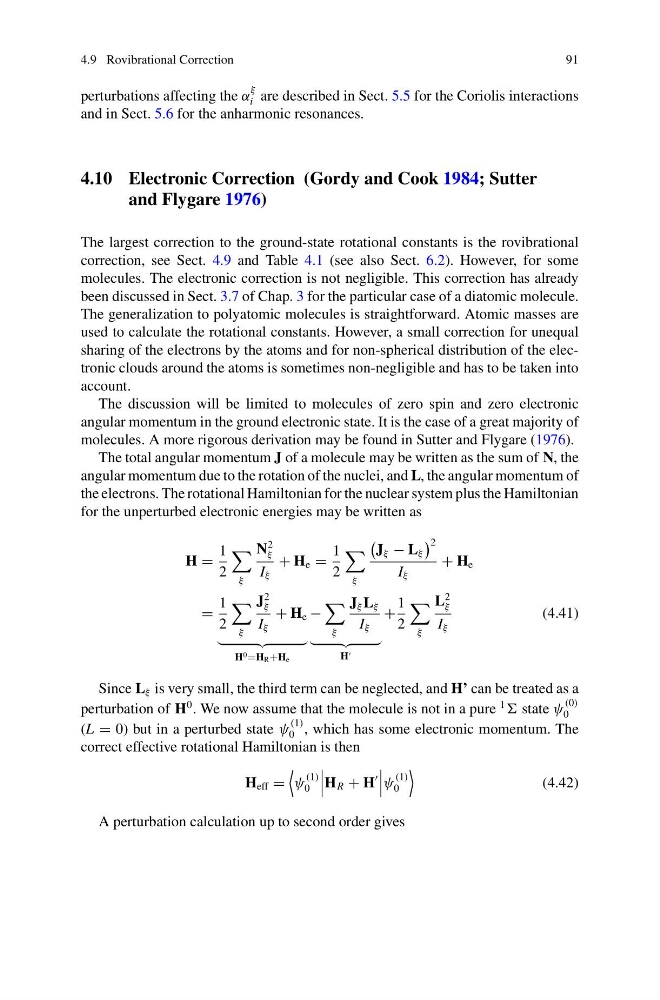
The total angular momentum J of a molecule may be written as the sum of N, the
angular momentum due to the rotation of the nuclei, and L, the angular momentum of
the electrons. The rotational Hamiltonian for the nuclear system plus the Hamiltonian
for the unperturbed electronic energies may be written as
H =
1
2
ξ
N
2
ξ
I ξ
+ H e =
1
2
ξ
J ξ − L ξ
2
I ξ
+ H e
=
1
2
ξ
J
2
ξ
I ξ
+ H e
H 0 =H R +H e
−
ξ
J ξ L ξ
I ξ
H
+
1
2
ξ
L
2
ξ
I ξ
(4.41)
Since L ξ is very small, the third term can be neglected, and H’ can be treated as a
perturbation of H
0 . We now assume that the molecule is not in a pure
1
state ψ
(0)
0
(L = 0) but in a perturbed state ψ
(1)
0 , which has some electronic momentum. The
correct effective rotational Hamiltonian is then
H eff =
ψ
(1)
0
HR + H
ψ
(1)
0
(4.42)
A perturbation calculation up to second order gives
91
perturbations affecting the α
ξ
i are described in Sect. 5.5 for the Coriolis interactions
and in Sect. 5.6 for the anharmonic resonances.
4.10 Electronic Correction (Gordy and Cook 1984; Sutter
and Flygare 1976)
The largest correction to the ground-state rotational constants is the rovibrational
correction, see Sect. 4.9 and Table 4.1 (see also Sect. 6.2). However, for some
molecules. The electronic correction is not negligible. This correction has already
been discussed in Sect. 3.7 of Chap. 3 for the particular case of a diatomic molecule.
The generalization to polyatomic molecules is straightforward. Atomic masses are
used to calculate the rotational constants. However, a small correction for unequal
sharing of the electrons by the atoms and for non-spherical distribution of the electronic clouds around the atoms is sometimes non-negligible and has to be taken into
account.
The discussion will be limited to molecules of zero spin and zero electronic
angular momentum in the ground electronic state. It is the case of a great majority of
molecules. A more rigorous derivation may be found in Sutter and Flygare (1976).
The total angular momentum J of a molecule may be written as the sum of N, the
angular momentum due to the rotation of the nuclei, and L, the angular momentum of
the electrons. The rotational Hamiltonian for the nuclear system plus the Hamiltonian
for the unperturbed electronic energies may be written as
H =
1
2
ξ
N
2
ξ
I ξ
+ H e =
1
2
ξ
J ξ − L ξ
2
I ξ
+ H e
=
1
2
ξ
J
2
ξ
I ξ
+ H e
H 0 =H R +H e
−
ξ
J ξ L ξ
I ξ
H
+
1
2
ξ
L
2
ξ
I ξ
(4.41)
Since L ξ is very small, the third term can be neglected, and H’ can be treated as a
perturbation of H
0 . We now assume that the molecule is not in a pure
1
state ψ
(0)
0
(L = 0) but in a perturbed state ψ
(1)
0 , which has some electronic momentum. The
correct effective rotational Hamiltonian is then
H eff =
ψ
(1)
0
HR + H
ψ
(1)
0
(4.42)
A perturbation calculation up to second order gives