

90
4 Rotation of the Polyatomic Molecule
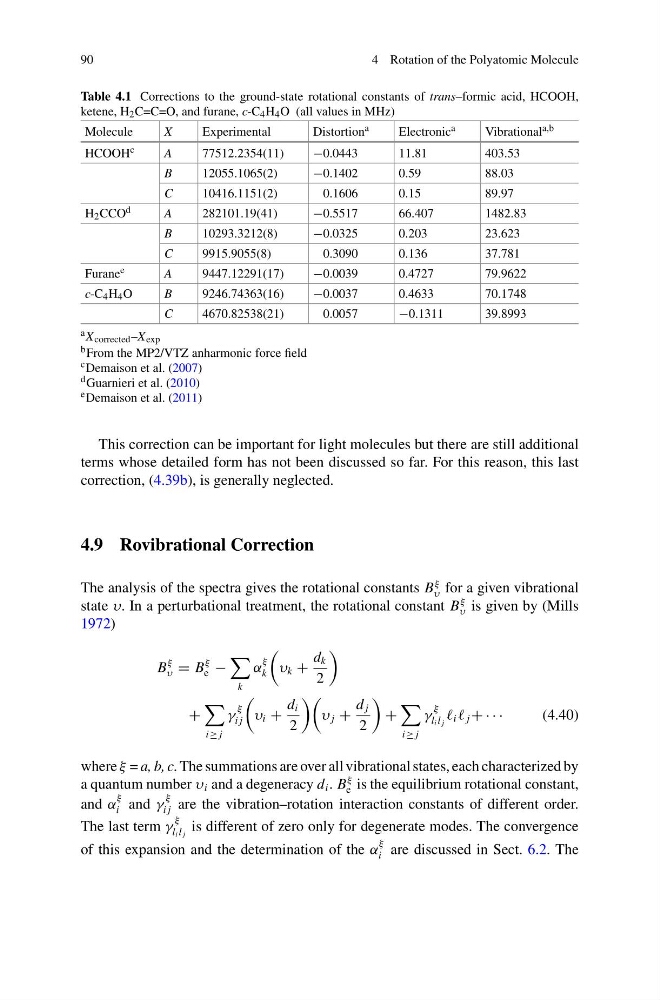
Table 4.1 Corrections to the ground-state rotational constants of trans–formic acid, HCOOH,
ketene, H 2 C=C=O, and furane, c-C 4 H 4 O (all values in MHz)
Molecule
X
Experimental
Distortion a
Electronic a
Vibrational a,b
HCOOH c
A
77512.2354(11)
−0.0443
11.81
403.53
B
12055.1065(2)
−0.1402
0.59
88.03
C
10416.1151(2)
0.1606
0.15
89.97
H 2 CCO d
A
282101.19(41)
−0.5517
66.407
1482.83
B
10293.3212(8)
−0.0325
0.203
23.623
C
9915.9055(8)
0.3090
0.136
37.781
Furane e
A
9447.12291(17)
−0.0039
0.4727
79.9622
c-C 4 H 4 O
B
9246.74363(16)
−0.0037
0.4633
70.1748
C
4670.82538(21)
0.0057
−0.1311
39.8993
a X corrected –X exp
b From the MP2/VTZ anharmonic force field
c Demaison et al. (2007)
d Guarnieri et al. (2010)
e Demaison et al. (2011)
This correction can be important for light molecules but there are still additional
terms whose detailed form has not been discussed so far. For this reason, this last
correction, (4.39b), is generally neglected.
4.9 Rovibrational Correction
The analysis of the spectra gives the rotational constants B
ξ
υ for a given vibrational
state υ. In a perturbational treatment, the rotational constant B
ξ
υ is given by (Mills
1972)
B
ξ
υ = B
ξ
e −
k
α
ξ
k
υ k +
d k
2
+
i≥ j
γ
ξ
i j
υ i +
d i
2
υ j +
d j
2
+
i≥ j
γ
ξ
l i l j
i j + · · ·
(4.40)
where ξ = a, b, c. The summations are over all vibrational states, each characterized by
a quantum number υ i and a degeneracy d i . B
ξ
e is the equilibrium rotational constant,
and α
ξ
i and γ
ξ
i j are the vibration–rotation interaction constants of different order.
The last term γ
ξ
l i l j
is different of zero only for degenerate modes. The convergence
of this expansion and the determination of the α
ξ
i are discussed in Sect. 6.2. The
4 Rotation of the Polyatomic Molecule
Table 4.1 Corrections to the ground-state rotational constants of trans–formic acid, HCOOH,
ketene, H 2 C=C=O, and furane, c-C 4 H 4 O (all values in MHz)
Molecule
X
Experimental
Distortion a
Electronic a
Vibrational a,b
HCOOH c
A
77512.2354(11)
−0.0443
11.81
403.53
B
12055.1065(2)
−0.1402
0.59
88.03
C
10416.1151(2)
0.1606
0.15
89.97
H 2 CCO d
A
282101.19(41)
−0.5517
66.407
1482.83
B
10293.3212(8)
−0.0325
0.203
23.623
C
9915.9055(8)
0.3090
0.136
37.781
Furane e
A
9447.12291(17)
−0.0039
0.4727
79.9622
c-C 4 H 4 O
B
9246.74363(16)
−0.0037
0.4633
70.1748
C
4670.82538(21)
0.0057
−0.1311
39.8993
a X corrected –X exp
b From the MP2/VTZ anharmonic force field
c Demaison et al. (2007)
d Guarnieri et al. (2010)
e Demaison et al. (2011)
This correction can be important for light molecules but there are still additional
terms whose detailed form has not been discussed so far. For this reason, this last
correction, (4.39b), is generally neglected.
4.9 Rovibrational Correction
The analysis of the spectra gives the rotational constants B
ξ
υ for a given vibrational
state υ. In a perturbational treatment, the rotational constant B
ξ
υ is given by (Mills
1972)
B
ξ
υ = B
ξ
e −
k
α
ξ
k
υ k +
d k
2
+
i≥ j
γ
ξ
i j
υ i +
d i
2
υ j +
d j
2
+
i≥ j
γ
ξ
l i l j
i j + · · ·
(4.40)
where ξ = a, b, c. The summations are over all vibrational states, each characterized by
a quantum number υ i and a degeneracy d i . B
ξ
e is the equilibrium rotational constant,
and α
ξ
i and γ
ξ
i j are the vibration–rotation interaction constants of different order.
The last term γ
ξ
l i l j
is different of zero only for degenerate modes. The convergence
of this expansion and the determination of the α
ξ
i are discussed in Sect. 6.2. The