

8.1.4 5/5/5/6/5-Membered Ring System
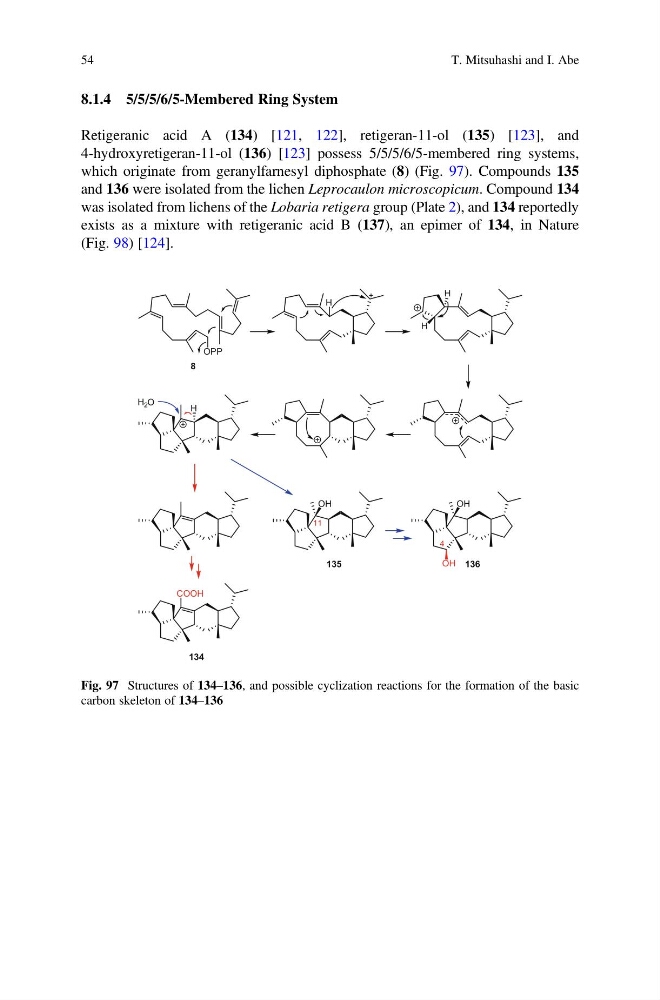
Retigeranic acid A (134) [121, 122], retigeran-11-ol (135) [123], and
4-hydroxyretigeran-11-ol (136) [123] possess 5/5/5/6/5-membered ring systems,
which originate from geranylfarnesyl diphosphate (8) (Fig. 97). Compounds 135
and 136 were isolated from the lichen Leprocaulon microscopicum. Compound 134
was isolated from lichens of the Lobaria retigera group (Plate 2), and 134 reportedly
exists as a mixture with retigeranic acid B (137), an epimer of 134, in Nature
(Fig. 98) [124].
H
OPP
8
H
H
COOH
H
OH
OH
OH
134
135
136
H 2 O
11
4
Fig. 97 Structures of 134–136, and possible cyclization reactions for the formation of the basic
carbon skeleton of 134–136
54
T. Mitsuhashi and I. Abe
Retigeranic acid A (134) [121, 122], retigeran-11-ol (135) [123], and
4-hydroxyretigeran-11-ol (136) [123] possess 5/5/5/6/5-membered ring systems,
which originate from geranylfarnesyl diphosphate (8) (Fig. 97). Compounds 135
and 136 were isolated from the lichen Leprocaulon microscopicum. Compound 134
was isolated from lichens of the Lobaria retigera group (Plate 2), and 134 reportedly
exists as a mixture with retigeranic acid B (137), an epimer of 134, in Nature
(Fig. 98) [124].
H
OPP
8
H
H
COOH
H
OH
OH
OH
134
135
136
H 2 O
11
4
Fig. 97 Structures of 134–136, and possible cyclization reactions for the formation of the basic
carbon skeleton of 134–136
54
T. Mitsuhashi and I. Abe