

8.1.3 5/3/7/6/5- and 5/4/7/6/5-Membered Ring Systems
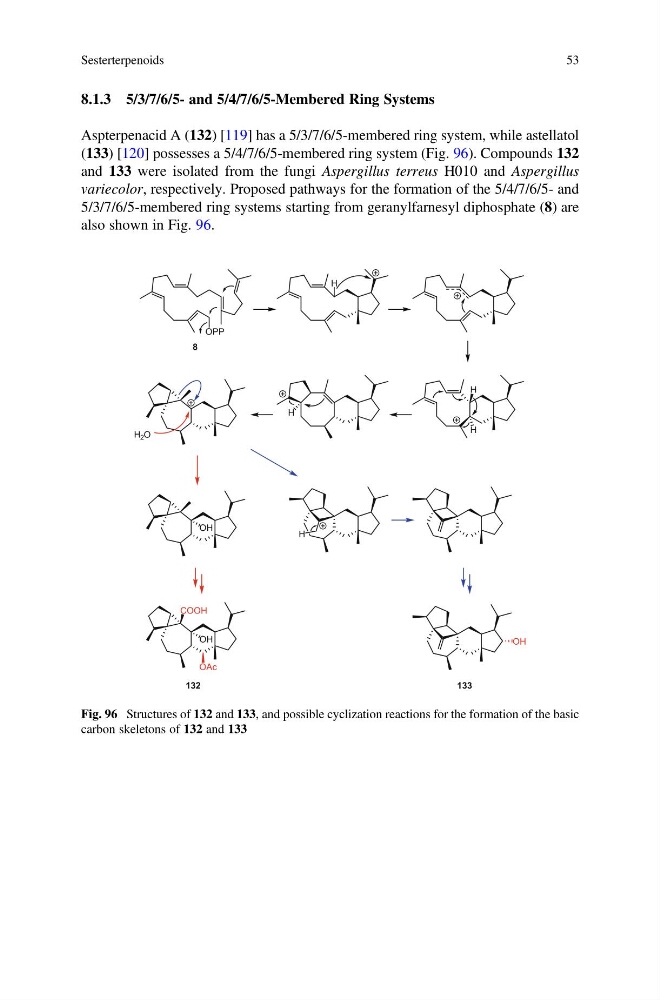
Aspterpenacid A (132) [119] has a 5/3/7/6/5-membered ring system, while astellatol
(133) [120] possesses a 5/4/7/6/5-membered ring system (Fig. 96). Compounds 132
and 133 were isolated from the fungi Aspergillus terreus H010 and Aspergillus
variecolor, respectively. Proposed pathways for the formation of the 5/4/7/6/5- and
5/3/7/6/5-membered ring systems starting from geranylfarnesyl diphosphate (8) are
also shown in Fig. 96.
H
H
H
H
OPP
OH
H
COOH
OH
OAc
OH
8
H 2 O
132
133
Fig. 96 Structures of 132 and 133, and possible cyclization reactions for the formation of the basic
carbon skeletons of 132 and 133
Sesterterpenoids
53
Aspterpenacid A (132) [119] has a 5/3/7/6/5-membered ring system, while astellatol
(133) [120] possesses a 5/4/7/6/5-membered ring system (Fig. 96). Compounds 132
and 133 were isolated from the fungi Aspergillus terreus H010 and Aspergillus
variecolor, respectively. Proposed pathways for the formation of the 5/4/7/6/5- and
5/3/7/6/5-membered ring systems starting from geranylfarnesyl diphosphate (8) are
also shown in Fig. 96.
H
H
H
H
OPP
OH
H
COOH
OH
OAc
OH
8
H 2 O
132
133
Fig. 96 Structures of 132 and 133, and possible cyclization reactions for the formation of the basic
carbon skeletons of 132 and 133
Sesterterpenoids
53