

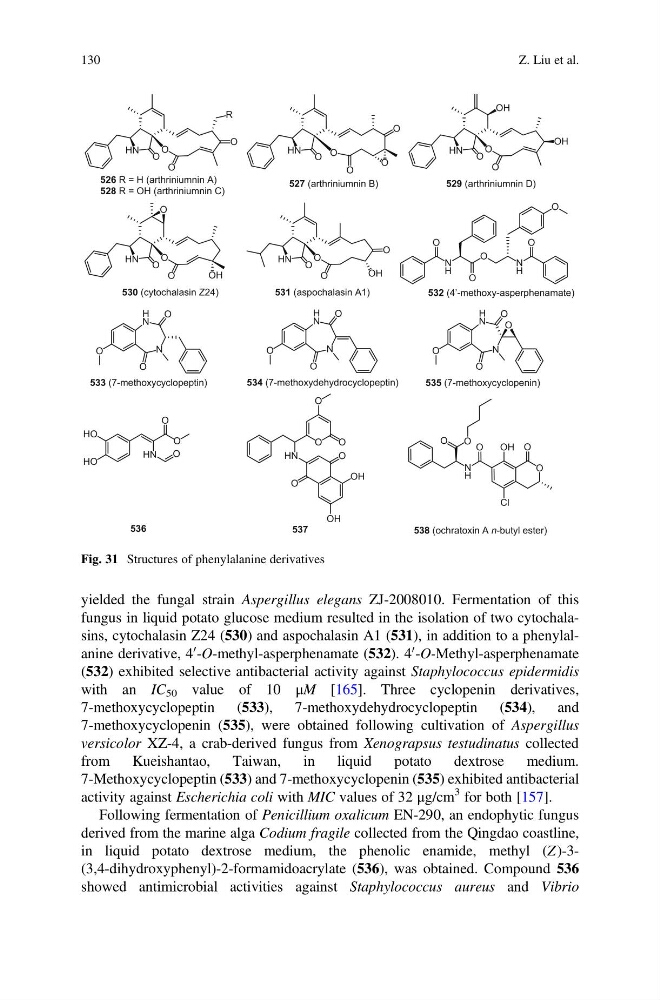
yielded the fungal strain Aspergillus elegans ZJ-2008010. Fermentation of this
fungus in liquid potato glucose medium resulted in the isolation of two cytochalasins, cytochalasin Z24 (530) and aspochalasin A1 (531), in addition to a phenylalanine derivative, 4
0 -O-methyl-asperphenamate (532). 4
0 -O-Methyl-asperphenamate
(532) exhibited selective antibacterial activity against Staphylococcus epidermidis
with an IC 50 value of 10 μM [165]. Three cyclopenin derivatives,
7-methoxycyclopeptin (533), 7-methoxydehydrocyclopeptin (534), and
7-methoxycyclopenin (535), were obtained following cultivation of Aspergillus
versicolor XZ-4, a crab-derived fungus from Xenograpsus testudinatus collected
from
Kueishantao,
Taiwan, in
liquid
potato dextrose
medium.
7-Methoxycyclopeptin (533) and 7-methoxycyclopenin (535) exhibited antibacterial
activity against Escherichia coli with MIC values of 32 μg/cm
3 for both [157].
Following fermentation of Penicillium oxalicum EN-290, an endophytic fungus
derived from the marine alga Codium fragile collected from the Qingdao coastline,
in liquid potato dextrose medium, the phenolic enamide, methyl (Z )-3(3,4-dihydroxyphenyl)-2-formamidoacrylate (536), was obtained. Compound 536
showed antimicrobial activities against Staphylococcus aureus and Vibrio
O
HN
O
O
O
526 R = H (arthriniumnin A)
528 R = OH (arthriniumnin C)
R
O
HN
O
527 (arthriniumnin B)
O
O
O
O
HN
O
O
529 (arthriniumnin D)
OH
OH
N
H
O
O
O
O
N
H
O
532 (4’-methoxy-asperphenamate)
O
HN
O
O
530 (cytochalasin Z24)
O
OH
O
HN
O
O
531 (aspochalasin A1)
OH
O
537
N
H
O
O
538 (ochratoxin A n-butyl ester)
536
N
H
N
O
O
O
533 (7-methoxycyclopeptin)
N
H
N
O
O
O
534 (7-methoxydehydrocyclopeptin)
N
H
N
O
O
O
535 (7-methoxycyclopenin)
O
HO
HO
HN
O
O
O
HN
O
O
O
OH
OH
O
O
O
O
O
Cl
OH
Fig. 31 Structures of phenylalanine derivatives
130
Z. Liu et al.
fungus in liquid potato glucose medium resulted in the isolation of two cytochalasins, cytochalasin Z24 (530) and aspochalasin A1 (531), in addition to a phenylalanine derivative, 4
0 -O-methyl-asperphenamate (532). 4
0 -O-Methyl-asperphenamate
(532) exhibited selective antibacterial activity against Staphylococcus epidermidis
with an IC 50 value of 10 μM [165]. Three cyclopenin derivatives,
7-methoxycyclopeptin (533), 7-methoxydehydrocyclopeptin (534), and
7-methoxycyclopenin (535), were obtained following cultivation of Aspergillus
versicolor XZ-4, a crab-derived fungus from Xenograpsus testudinatus collected
from
Kueishantao,
Taiwan, in
liquid
potato dextrose
medium.
7-Methoxycyclopeptin (533) and 7-methoxycyclopenin (535) exhibited antibacterial
activity against Escherichia coli with MIC values of 32 μg/cm
3 for both [157].
Following fermentation of Penicillium oxalicum EN-290, an endophytic fungus
derived from the marine alga Codium fragile collected from the Qingdao coastline,
in liquid potato dextrose medium, the phenolic enamide, methyl (Z )-3(3,4-dihydroxyphenyl)-2-formamidoacrylate (536), was obtained. Compound 536
showed antimicrobial activities against Staphylococcus aureus and Vibrio
O
HN
O
O
O
526 R = H (arthriniumnin A)
528 R = OH (arthriniumnin C)
R
O
HN
O
527 (arthriniumnin B)
O
O
O
O
HN
O
O
529 (arthriniumnin D)
OH
OH
N
H
O
O
O
O
N
H
O
532 (4’-methoxy-asperphenamate)
O
HN
O
O
530 (cytochalasin Z24)
O
OH
O
HN
O
O
531 (aspochalasin A1)
OH
O
537
N
H
O
O
538 (ochratoxin A n-butyl ester)
536
N
H
N
O
O
O
533 (7-methoxycyclopeptin)
N
H
N
O
O
O
534 (7-methoxydehydrocyclopeptin)
N
H
N
O
O
O
535 (7-methoxycyclopenin)
O
HO
HO
HN
O
O
O
HN
O
O
O
OH
OH
O
O
O
O
O
Cl
OH
Fig. 31 Structures of phenylalanine derivatives
130
Z. Liu et al.