

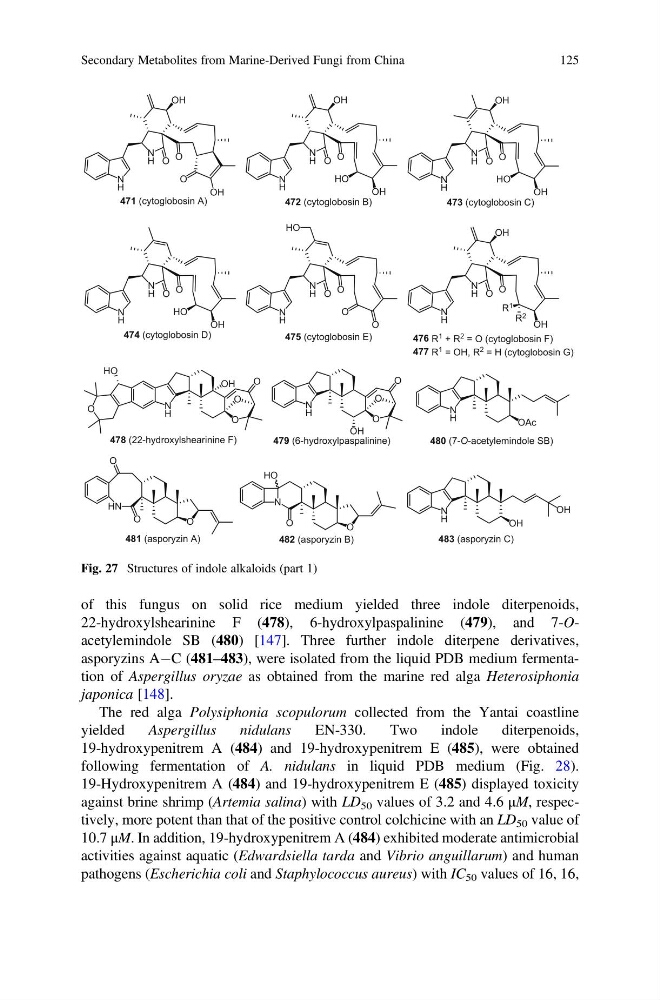
of this fungus on solid rice medium yielded three indole diterpenoids,
22-hydroxylshearinine F (478), 6-hydroxylpaspalinine (479), and 7-Oacetylemindole SB (480) [147]. Three further indole diterpene derivatives,
asporyzins AÀC (481–483), were isolated from the liquid PDB medium fermentation of Aspergillus oryzae as obtained from the marine red alga Heterosiphonia
japonica [148].
The red alga Polysiphonia scopulorum collected from the Yantai coastline
yielded
Aspergillus
nidulans
EN-330.
Two
indole
diterpenoids,
19-hydroxypenitrem A (484) and 19-hydroxypenitrem E (485), were obtained
following fermentation of A. nidulans in liquid PDB medium (Fig. 28).
19-Hydroxypenitrem A (484) and 19-hydroxypenitrem E (485) displayed toxicity
against brine shrimp (Artemia salina) with LD 50 values of 3.2 and 4.6 μM, respectively, more potent than that of the positive control colchicine with an LD 50 value of
10.7 μM. In addition, 19-hydroxypenitrem A (484) exhibited moderate antimicrobial
activities against aquatic (Edwardsiella tarda and Vibrio anguillarum) and human
pathogens (Escherichia coli and Staphylococcus aureus) with IC 50 values of 16, 16,
N
H
N
H O
OH
OH
O
O
471 (cytoglobosin A)
N
H
N
H O
OH
HO
O
472 (cytoglobosin B)
OH
N
H
N
H O
OH
HO
O
473 (cytoglobosin C)
OH
N
H
N
H O
OH
HO
O
474 (cytoglobosin D)
N
H
N
H O
O
O
O
475 (cytoglobosin E)
HO
N
H
N
H O
OH
R 1
O
476 R
1 + R
2 = O (cytoglobosin F)
477 R 1 = OH, R 2 = H (cytoglobosin G)
OH
R 2
O
N
H
O
O
O
OH
HO
478 (22-hydroxylshearinine F)
N
H
O
O
O
479 (6-hydroxylpaspalinine)
OH
N
H
480 (7-O-acetylemindole SB)
OAc
HN
O
O
O
481 (asporyzin A)
N
O
HO
482 (asporyzin B)
O
N
H
483 (asporyzin C)
OH
OH
Fig. 27 Structures of indole alkaloids (part 1)
Secondary Metabolites from Marine-Derived Fungi from China
125
22-hydroxylshearinine F (478), 6-hydroxylpaspalinine (479), and 7-Oacetylemindole SB (480) [147]. Three further indole diterpene derivatives,
asporyzins AÀC (481–483), were isolated from the liquid PDB medium fermentation of Aspergillus oryzae as obtained from the marine red alga Heterosiphonia
japonica [148].
The red alga Polysiphonia scopulorum collected from the Yantai coastline
yielded
Aspergillus
nidulans
EN-330.
Two
indole
diterpenoids,
19-hydroxypenitrem A (484) and 19-hydroxypenitrem E (485), were obtained
following fermentation of A. nidulans in liquid PDB medium (Fig. 28).
19-Hydroxypenitrem A (484) and 19-hydroxypenitrem E (485) displayed toxicity
against brine shrimp (Artemia salina) with LD 50 values of 3.2 and 4.6 μM, respectively, more potent than that of the positive control colchicine with an LD 50 value of
10.7 μM. In addition, 19-hydroxypenitrem A (484) exhibited moderate antimicrobial
activities against aquatic (Edwardsiella tarda and Vibrio anguillarum) and human
pathogens (Escherichia coli and Staphylococcus aureus) with IC 50 values of 16, 16,
N
H
N
H O
OH
OH
O
O
471 (cytoglobosin A)
N
H
N
H O
OH
HO
O
472 (cytoglobosin B)
OH
N
H
N
H O
OH
HO
O
473 (cytoglobosin C)
OH
N
H
N
H O
OH
HO
O
474 (cytoglobosin D)
N
H
N
H O
O
O
O
475 (cytoglobosin E)
HO
N
H
N
H O
OH
R 1
O
476 R
1 + R
2 = O (cytoglobosin F)
477 R 1 = OH, R 2 = H (cytoglobosin G)
OH
R 2
O
N
H
O
O
O
OH
HO
478 (22-hydroxylshearinine F)
N
H
O
O
O
479 (6-hydroxylpaspalinine)
OH
N
H
480 (7-O-acetylemindole SB)
OAc
HN
O
O
O
481 (asporyzin A)
N
O
HO
482 (asporyzin B)
O
N
H
483 (asporyzin C)
OH
OH
Fig. 27 Structures of indole alkaloids (part 1)
Secondary Metabolites from Marine-Derived Fungi from China
125