

4 Terpenes
4.1 Sesquiterpenes
The most frequently reported terpenes from marine fungi are sesquiterpenes. Their
distribution among fungi is diverse and there is no clear focus of accumulation in a
particular fungal genus. The fungal strain Penicillium sp. SCS-KFD08 was isolated
from the marine worm Sipunculus nudus collected from Haikou Bay, Hainan. The
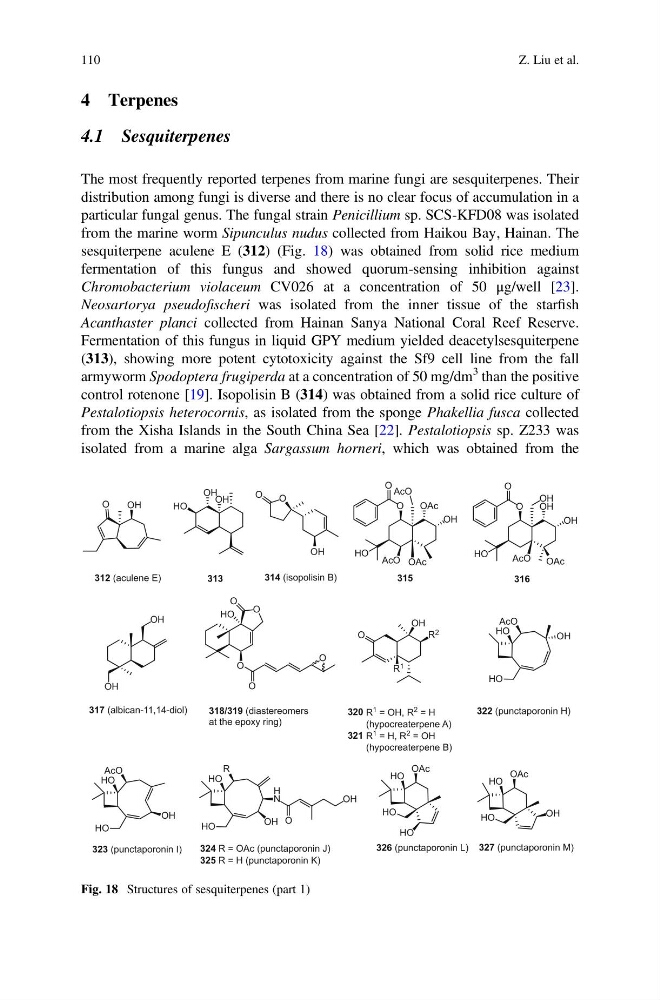
sesquiterpene aculene E (312) (Fig. 18) was obtained from solid rice medium
fermentation of this fungus and showed quorum-sensing inhibition against
Chromobacterium violaceum CV026 at a concentration of 50 μg/well [23].
Neosartorya pseudofischeri was isolated from the inner tissue of the starfish
Acanthaster planci collected from Hainan Sanya National Coral Reef Reserve.
Fermentation of this fungus in liquid GPY medium yielded deacetylsesquiterpene
(313), showing more potent cytotoxicity against the Sf9 cell line from the fall
armyworm Spodoptera frugiperda at a concentration of 50 mg/dm
3 than the positive
control rotenone [19]. Isopolisin B (314) was obtained from a solid rice culture of
Pestalotiopsis heterocornis, as isolated from the sponge Phakellia fusca collected
from the Xisha Islands in the South China Sea [22]. Pestalotiopsis sp. Z233 was
isolated from a marine alga Sargassum horneri, which was obtained from the
O
OH
312 (aculene E)
O
O
OH
314 (isopolisin B)
AcO
OAc
AcO
OH
OAc
O
O
HO
315
OAc
OH
AcO
OH
OH
O
O
HO
316
OH
OH
317 (albican-11,14-diol)
R 2
OH
R 1
O
320 R
1 = OH, R
2 = H
(hypocreaterpene A)
321 R
1 = H, R
2 = OH
(hypocreaterpene B)
OH
OH
HO
313
OH
AcO
HO
HO
322 (punctaporonin H)
AcO
HO
HO
OH
323 (punctaporonin I)
HO
HO
324 R = OAc (punctaporonin J)
325 R = H (punctaporonin K)
OH
H
N
O
OH
R
HO
OAc
HO
HO
HO
OAc
HO
OH
326 (punctaporonin L) 327 (punctaporonin M)
O
O
O
O
O
HO
318/319 (diastereomers
at the epoxy ring)
Fig. 18 Structures of sesquiterpenes (part 1)
110
Z. Liu et al.
4.1 Sesquiterpenes
The most frequently reported terpenes from marine fungi are sesquiterpenes. Their
distribution among fungi is diverse and there is no clear focus of accumulation in a
particular fungal genus. The fungal strain Penicillium sp. SCS-KFD08 was isolated
from the marine worm Sipunculus nudus collected from Haikou Bay, Hainan. The
sesquiterpene aculene E (312) (Fig. 18) was obtained from solid rice medium
fermentation of this fungus and showed quorum-sensing inhibition against
Chromobacterium violaceum CV026 at a concentration of 50 μg/well [23].
Neosartorya pseudofischeri was isolated from the inner tissue of the starfish
Acanthaster planci collected from Hainan Sanya National Coral Reef Reserve.
Fermentation of this fungus in liquid GPY medium yielded deacetylsesquiterpene
(313), showing more potent cytotoxicity against the Sf9 cell line from the fall
armyworm Spodoptera frugiperda at a concentration of 50 mg/dm
3 than the positive
control rotenone [19]. Isopolisin B (314) was obtained from a solid rice culture of
Pestalotiopsis heterocornis, as isolated from the sponge Phakellia fusca collected
from the Xisha Islands in the South China Sea [22]. Pestalotiopsis sp. Z233 was
isolated from a marine alga Sargassum horneri, which was obtained from the
O
OH
312 (aculene E)
O
O
OH
314 (isopolisin B)
AcO
OAc
AcO
OH
OAc
O
O
HO
315
OAc
OH
AcO
OH
OH
O
O
HO
316
OH
OH
317 (albican-11,14-diol)
R 2
OH
R 1
O
320 R
1 = OH, R
2 = H
(hypocreaterpene A)
321 R
1 = H, R
2 = OH
(hypocreaterpene B)
OH
OH
HO
313
OH
AcO
HO
HO
322 (punctaporonin H)
AcO
HO
HO
OH
323 (punctaporonin I)
HO
HO
324 R = OAc (punctaporonin J)
325 R = H (punctaporonin K)
OH
H
N
O
OH
R
HO
OAc
HO
HO
HO
OAc
HO
OH
326 (punctaporonin L) 327 (punctaporonin M)
O
O
O
O
O
HO
318/319 (diastereomers
at the epoxy ring)
Fig. 18 Structures of sesquiterpenes (part 1)
110
Z. Liu et al.