

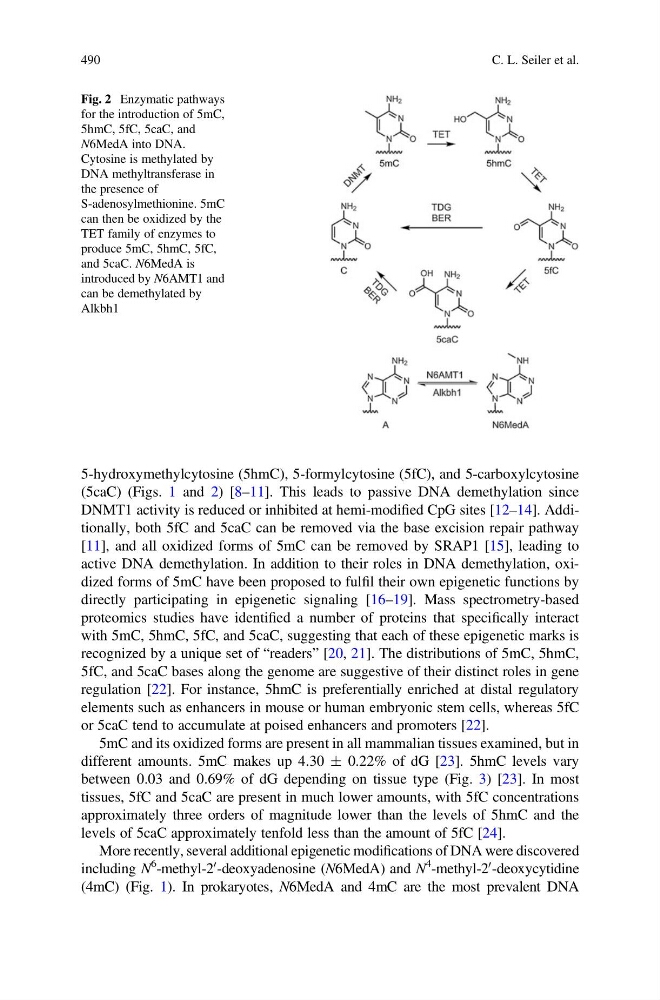
5-hydroxymethylcytosine (5hmC), 5-formylcytosine (5fC), and 5-carboxylcytosine
(5caC) (Figs. 1 and 2) [8–11]. This leads to passive DNA demethylation since
DNMT1 activity is reduced or inhibited at hemi-modified CpG sites [12–14]. Additionally, both 5fC and 5caC can be removed via the base excision repair pathway
[11], and all oxidized forms of 5mC can be removed by SRAP1 [15], leading to
active DNA demethylation. In addition to their roles in DNA demethylation, oxidized forms of 5mC have been proposed to fulfil their own epigenetic functions by
directly participating in epigenetic signaling [16–19]. Mass spectrometry-based
proteomics studies have identified a number of proteins that specifically interact
with 5mC, 5hmC, 5fC, and 5caC, suggesting that each of these epigenetic marks is
recognized by a unique set of “readers” [20, 21]. The distributions of 5mC, 5hmC,
5fC, and 5caC bases along the genome are suggestive of their distinct roles in gene
regulation [22]. For instance, 5hmC is preferentially enriched at distal regulatory
elements such as enhancers in mouse or human embryonic stem cells, whereas 5fC
or 5caC tend to accumulate at poised enhancers and promoters [22].
5mC and its oxidized forms are present in all mammalian tissues examined, but in
different amounts. 5mC makes up 4.30 Æ 0.22% of dG [23]. 5hmC levels vary
between 0.03 and 0.69% of dG depending on tissue type (Fig. 3) [23]. In most
tissues, 5fC and 5caC are present in much lower amounts, with 5fC concentrations
approximately three orders of magnitude lower than the levels of 5hmC and the
levels of 5caC approximately tenfold less than the amount of 5fC [24].
More recently, several additional epigenetic modifications of DNA were discovered
including N
6
-methyl-2
0 -deoxyadenosine (N6MedA) and N
4
-methyl-2
0 -deoxycytidine
(4mC) (Fig. 1). In prokaryotes, N6MedA and 4mC are the most prevalent DNA
Fig. 2 Enzymatic pathways
for the introduction of 5mC,
5hmC, 5fC, 5caC, and
N6MedA into DNA.
Cytosine is methylated by
DNA methyltransferase in
the presence of
S-adenosylmethionine. 5mC
can then be oxidized by the
TET family of enzymes to
produce 5mC, 5hmC, 5fC,
and 5caC. N6MedA is
introduced by N6AMT1 and
can be demethylated by
Alkbh1
490
C. L. Seiler et al.
(5caC) (Figs. 1 and 2) [8–11]. This leads to passive DNA demethylation since
DNMT1 activity is reduced or inhibited at hemi-modified CpG sites [12–14]. Additionally, both 5fC and 5caC can be removed via the base excision repair pathway
[11], and all oxidized forms of 5mC can be removed by SRAP1 [15], leading to
active DNA demethylation. In addition to their roles in DNA demethylation, oxidized forms of 5mC have been proposed to fulfil their own epigenetic functions by
directly participating in epigenetic signaling [16–19]. Mass spectrometry-based
proteomics studies have identified a number of proteins that specifically interact
with 5mC, 5hmC, 5fC, and 5caC, suggesting that each of these epigenetic marks is
recognized by a unique set of “readers” [20, 21]. The distributions of 5mC, 5hmC,
5fC, and 5caC bases along the genome are suggestive of their distinct roles in gene
regulation [22]. For instance, 5hmC is preferentially enriched at distal regulatory
elements such as enhancers in mouse or human embryonic stem cells, whereas 5fC
or 5caC tend to accumulate at poised enhancers and promoters [22].
5mC and its oxidized forms are present in all mammalian tissues examined, but in
different amounts. 5mC makes up 4.30 Æ 0.22% of dG [23]. 5hmC levels vary
between 0.03 and 0.69% of dG depending on tissue type (Fig. 3) [23]. In most
tissues, 5fC and 5caC are present in much lower amounts, with 5fC concentrations
approximately three orders of magnitude lower than the levels of 5hmC and the
levels of 5caC approximately tenfold less than the amount of 5fC [24].
More recently, several additional epigenetic modifications of DNA were discovered
including N
6
-methyl-2
0 -deoxyadenosine (N6MedA) and N
4
-methyl-2
0 -deoxycytidine
(4mC) (Fig. 1). In prokaryotes, N6MedA and 4mC are the most prevalent DNA
Fig. 2 Enzymatic pathways
for the introduction of 5mC,
5hmC, 5fC, 5caC, and
N6MedA into DNA.
Cytosine is methylated by
DNA methyltransferase in
the presence of
S-adenosylmethionine. 5mC
can then be oxidized by the
TET family of enzymes to
produce 5mC, 5hmC, 5fC,
and 5caC. N6MedA is
introduced by N6AMT1 and
can be demethylated by
Alkbh1
490
C. L. Seiler et al.