

oxBS-Seq
Oxidative bisulfite sequencing
redBS-Seq
Reduced bisulfite sequencing
RRBS
Reduced representation bisulfite sequencing
SAM
S-adenosyl-L-methionine
SMRT
Single-molecule real-time
SNPs
Single-nucleotide polymorphisms
TAB
TET-assisted bisulfite
TAB-Seq
TET-assisted bisulfite sequencing
TET
Ten-eleven translocation protein
TLC
Thin-layer chromatography
WGBS
Whole-genome bisulfite sequencing
1 Introduction
The human genome contains three billion base pairs [1]. Of these, nearly 27 million
cytosines exist in the CpG sequence context, making them potential targets for DNA
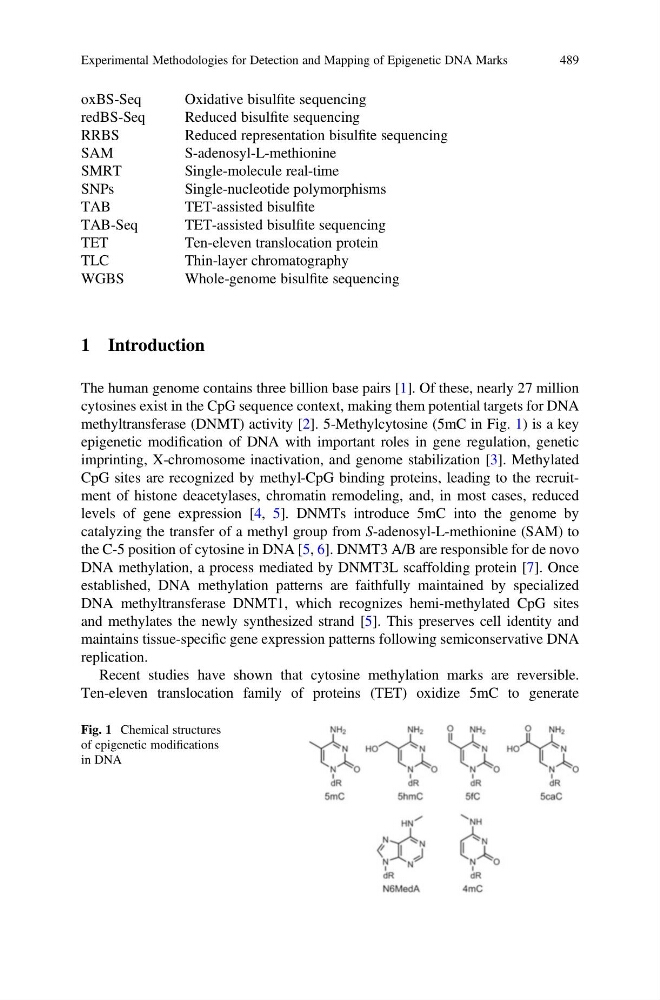
methyltransferase (DNMT) activity [2]. 5-Methylcytosine (5mC in Fig. 1) is a key
epigenetic modification of DNA with important roles in gene regulation, genetic
imprinting, X-chromosome inactivation, and genome stabilization [3]. Methylated
CpG sites are recognized by methyl-CpG binding proteins, leading to the recruitment of histone deacetylases, chromatin remodeling, and, in most cases, reduced
levels of gene expression [4, 5]. DNMTs introduce 5mC into the genome by
catalyzing the transfer of a methyl group from S-adenosyl-L-methionine (SAM) to
the C-5 position of cytosine in DNA [5, 6]. DNMT3 A/B are responsible for de novo
DNA methylation, a process mediated by DNMT3L scaffolding protein [7]. Once
established, DNA methylation patterns are faithfully maintained by specialized
DNA methyltransferase DNMT1, which recognizes hemi-methylated CpG sites
and methylates the newly synthesized strand [5]. This preserves cell identity and
maintains tissue-specific gene expression patterns following semiconservative DNA
replication.
Recent studies have shown that cytosine methylation marks are reversible.
Ten-eleven translocation family of proteins (TET) oxidize 5mC to generate
Fig. 1 Chemical structures
of epigenetic modifications
in DNA
Experimental Methodologies for Detection and Mapping of Epigenetic DNA Marks
489
Oxidative bisulfite sequencing
redBS-Seq
Reduced bisulfite sequencing
RRBS
Reduced representation bisulfite sequencing
SAM
S-adenosyl-L-methionine
SMRT
Single-molecule real-time
SNPs
Single-nucleotide polymorphisms
TAB
TET-assisted bisulfite
TAB-Seq
TET-assisted bisulfite sequencing
TET
Ten-eleven translocation protein
TLC
Thin-layer chromatography
WGBS
Whole-genome bisulfite sequencing
1 Introduction
The human genome contains three billion base pairs [1]. Of these, nearly 27 million
cytosines exist in the CpG sequence context, making them potential targets for DNA
methyltransferase (DNMT) activity [2]. 5-Methylcytosine (5mC in Fig. 1) is a key
epigenetic modification of DNA with important roles in gene regulation, genetic
imprinting, X-chromosome inactivation, and genome stabilization [3]. Methylated
CpG sites are recognized by methyl-CpG binding proteins, leading to the recruitment of histone deacetylases, chromatin remodeling, and, in most cases, reduced
levels of gene expression [4, 5]. DNMTs introduce 5mC into the genome by
catalyzing the transfer of a methyl group from S-adenosyl-L-methionine (SAM) to
the C-5 position of cytosine in DNA [5, 6]. DNMT3 A/B are responsible for de novo
DNA methylation, a process mediated by DNMT3L scaffolding protein [7]. Once
established, DNA methylation patterns are faithfully maintained by specialized
DNA methyltransferase DNMT1, which recognizes hemi-methylated CpG sites
and methylates the newly synthesized strand [5]. This preserves cell identity and
maintains tissue-specific gene expression patterns following semiconservative DNA
replication.
Recent studies have shown that cytosine methylation marks are reversible.
Ten-eleven translocation family of proteins (TET) oxidize 5mC to generate
Fig. 1 Chemical structures
of epigenetic modifications
in DNA
Experimental Methodologies for Detection and Mapping of Epigenetic DNA Marks
489