

analysis of the bromodomains demonstrated that 40 of the 61 human bromodomains
contain cysteines which could be targeted with this strategy.
Bromodomains have been coincidentally and rationally targeted by bivalent small
molecules which target multiple bromodomains in the same protein. These molecules have a high affinity due to the potential for an additive free energy of binding
from the two individual ligands. A compound was developed by AstraZeneca,
BiBET, which binds in a multivalent manner to both bromodomains of BRD4.
While no co-crystal structure with both BD1 or BD2 could be solved, a combination
of analytical ultracentrifugation and in-cell bioluminescence resonance energy
transfer (BRET) experiments demonstrated a conformational change in the dual
bromodomain construct tested, as well as an increase in BRET upon addition of
the bivalent molecule [131, 132]. In a parallel study, Bradner et al. developed a
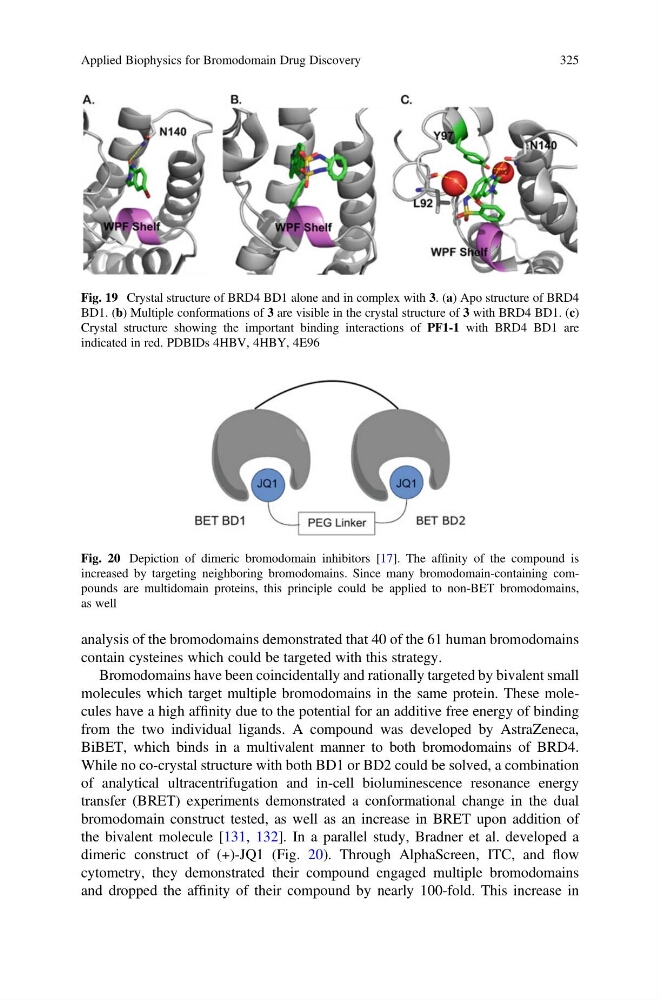
dimeric construct of (+)-JQ1 (Fig. 20). Through AlphaScreen, ITC, and flow
cytometry, they demonstrated their compound engaged multiple bromodomains
and dropped the affinity of their compound by nearly 100-fold. This increase in
Fig. 19 Crystal structure of BRD4 BD1 alone and in complex with 3. (a) Apo structure of BRD4
BD1. (b) Multiple conformations of 3 are visible in the crystal structure of 3 with BRD4 BD1. (c)
Crystal structure showing the important binding interactions of PF1-1 with BRD4 BD1 are
indicated in red. PDBIDs 4HBV, 4HBY, 4E96
Fig. 20 Depiction of dimeric bromodomain inhibitors [17]. The affinity of the compound is
increased by targeting neighboring bromodomains. Since many bromodomain-containing compounds are multidomain proteins, this principle could be applied to non-BET bromodomains,
as well
Applied Biophysics for Bromodomain Drug Discovery
325
contain cysteines which could be targeted with this strategy.
Bromodomains have been coincidentally and rationally targeted by bivalent small
molecules which target multiple bromodomains in the same protein. These molecules have a high affinity due to the potential for an additive free energy of binding
from the two individual ligands. A compound was developed by AstraZeneca,
BiBET, which binds in a multivalent manner to both bromodomains of BRD4.
While no co-crystal structure with both BD1 or BD2 could be solved, a combination
of analytical ultracentrifugation and in-cell bioluminescence resonance energy
transfer (BRET) experiments demonstrated a conformational change in the dual
bromodomain construct tested, as well as an increase in BRET upon addition of
the bivalent molecule [131, 132]. In a parallel study, Bradner et al. developed a
dimeric construct of (+)-JQ1 (Fig. 20). Through AlphaScreen, ITC, and flow
cytometry, they demonstrated their compound engaged multiple bromodomains
and dropped the affinity of their compound by nearly 100-fold. This increase in
Fig. 19 Crystal structure of BRD4 BD1 alone and in complex with 3. (a) Apo structure of BRD4
BD1. (b) Multiple conformations of 3 are visible in the crystal structure of 3 with BRD4 BD1. (c)
Crystal structure showing the important binding interactions of PF1-1 with BRD4 BD1 are
indicated in red. PDBIDs 4HBV, 4HBY, 4E96
Fig. 20 Depiction of dimeric bromodomain inhibitors [17]. The affinity of the compound is
increased by targeting neighboring bromodomains. Since many bromodomain-containing compounds are multidomain proteins, this principle could be applied to non-BET bromodomains,
as well
Applied Biophysics for Bromodomain Drug Discovery
325