

activity was maintained when comparing the bivalent inhibitors with (+)-JQ1
in vivo [133].
Another application of bivalent ligands is the combination of bromodomain
inhibitors and ubiquitin ligase targeting agents [134–136]. This technique selectively
degrades the entire protein of interest akin to shRNA; however, since these ligands
can dissociate from the protein of interest, they can act catalytically. These ligands
function by recruiting a ubiquitin ligase (e.g., E3 of von Hippel-Lindau ubiquitin
ligase) to the protein of interest. Recruitment of the ubiquitin ligase leads to polyubiquitination of the ε-nitrogen of surface-exposed lysines; following ubiquitination
the protein of interest is degraded by the proteasome [137]. Since this chemical
knockout is induced by dosage, this strategy can be used on protein targets in which
a genetic knockout is embryonically lethal. Initial applications of this smallmolecule knockout strategy were pioneered by Schneekloth et al. on the androgen
receptor using an MDM2 E3 ligase-recruiting molecule. This strategy has since been
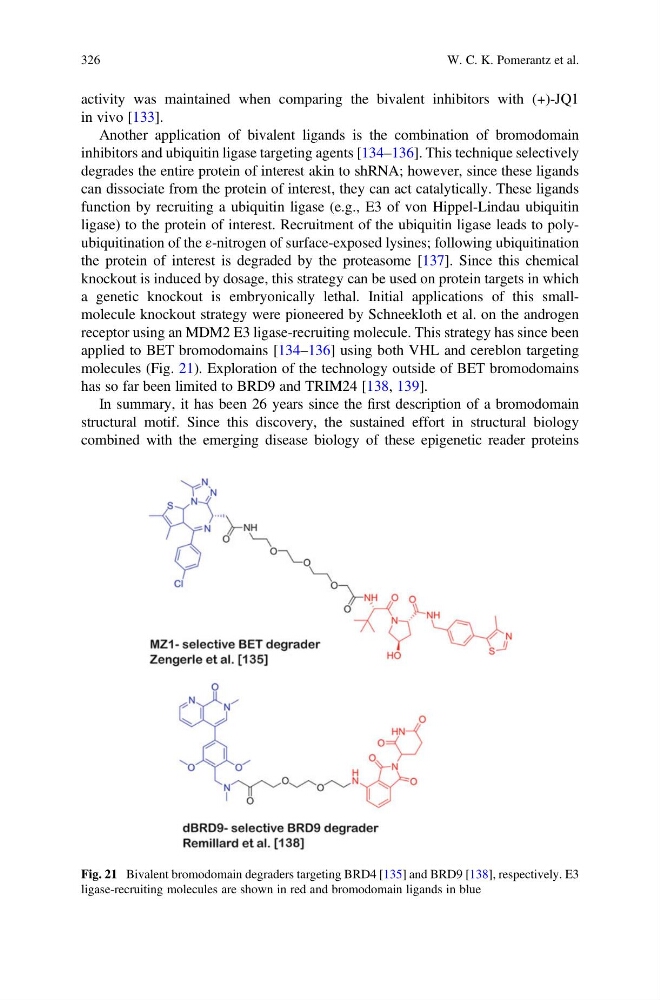
applied to BET bromodomains [134–136] using both VHL and cereblon targeting
molecules (Fig. 21). Exploration of the technology outside of BET bromodomains
has so far been limited to BRD9 and TRIM24 [138, 139].
In summary, it has been 26 years since the first description of a bromodomain
structural motif. Since this discovery, the sustained effort in structural biology
combined with the emerging disease biology of these epigenetic reader proteins
Fig. 21 Bivalent bromodomain degraders targeting BRD4 [135] and BRD9 [138], respectively. E3
ligase-recruiting molecules are shown in red and bromodomain ligands in blue
326
W. C. K. Pomerantz et al.
in vivo [133].
Another application of bivalent ligands is the combination of bromodomain
inhibitors and ubiquitin ligase targeting agents [134–136]. This technique selectively
degrades the entire protein of interest akin to shRNA; however, since these ligands
can dissociate from the protein of interest, they can act catalytically. These ligands
function by recruiting a ubiquitin ligase (e.g., E3 of von Hippel-Lindau ubiquitin
ligase) to the protein of interest. Recruitment of the ubiquitin ligase leads to polyubiquitination of the ε-nitrogen of surface-exposed lysines; following ubiquitination
the protein of interest is degraded by the proteasome [137]. Since this chemical
knockout is induced by dosage, this strategy can be used on protein targets in which
a genetic knockout is embryonically lethal. Initial applications of this smallmolecule knockout strategy were pioneered by Schneekloth et al. on the androgen
receptor using an MDM2 E3 ligase-recruiting molecule. This strategy has since been
applied to BET bromodomains [134–136] using both VHL and cereblon targeting
molecules (Fig. 21). Exploration of the technology outside of BET bromodomains
has so far been limited to BRD9 and TRIM24 [138, 139].
In summary, it has been 26 years since the first description of a bromodomain
structural motif. Since this discovery, the sustained effort in structural biology
combined with the emerging disease biology of these epigenetic reader proteins
Fig. 21 Bivalent bromodomain degraders targeting BRD4 [135] and BRD9 [138], respectively. E3
ligase-recruiting molecules are shown in red and bromodomain ligands in blue
326
W. C. K. Pomerantz et al.