

against 11 bromodomains. BET family bromodomains gave ΔT m values between
2.08 and 6.48
C. CREBBP had a T m of 1.72
C. Despite showing binding to
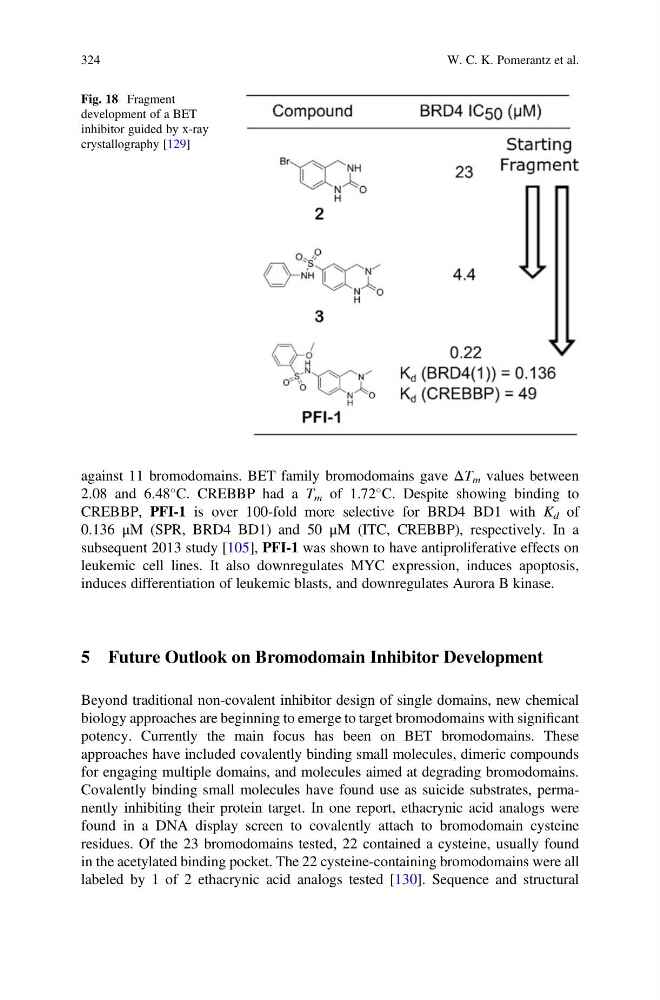
CREBBP, PFI-1 is over 100-fold more selective for BRD4 BD1 with K d of
0.136 μM (SPR, BRD4 BD1) and 50 μM (ITC, CREBBP), respectively. In a
subsequent 2013 study [105], PFI-1 was shown to have antiproliferative effects on
leukemic cell lines. It also downregulates MYC expression, induces apoptosis,
induces differentiation of leukemic blasts, and downregulates Aurora B kinase.
5 Future Outlook on Bromodomain Inhibitor Development
Beyond traditional non-covalent inhibitor design of single domains, new chemical
biology approaches are beginning to emerge to target bromodomains with significant
potency. Currently the main focus has been on BET bromodomains. These
approaches have included covalently binding small molecules, dimeric compounds
for engaging multiple domains, and molecules aimed at degrading bromodomains.
Covalently binding small molecules have found use as suicide substrates, permanently inhibiting their protein target. In one report, ethacrynic acid analogs were
found in a DNA display screen to covalently attach to bromodomain cysteine
residues. Of the 23 bromodomains tested, 22 contained a cysteine, usually found
in the acetylated binding pocket. The 22 cysteine-containing bromodomains were all
labeled by 1 of 2 ethacrynic acid analogs tested [130]. Sequence and structural
Fig. 18 Fragment
development of a BET
inhibitor guided by x-ray
crystallography [129]
324
W. C. K. Pomerantz et al.
2.08 and 6.48
C. CREBBP had a T m of 1.72
C. Despite showing binding to
CREBBP, PFI-1 is over 100-fold more selective for BRD4 BD1 with K d of
0.136 μM (SPR, BRD4 BD1) and 50 μM (ITC, CREBBP), respectively. In a
subsequent 2013 study [105], PFI-1 was shown to have antiproliferative effects on
leukemic cell lines. It also downregulates MYC expression, induces apoptosis,
induces differentiation of leukemic blasts, and downregulates Aurora B kinase.
5 Future Outlook on Bromodomain Inhibitor Development
Beyond traditional non-covalent inhibitor design of single domains, new chemical
biology approaches are beginning to emerge to target bromodomains with significant
potency. Currently the main focus has been on BET bromodomains. These
approaches have included covalently binding small molecules, dimeric compounds
for engaging multiple domains, and molecules aimed at degrading bromodomains.
Covalently binding small molecules have found use as suicide substrates, permanently inhibiting their protein target. In one report, ethacrynic acid analogs were
found in a DNA display screen to covalently attach to bromodomain cysteine
residues. Of the 23 bromodomains tested, 22 contained a cysteine, usually found
in the acetylated binding pocket. The 22 cysteine-containing bromodomains were all
labeled by 1 of 2 ethacrynic acid analogs tested [130]. Sequence and structural
Fig. 18 Fragment
development of a BET
inhibitor guided by x-ray
crystallography [129]
324
W. C. K. Pomerantz et al.