

4.3.2 TR-FRET: A Complimentary Screening Platform to AlphaScreen
TR-FRET or HTR-FRET (homogeneous time-resolved fluorescence resonance
energy transfer) is a bead-based proximity assay which works on a similar principle
to AlphaScreen. The assay is based on bringing together a donor and acceptor bead
due to a molecular interaction between the protein of interest and a peptide or smallmolecule partner. Unlike AlphaScreen, this information is relayed by FRET between
the beads. Irradiation of the donor bead by light is followed by relaxation by
fluorescence. This fluorescence excites the nearby acceptor bead which again relaxes
by fluorescence. The ratio of fluorescence of the acceptor bead to the fluorescence of
the donor bead normalizes the signal in each well and can be read as a measurement
of the direct-binding interaction between the protein of interest and its binding
partner. An advantage of this technique is that the beads are light stable and a
prepared plate may be read for as long as the protein and binding partner are stable.
The dependence of this assay on fluorescence may cause concern that small molecules which fluoresce could interfere with the assay. To address this issue, rare earth
cryptates have been developed as donor dyes such as Eu
2+ and Tb
3+ which have
long-lived fluorescence decay times, mitigating effects of biological and smallmolecule fluorescence. HTR-FRET has been used widely in HTS campaigns and
confirmation assays to discover ligands for BAZ2A/B [120], CECR2 [119], CBP
[121], BETs [81], PCAF [122], and BRD9 [123]. Variations of this assay are sold
commercially for about half of the human bromodomains.
4.3.3 Fluorescence Polarization: A Homogeneous High-Throughput
Discovery Assay
An alternative inhibition assay to bead-based assays is fluorescence polarization
(FP). FP is a fluorescence assay which requires a fluorescently labeled, high-affinity
ligand for the protein of interest. The fluorescent tag must be appended such that
binding of the ligand is unhindered to the target protein. Histone peptides can be
used as ligands for bromodomains; however, they are often too low affinity to
provide sufficient signal. Determination of IC 50 s begins with measuring the affinity
of the fluorescently labeled probe with the protein in a direct-binding experiment.
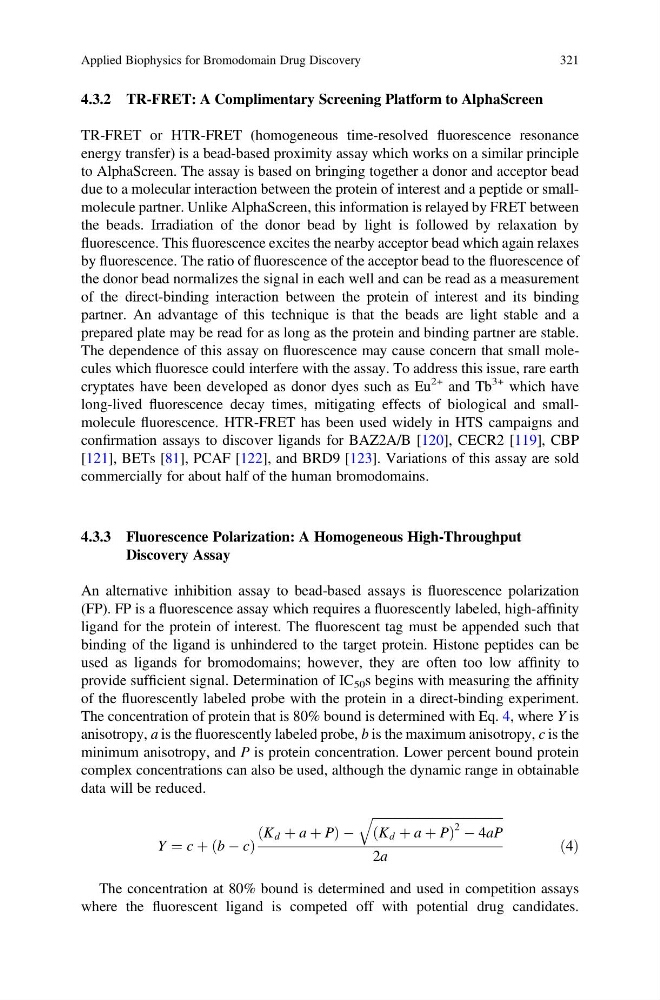
The concentration of protein that is 80% bound is determined with Eq. 4, where Y is
anisotropy, a is the fluorescently labeled probe, b is the maximum anisotropy, c is the
minimum anisotropy, and P is protein concentration. Lower percent bound protein
complex concentrations can also be used, although the dynamic range in obtainable
data will be reduced.
Y ¼ c þ b À c
ð
Þ
K d þ a þ P
ð
ÞÀ
ffiffiffiffiffiffiffiffiffiffiffiffiffiffiffiffiffiffiffiffiffiffiffiffiffiffiffiffiffiffiffiffiffiffiffiffiffiffiffiffiffiffi
K d þ a þ P
ð
Þ
2 À 4aP
q
2a
ð4Þ
The concentration at 80% bound is determined and used in competition assays
where the fluorescent ligand is competed off with potential drug candidates.
Applied Biophysics for Bromodomain Drug Discovery
321
TR-FRET or HTR-FRET (homogeneous time-resolved fluorescence resonance
energy transfer) is a bead-based proximity assay which works on a similar principle
to AlphaScreen. The assay is based on bringing together a donor and acceptor bead
due to a molecular interaction between the protein of interest and a peptide or smallmolecule partner. Unlike AlphaScreen, this information is relayed by FRET between
the beads. Irradiation of the donor bead by light is followed by relaxation by
fluorescence. This fluorescence excites the nearby acceptor bead which again relaxes
by fluorescence. The ratio of fluorescence of the acceptor bead to the fluorescence of
the donor bead normalizes the signal in each well and can be read as a measurement
of the direct-binding interaction between the protein of interest and its binding
partner. An advantage of this technique is that the beads are light stable and a
prepared plate may be read for as long as the protein and binding partner are stable.
The dependence of this assay on fluorescence may cause concern that small molecules which fluoresce could interfere with the assay. To address this issue, rare earth
cryptates have been developed as donor dyes such as Eu
2+ and Tb
3+ which have
long-lived fluorescence decay times, mitigating effects of biological and smallmolecule fluorescence. HTR-FRET has been used widely in HTS campaigns and
confirmation assays to discover ligands for BAZ2A/B [120], CECR2 [119], CBP
[121], BETs [81], PCAF [122], and BRD9 [123]. Variations of this assay are sold
commercially for about half of the human bromodomains.
4.3.3 Fluorescence Polarization: A Homogeneous High-Throughput
Discovery Assay
An alternative inhibition assay to bead-based assays is fluorescence polarization
(FP). FP is a fluorescence assay which requires a fluorescently labeled, high-affinity
ligand for the protein of interest. The fluorescent tag must be appended such that
binding of the ligand is unhindered to the target protein. Histone peptides can be
used as ligands for bromodomains; however, they are often too low affinity to
provide sufficient signal. Determination of IC 50 s begins with measuring the affinity
of the fluorescently labeled probe with the protein in a direct-binding experiment.
The concentration of protein that is 80% bound is determined with Eq. 4, where Y is
anisotropy, a is the fluorescently labeled probe, b is the maximum anisotropy, c is the
minimum anisotropy, and P is protein concentration. Lower percent bound protein
complex concentrations can also be used, although the dynamic range in obtainable
data will be reduced.
Y ¼ c þ b À c
ð
Þ
K d þ a þ P
ð
ÞÀ
ffiffiffiffiffiffiffiffiffiffiffiffiffiffiffiffiffiffiffiffiffiffiffiffiffiffiffiffiffiffiffiffiffiffiffiffiffiffiffiffiffiffi
K d þ a þ P
ð
Þ
2 À 4aP
q
2a
ð4Þ
The concentration at 80% bound is determined and used in competition assays
where the fluorescent ligand is competed off with potential drug candidates.
Applied Biophysics for Bromodomain Drug Discovery
321