

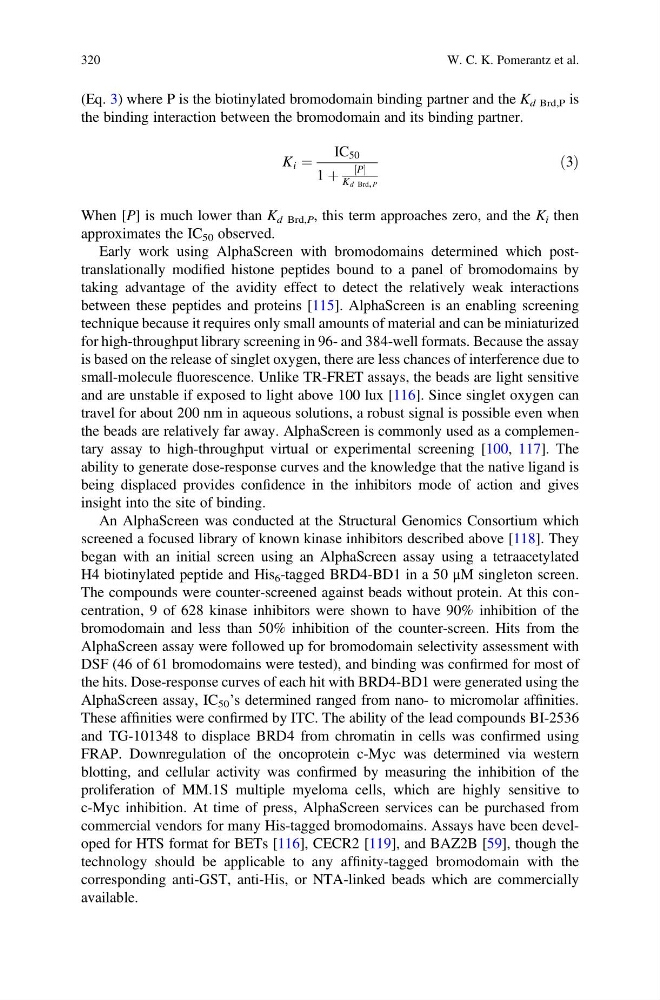
(Eq. 3) where P is the biotinylated bromodomain binding partner and the K d Brd,P is
the binding interaction between the bromodomain and its binding partner.
K i ¼
IC 50
1 þ
P
½
K d Brd, P
ð3Þ
When [P] is much lower than K d Brd,P , this term approaches zero, and the K i then
approximates the IC 50 observed.
Early work using AlphaScreen with bromodomains determined which posttranslationally modified histone peptides bound to a panel of bromodomains by
taking advantage of the avidity effect to detect the relatively weak interactions
between these peptides and proteins [115]. AlphaScreen is an enabling screening
technique because it requires only small amounts of material and can be miniaturized
for high-throughput library screening in 96- and 384-well formats. Because the assay
is based on the release of singlet oxygen, there are less chances of interference due to
small-molecule fluorescence. Unlike TR-FRET assays, the beads are light sensitive
and are unstable if exposed to light above 100 lux [116]. Since singlet oxygen can
travel for about 200 nm in aqueous solutions, a robust signal is possible even when
the beads are relatively far away. AlphaScreen is commonly used as a complementary assay to high-throughput virtual or experimental screening [100, 117]. The
ability to generate dose-response curves and the knowledge that the native ligand is
being displaced provides confidence in the inhibitors mode of action and gives
insight into the site of binding.
An AlphaScreen was conducted at the Structural Genomics Consortium which
screened a focused library of known kinase inhibitors described above [118]. They
began with an initial screen using an AlphaScreen assay using a tetraacetylated
H4 biotinylated peptide and His 6 -tagged BRD4-BD1 in a 50 μM singleton screen.
The compounds were counter-screened against beads without protein. At this concentration, 9 of 628 kinase inhibitors were shown to have 90% inhibition of the
bromodomain and less than 50% inhibition of the counter-screen. Hits from the
AlphaScreen assay were followed up for bromodomain selectivity assessment with
DSF (46 of 61 bromodomains were tested), and binding was confirmed for most of
the hits. Dose-response curves of each hit with BRD4-BD1 were generated using the
AlphaScreen assay, IC 50 ’s determined ranged from nano- to micromolar affinities.
These affinities were confirmed by ITC. The ability of the lead compounds BI-2536
and TG-101348 to displace BRD4 from chromatin in cells was confirmed using
FRAP. Downregulation of the oncoprotein c-Myc was determined via western
blotting, and cellular activity was confirmed by measuring the inhibition of the
proliferation of MM.1S multiple myeloma cells, which are highly sensitive to
c-Myc inhibition. At time of press, AlphaScreen services can be purchased from
commercial vendors for many His-tagged bromodomains. Assays have been developed for HTS format for BETs [116], CECR2 [119], and BAZ2B [59], though the
technology should be applicable to any affinity-tagged bromodomain with the
corresponding anti-GST, anti-His, or NTA-linked beads which are commercially
available.
320
W. C. K. Pomerantz et al.
the binding interaction between the bromodomain and its binding partner.
K i ¼
IC 50
1 þ
P
½
K d Brd, P
ð3Þ
When [P] is much lower than K d Brd,P , this term approaches zero, and the K i then
approximates the IC 50 observed.
Early work using AlphaScreen with bromodomains determined which posttranslationally modified histone peptides bound to a panel of bromodomains by
taking advantage of the avidity effect to detect the relatively weak interactions
between these peptides and proteins [115]. AlphaScreen is an enabling screening
technique because it requires only small amounts of material and can be miniaturized
for high-throughput library screening in 96- and 384-well formats. Because the assay
is based on the release of singlet oxygen, there are less chances of interference due to
small-molecule fluorescence. Unlike TR-FRET assays, the beads are light sensitive
and are unstable if exposed to light above 100 lux [116]. Since singlet oxygen can
travel for about 200 nm in aqueous solutions, a robust signal is possible even when
the beads are relatively far away. AlphaScreen is commonly used as a complementary assay to high-throughput virtual or experimental screening [100, 117]. The
ability to generate dose-response curves and the knowledge that the native ligand is
being displaced provides confidence in the inhibitors mode of action and gives
insight into the site of binding.
An AlphaScreen was conducted at the Structural Genomics Consortium which
screened a focused library of known kinase inhibitors described above [118]. They
began with an initial screen using an AlphaScreen assay using a tetraacetylated
H4 biotinylated peptide and His 6 -tagged BRD4-BD1 in a 50 μM singleton screen.
The compounds were counter-screened against beads without protein. At this concentration, 9 of 628 kinase inhibitors were shown to have 90% inhibition of the
bromodomain and less than 50% inhibition of the counter-screen. Hits from the
AlphaScreen assay were followed up for bromodomain selectivity assessment with
DSF (46 of 61 bromodomains were tested), and binding was confirmed for most of
the hits. Dose-response curves of each hit with BRD4-BD1 were generated using the
AlphaScreen assay, IC 50 ’s determined ranged from nano- to micromolar affinities.
These affinities were confirmed by ITC. The ability of the lead compounds BI-2536
and TG-101348 to displace BRD4 from chromatin in cells was confirmed using
FRAP. Downregulation of the oncoprotein c-Myc was determined via western
blotting, and cellular activity was confirmed by measuring the inhibition of the
proliferation of MM.1S multiple myeloma cells, which are highly sensitive to
c-Myc inhibition. At time of press, AlphaScreen services can be purchased from
commercial vendors for many His-tagged bromodomains. Assays have been developed for HTS format for BETs [116], CECR2 [119], and BAZ2B [59], though the
technology should be applicable to any affinity-tagged bromodomain with the
corresponding anti-GST, anti-His, or NTA-linked beads which are commercially
available.
320
W. C. K. Pomerantz et al.