

discovered with other HTS techniques. Typically, the assay consists of an acceptor
bead loaded with either a glutathione S-transferase (GST) or nickel nitrilotriacetic
acid (NTA) tag to bind to a corresponding recombinant bromodomain and a
streptavidin-loaded donor bead to bind to a biotinylated partner known to interact
with the bromodomain. Commonly, a polyacetylated histone tail peptide or a smallmolecule ligand is biotinylated and used as the binding partner. Due to the
multivalency of the beads used in AlphaScreen (multiple proteins are displayed on
a single bead), an avidity effect is promoted by the interactions between the beads
and their binding partners. This allows for relatively low-affinity partners (such as
histone peptides and bromodomains which are generally in the single- to doubledigit micromolar affinity range or higher) to be used in very low concentrations
(often nanomolar) and still provide robust signal. Signal is produced upon irradiation
of the ternary complex (donor bead-protein-ligand-acceptor bead) with 680 nm light
which excites the donor beads, leading to the formation of singlet oxygen (Fig. 17).
The singlet oxygen may then react with the acceptor bead which emits energy at
550 nm. The observed signal is distance-dependent based on the short lifetime of
singlet oxygen in aqueous solutions (200 nm). In conjunction with bromodomains,
AlphaScreen is commonly used as a competition-based assay where the IC 50 of a
small molecule is measured by displacing a biotinylated histone tail peptide or small
molecule. Due to the avidity effect mentioned above, protein and peptide levels used
in the assay are typically much lower than their dissociation constant (K d ). Using low
levels of protein and peptide in competition assays allows for estimation of K i values
for small-molecule ligands based on the IC 50 using the Cheng-Prusoff equation
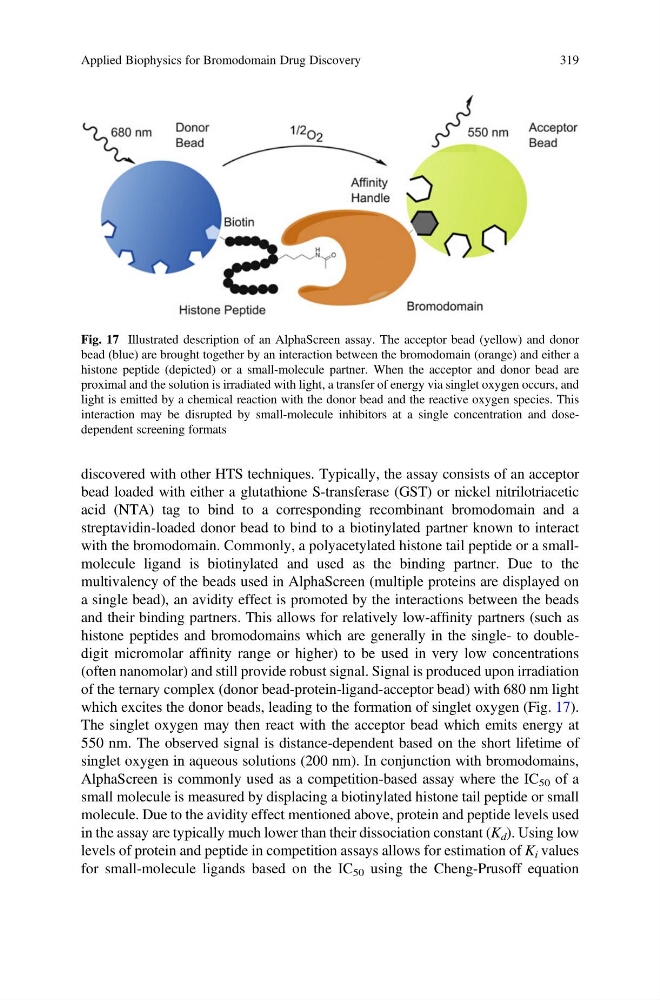
Fig. 17 Illustrated description of an AlphaScreen assay. The acceptor bead (yellow) and donor
bead (blue) are brought together by an interaction between the bromodomain (orange) and either a
histone peptide (depicted) or a small-molecule partner. When the acceptor and donor bead are
proximal and the solution is irradiated with light, a transfer of energy via singlet oxygen occurs, and
light is emitted by a chemical reaction with the donor bead and the reactive oxygen species. This
interaction may be disrupted by small-molecule inhibitors at a single concentration and dosedependent screening formats
Applied Biophysics for Bromodomain Drug Discovery
319
bead loaded with either a glutathione S-transferase (GST) or nickel nitrilotriacetic
acid (NTA) tag to bind to a corresponding recombinant bromodomain and a
streptavidin-loaded donor bead to bind to a biotinylated partner known to interact
with the bromodomain. Commonly, a polyacetylated histone tail peptide or a smallmolecule ligand is biotinylated and used as the binding partner. Due to the
multivalency of the beads used in AlphaScreen (multiple proteins are displayed on
a single bead), an avidity effect is promoted by the interactions between the beads
and their binding partners. This allows for relatively low-affinity partners (such as
histone peptides and bromodomains which are generally in the single- to doubledigit micromolar affinity range or higher) to be used in very low concentrations
(often nanomolar) and still provide robust signal. Signal is produced upon irradiation
of the ternary complex (donor bead-protein-ligand-acceptor bead) with 680 nm light
which excites the donor beads, leading to the formation of singlet oxygen (Fig. 17).
The singlet oxygen may then react with the acceptor bead which emits energy at
550 nm. The observed signal is distance-dependent based on the short lifetime of
singlet oxygen in aqueous solutions (200 nm). In conjunction with bromodomains,
AlphaScreen is commonly used as a competition-based assay where the IC 50 of a
small molecule is measured by displacing a biotinylated histone tail peptide or small
molecule. Due to the avidity effect mentioned above, protein and peptide levels used
in the assay are typically much lower than their dissociation constant (K d ). Using low
levels of protein and peptide in competition assays allows for estimation of K i values
for small-molecule ligands based on the IC 50 using the Cheng-Prusoff equation
Fig. 17 Illustrated description of an AlphaScreen assay. The acceptor bead (yellow) and donor
bead (blue) are brought together by an interaction between the bromodomain (orange) and either a
histone peptide (depicted) or a small-molecule partner. When the acceptor and donor bead are
proximal and the solution is irradiated with light, a transfer of energy via singlet oxygen occurs, and
light is emitted by a chemical reaction with the donor bead and the reactive oxygen species. This
interaction may be disrupted by small-molecule inhibitors at a single concentration and dosedependent screening formats
Applied Biophysics for Bromodomain Drug Discovery
319