

4.2.4 Based on the NOE, STD NMR Can Provide a Binding
Epitope Map
Saturation transfer difference (STD) NMR is a ligand-observed method that has been
used to find bromodomain inhibitors. STD NMR is based on the nuclear Overhauser
effect (NOE), the transfer of magnetization from protein to ligand. In this experiment, a saturating selective pulse is applied to a region of the spectrum where only
protein nuclei will resonate (0 to À2 ppm). The magnetization is transferred through
spin diffusion to bound ligands resulting in an increase in their signal intensity
described as the on-resonance spectrum. The off-resonance spectrum (no selective
saturation) is subtracted from the on-resonance spectrum. Binding ligands will
exhibit a peak in the difference spectrum, while non-binding ligand will not have
visible resonances (Fig. 13). Because the NOE effect is distance dependent, a
binding epitope can be determined by analyzing which proton resonances give
the strongest STD signal (group epitope mapping, GEM STD) [97]. Geist et al.
conducted BRD4 binding studies using STD GEM with a novel application of
waterLOGSY NMR, LOGSY titration, to generate a binding epitope map and
identify protein-bound water molecules near the bound ligand [98]. STD NMR has
been used as a binding assay to discover bromodomain inhibitors for BAZ2A
[59, 99], CBP [100], BRD4 [83], and BRD7 [101]. Despite giving easy to analyze
data, STD can be challenging for small proteins (MW < 20 kDa) such as
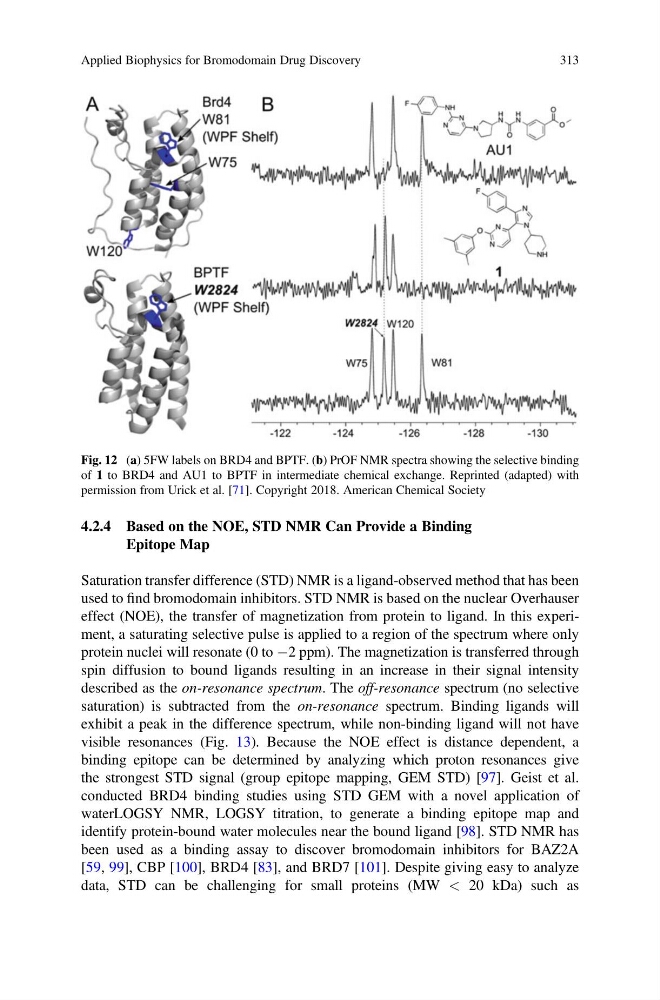
Fig. 12 (a) 5FW labels on BRD4 and BPTF. (b) PrOF NMR spectra showing the selective binding
of 1 to BRD4 and AU1 to BPTF in intermediate chemical exchange. Reprinted (adapted) with
permission from Urick et al. [71]. Copyright 2018. American Chemical Society
Applied Biophysics for Bromodomain Drug Discovery
313
Epitope Map
Saturation transfer difference (STD) NMR is a ligand-observed method that has been
used to find bromodomain inhibitors. STD NMR is based on the nuclear Overhauser
effect (NOE), the transfer of magnetization from protein to ligand. In this experiment, a saturating selective pulse is applied to a region of the spectrum where only
protein nuclei will resonate (0 to À2 ppm). The magnetization is transferred through
spin diffusion to bound ligands resulting in an increase in their signal intensity
described as the on-resonance spectrum. The off-resonance spectrum (no selective
saturation) is subtracted from the on-resonance spectrum. Binding ligands will
exhibit a peak in the difference spectrum, while non-binding ligand will not have
visible resonances (Fig. 13). Because the NOE effect is distance dependent, a
binding epitope can be determined by analyzing which proton resonances give
the strongest STD signal (group epitope mapping, GEM STD) [97]. Geist et al.
conducted BRD4 binding studies using STD GEM with a novel application of
waterLOGSY NMR, LOGSY titration, to generate a binding epitope map and
identify protein-bound water molecules near the bound ligand [98]. STD NMR has
been used as a binding assay to discover bromodomain inhibitors for BAZ2A
[59, 99], CBP [100], BRD4 [83], and BRD7 [101]. Despite giving easy to analyze
data, STD can be challenging for small proteins (MW < 20 kDa) such as
Fig. 12 (a) 5FW labels on BRD4 and BPTF. (b) PrOF NMR spectra showing the selective binding
of 1 to BRD4 and AU1 to BPTF in intermediate chemical exchange. Reprinted (adapted) with
permission from Urick et al. [71]. Copyright 2018. American Chemical Society
Applied Biophysics for Bromodomain Drug Discovery
313