

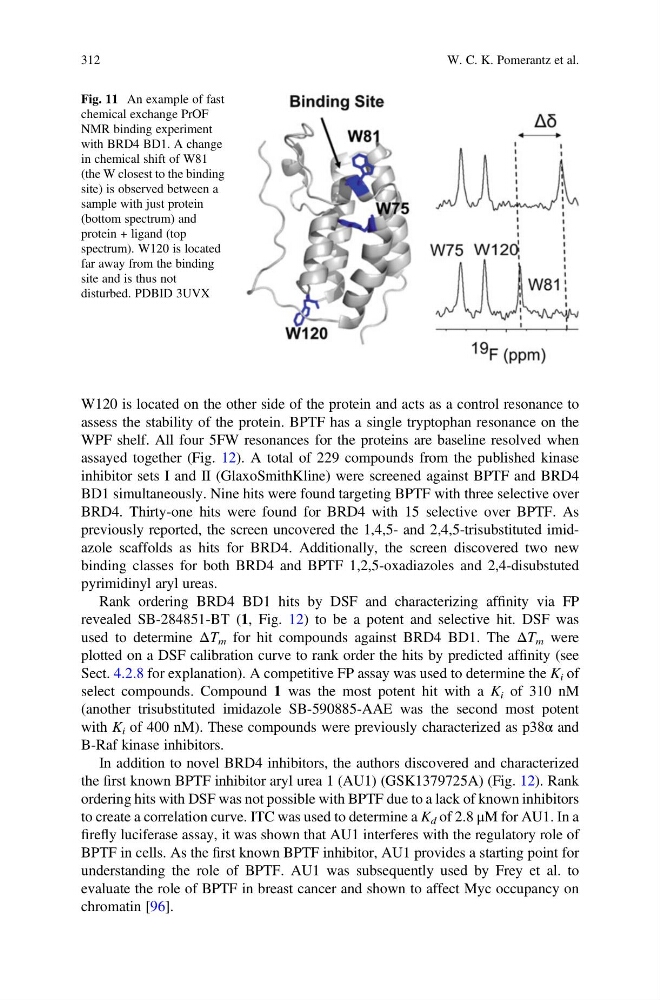
W120 is located on the other side of the protein and acts as a control resonance to
assess the stability of the protein. BPTF has a single tryptophan resonance on the
WPF shelf. All four 5FW resonances for the proteins are baseline resolved when
assayed together (Fig. 12). A total of 229 compounds from the published kinase
inhibitor sets I and II (GlaxoSmithKline) were screened against BPTF and BRD4
BD1 simultaneously. Nine hits were found targeting BPTF with three selective over
BRD4. Thirty-one hits were found for BRD4 with 15 selective over BPTF. As
previously reported, the screen uncovered the 1,4,5- and 2,4,5-trisubstituted imidazole scaffolds as hits for BRD4. Additionally, the screen discovered two new
binding classes for both BRD4 and BPTF 1,2,5-oxadiazoles and 2,4-disubstuted
pyrimidinyl aryl ureas.
Rank ordering BRD4 BD1 hits by DSF and characterizing affinity via FP
revealed SB-284851-BT (1, Fig. 12) to be a potent and selective hit. DSF was
used to determine ΔT m for hit compounds against BRD4 BD1. The ΔT m were
plotted on a DSF calibration curve to rank order the hits by predicted affinity (see
Sect. 4.2.8 for explanation). A competitive FP assay was used to determine the K i of
select compounds. Compound 1 was the most potent hit with a K i of 310 nM
(another trisubstituted imidazole SB-590885-AAE was the second most potent
with K i of 400 nM). These compounds were previously characterized as p38α and
B-Raf kinase inhibitors.
In addition to novel BRD4 inhibitors, the authors discovered and characterized
the first known BPTF inhibitor aryl urea 1 (AU1) (GSK1379725A) (Fig. 12). Rank
ordering hits with DSF was not possible with BPTF due to a lack of known inhibitors
to create a correlation curve. ITC was used to determine a K d of 2.8 μM for AU1. In a
firefly luciferase assay, it was shown that AU1 interferes with the regulatory role of
BPTF in cells. As the first known BPTF inhibitor, AU1 provides a starting point for
understanding the role of BPTF. AU1 was subsequently used by Frey et al. to
evaluate the role of BPTF in breast cancer and shown to affect Myc occupancy on
chromatin [96].
Fig. 11 An example of fast
chemical exchange PrOF
NMR binding experiment
with BRD4 BD1. A change
in chemical shift of W81
(the W closest to the binding
site) is observed between a
sample with just protein
(bottom spectrum) and
protein + ligand (top
spectrum). W120 is located
far away from the binding
site and is thus not
disturbed. PDBID 3UVX
312
W. C. K. Pomerantz et al.
assess the stability of the protein. BPTF has a single tryptophan resonance on the
WPF shelf. All four 5FW resonances for the proteins are baseline resolved when
assayed together (Fig. 12). A total of 229 compounds from the published kinase
inhibitor sets I and II (GlaxoSmithKline) were screened against BPTF and BRD4
BD1 simultaneously. Nine hits were found targeting BPTF with three selective over
BRD4. Thirty-one hits were found for BRD4 with 15 selective over BPTF. As
previously reported, the screen uncovered the 1,4,5- and 2,4,5-trisubstituted imidazole scaffolds as hits for BRD4. Additionally, the screen discovered two new
binding classes for both BRD4 and BPTF 1,2,5-oxadiazoles and 2,4-disubstuted
pyrimidinyl aryl ureas.
Rank ordering BRD4 BD1 hits by DSF and characterizing affinity via FP
revealed SB-284851-BT (1, Fig. 12) to be a potent and selective hit. DSF was
used to determine ΔT m for hit compounds against BRD4 BD1. The ΔT m were
plotted on a DSF calibration curve to rank order the hits by predicted affinity (see
Sect. 4.2.8 for explanation). A competitive FP assay was used to determine the K i of
select compounds. Compound 1 was the most potent hit with a K i of 310 nM
(another trisubstituted imidazole SB-590885-AAE was the second most potent
with K i of 400 nM). These compounds were previously characterized as p38α and
B-Raf kinase inhibitors.
In addition to novel BRD4 inhibitors, the authors discovered and characterized
the first known BPTF inhibitor aryl urea 1 (AU1) (GSK1379725A) (Fig. 12). Rank
ordering hits with DSF was not possible with BPTF due to a lack of known inhibitors
to create a correlation curve. ITC was used to determine a K d of 2.8 μM for AU1. In a
firefly luciferase assay, it was shown that AU1 interferes with the regulatory role of
BPTF in cells. As the first known BPTF inhibitor, AU1 provides a starting point for
understanding the role of BPTF. AU1 was subsequently used by Frey et al. to
evaluate the role of BPTF in breast cancer and shown to affect Myc occupancy on
chromatin [96].
Fig. 11 An example of fast
chemical exchange PrOF
NMR binding experiment
with BRD4 BD1. A change
in chemical shift of W81
(the W closest to the binding
site) is observed between a
sample with just protein
(bottom spectrum) and
protein + ligand (top
spectrum). W120 is located
far away from the binding
site and is thus not
disturbed. PDBID 3UVX
312
W. C. K. Pomerantz et al.